 Apply now
 How to apply
 Save course for later
 Send me a PDF copy
 I want more info
Develop strong laboratory skills
'I love how the course works, learning the theory first and then putting it into practice during practical classes. We learn specific techniques and skills that prepare us for our careers. During a practical class in third year haematology, I found it difficult to differentiate some of the white blood cells. The demonstrators gave me a few amazing tips on how to do this, that you won’t find in any textbook.'
Studying medical laboratory science
'Medical laboratory scientists test human and animal specimens to diagnose a disease or mutation, or find toxins and poisons. Some of the best moments I've had at QUT have been learning more about infectious diseases and immunity. Connecting theory to practice helped develop a deeper understanding of diseases and how the body works to defend itself.'
Explore QUT laboratories
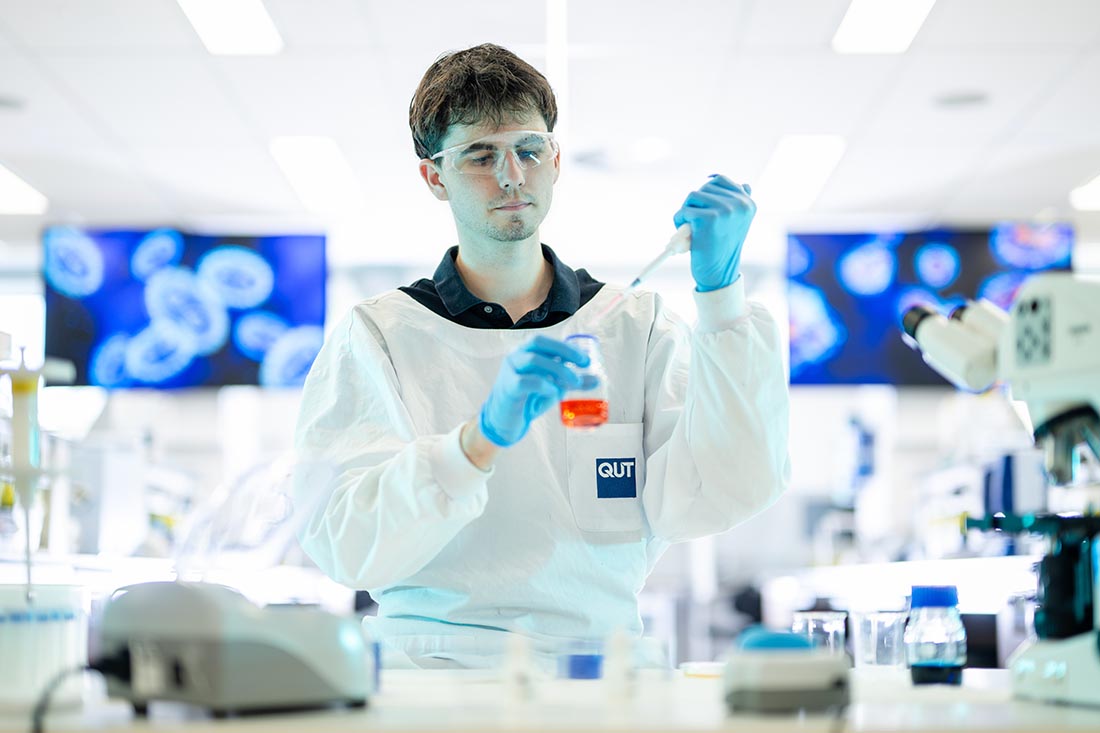
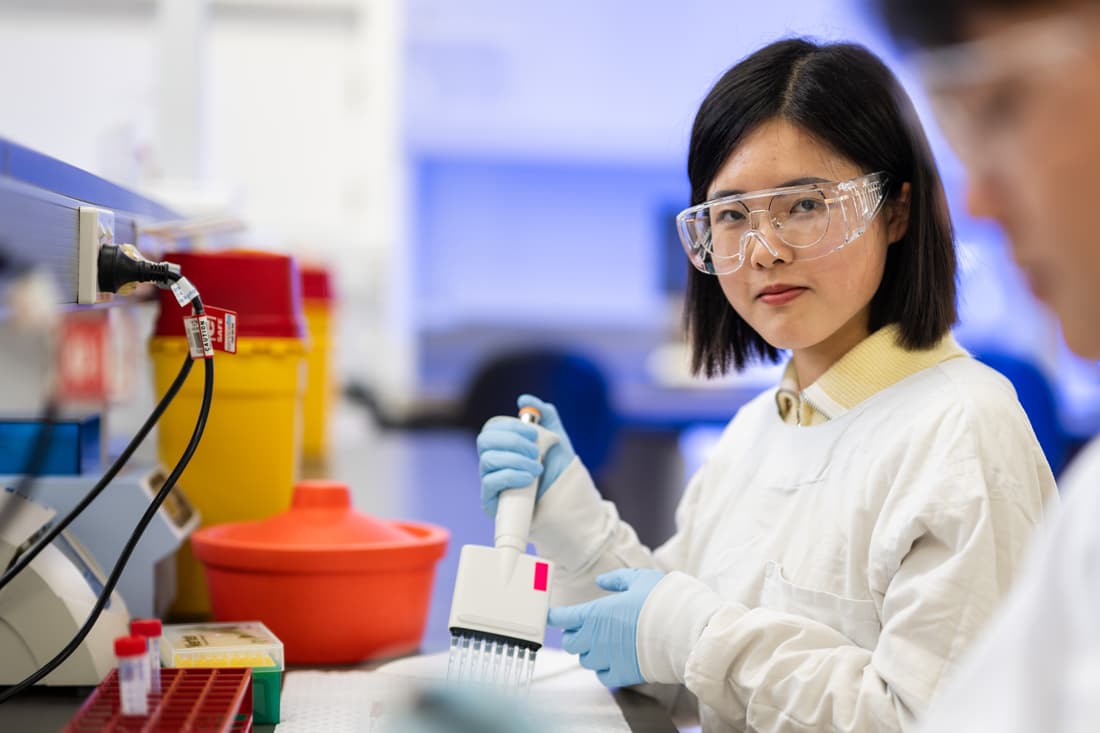
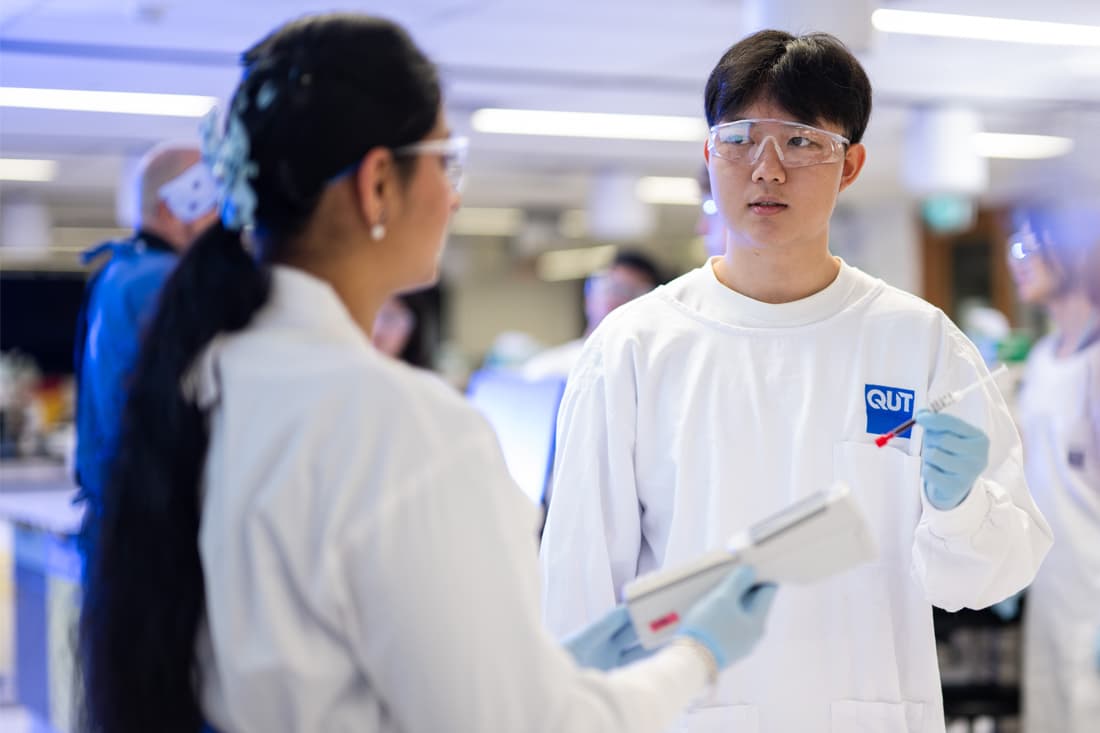
Take a sneak peek at where you will learn if you choose to study biomedical science or medical laboratory science at QUT. You’ll be learning in the laboratories from Semester 1 of your first year. Check out the spaces where you’ll master lab skills.
Providing career pathways
After deciding a career in pathology was for me, I spent a great deal of time reading job advertisements. The overwhelming majority of pathology jobs require the medical laboratory science degree. I chose QUT because their course is centred on practical and specific pathology subjects, and extremely focused on career pathways. I was impressed with the industry connections and quality of the lecturers and guest speakers. Every one of them had extensive experience and ties to the industry.
Practical placements that count
In my final year, I had a 12-week laboratory placement in an area of my preference. This was in a busy metropolitan histology laboratory, where I had the chance to rotate through all the different areas, including embedding, sectioning, special stains and immunohistochemistry. I found the experience extremely interesting and valuable, and it led to my first job in a pathology laboratory.
Opportunity to gain practical experience
‘QUT provides students with the opportunity to undertake internships. During these placements, we get to experience the working environment and pace of a real laboratory and explore areas that may not be covered in our university coursework. I completed my first placement in histology and my second in haematology. I found both fields fascinating, and they offered experiences that were quite different from our practical classes at uni.’
Bachelor of Medical Laboratory Science student
Hands-on learning from day one
'One of the best things about my course is the emphasis on real-world practice and hands-on learning that starts from day one. The technical and professional skills I have developed at QUT will prepare me for my future career.'
Bachelor of Medical Laboratory Science graduate
Hands-on learning opportunities
‘I have always been interested in biology and chemistry since high school and have long aspired to work in a health-related field. Studying medical laboratory science at QUT was the perfect choice for me, as it not only combines two of my favourite sciences but also allows me to apply the skills I’ve learned in a real-world setting, such as a hospital laboratory.’
Bachelor of Medical Laboratory Science student





Highlights
- Be prepared for a career in medical laboratory science, medicine, research and the healthcare industry as this course is designed in consultation with industry professionals
- Learn from real-world experts who are leaders in the fields of diagnostic pathology and research
- Use industry-standard equipment and develop skills in advanced diagnostic techniques
- Gain real-world experience with 16 weeks of industry placements in an accredited pathology laboratory or research facility
- Graduate eligible for membership of the Australian Institute of Medical and Clinical Scientists and meet registration requirements in the United Kingdom, New Zealand and Hong Kong
Highlights
- Be prepared for a career in medical laboratory science, medicine, research and the healthcare industry as this course is designed in consultation with industry professionals
- Learn from real-world experts who are leaders in the fields of diagnostic pathology and research
- Use industry-standard equipment and develop skills in advanced diagnostic techniques
- Gain real-world experience with 16 weeks of industry placements in an accredited pathology laboratory or research facility
- Graduate eligible for membership of the Australian Institute of Medical and Clinical Scientists and meet registration requirements in the United Kingdom, New Zealand and Hong Kong
Why choose this course?
Medical laboratory scientists perform scientific investigations on samples from people and animals using high-tech equipment. They perform and analyse tests to monitor general health, diagnose conditions like infectious diseases and cancer, and see how treatments are working.
This course is designed to give you a clear path to becoming a medical laboratory scientist and to meet the eligibility requirements for membership into the Australian Institute of Medical Scientists.
The Bachelor of Medical Laboratory Science is also a great option if you’re looking for a career in medicine or research and provides a strong pathway to postgraduate study.
Real-world learning
You will complete two eight-week professional placements where you will work in accredited pathology laboratories and research facilities. By taking multiple placements, you will have the opportunity to explore different types of workplaces before graduating. You will learn from, and work alongside, experienced medical laboratory scientists and demonstrate your skills to potential future employers.
You will also gain hands-on experience in the modern QUT laboratories from your first year. The course is designed to develop your skills so you will feel confident and ready to enter the workplace. You will graduate knowing advanced techniques and able to perform investigations to a professional standard.
Try research
Extend your studies with extracurricular activities by taking part in Vacation Research Experience Scheme (VRES) or research assistant positions. VRES allows you to contribute to groundbreaking research between semesters as part of a paid research project. You will get to try your hand at research before deciding whether to pursue a research degree. Explore health research topics currently available.
Learn from the best
You will benefit from the extensive knowledge our leading researchers bring to the classroom. QUT researchers have made groundbreaking discoveries in biomedical research in institutions like the Centre for Microbiome Research, and they share their learnings with you. You’ll have opportunities to engage with leading researchers and build useful networks for later research or postgraduate study.
Explore this course
You will develop practical laboratory, diagnostic and investigative skills through real-world experience, to ensure you are ready for a career as a medical laboratory scientist or prepare you for research or pathways to further study such as medicine.
Learn from leading, established industry professionals and complete 16 weeks of professional placement, working alongside medical laboratory scientists and clinical researchers in accredited pathology laboratories and research facilities.
Work Integrated Learning
During this course you will be required to complete 576 hours of professional work placements.
Careers and outcomes
As a medical laboratory scientist, you can work in a variety of areas such as genes and DNA (genomics), blood (haematology), tissues (histopathology), cells (cytopathology), germs (microbiology) and the chemicals in the body (biochemistry).
You may wish to pursue a future in research exploring advancements in technology and disease discovery. QUT graduates have worked in research areas such as cancer diagnosis, malaria, stem cells and infectious diseases, among others.
The Bachelor of Medical Laboratory Science also provides a strong foundation for further postgraduate study in medicine or pathways to allied health.
Professional recognition
This course is accredited by the Australian Institute of Medical Scientists and graduates will have completed the academic and work placement requirements for admission as a full member.
Depending on your employment, you will be eligible to apply for membership of various professional organisations including:
- Australasian Association for Clinical Biochemistry and Laboratory Medicine
- Australian and New Zealand Society of Blood Transfusion
- Australian Society of Cytology
- Australian Society of Microbiology
- Australian Society of Thrombosis and Haemostasis
- Haematology Society of Australia and New Zealand
- Human Genetics Society of Australasia
Possible careers
- Biochemist
- Cytologist
- Cytopathologist
- Genetic pathologist
- Haematologist
- Histopathologist
- Hospital scientist
- Medical scientist
- Medicine (after further study)
- Microbiologist
- Molecular pathologist
- Pathology scientist
- Research scientist
Year 1
The course commences by developing a sound knowledge and understanding of fundamental concepts that underpin medical laboratory science: cellular and molecular biosciences, anatomy, physiology mathematics, statistics, biophysics and chemistry. You will also be introduced to the local, national and global profession of medical laboratory science, and the Australian Healthcare System in the first of your professionally orientated units in the course.
Year 2
In your second year, you will explore more specialised concepts in pathology, biochemistry, microbiology, immunology, cytogenetic and molecular pathology, histopathological techniques, quantitative medical science, and quality assurance systems. In your practical classes, you will learn some of the latest techniques used in the clinical diagnostic pathology industry, giving you the opportunity to develop your skills to professional standards.
Year 3
The third year of the program allows you to further develop and refine your knowledge, understanding and practical skills to a more advanced level, and learn how they are applied in the clinical disciplines of molecular diagnostics, microbiology, chemical pathology, diagnostic endocrinology, histopathology, cytopathology, haematology and, transfusion and transplantation science.
Year 4
In your first semester, you will undertake a semester-long work integrated learning internship in a recognised laboratory. During that time you will also complete studies in health informatics and learn how this relates to day-to-day laboratory operations. In your final semester, you will complete an elective of your choice designed to complement your learning, e.g. pharmacology, marketing, management or research techniques. You will also prepare professional plans and identify graduate opportunities, as well as further your clinical discipline specific learning in the context of intercultural health and contemporary issues in medical science.
Students complete 24 credit points of QUT You units made up of:
Core
QUT002 QUT You: Walking on Country and QUT005 QUT You: Seeing Me, Seeing You: Skills for a Diverse World and
Electives
2 x QUT You Elective Units
Year 1
The course commences by developing a sound knowledge and understanding of fundamental concepts that underpin medical laboratory science: cellular and molecular biosciences, anatomy, physiology mathematics, statistics, biophysics and chemistry. You will also be introduced to the local, national and global profession of medical laboratory science, and the Australian Healthcare System in the first of your professionally orientated units in the course.
Year 2
In your second year, you will explore more specialised concepts in pathology, biochemistry, microbiology, immunology, cytogenetic and molecular pathology, histopathological techniques, quantitative medical science, and quality assurance systems. In your practical classes, you will learn some of the latest techniques used in the clinical diagnostic pathology industry, giving you the opportunity to develop your skills to professional standards.
Year 3
The third year of the program allows you to further develop and refine your knowledge, understanding and practical skills to a more advanced level, and learn how they are applied in the clinical disciplines of molecular diagnostics, microbiology, chemical pathology, diagnostic endocrinology, histopathology, cytopathology, haematology and, transfusion and transplantation science.
Year 4
In your first semester, you will undertake a semester-long work integrated learning internship in a recognised laboratory. During that time you will also complete studies in health informatics and learn how this relates to day-to-day laboratory operations. In your final semester, you will complete an elective of your choice designed to complement your learning, e.g. pharmacology, marketing, management or research techniques. You will also prepare professional plans and identify graduate opportunities, as well as further your clinical discipline specific learning in the context of intercultural health and contemporary issues in medical science.
Students complete 24 credit points of QUT You units made up of:
Core
QUT002 QUT You: Walking on Country and QUT005 QUT You: Seeing Me, Seeing You: Skills for a Diverse World and
Electives
2 x QUT You Elective Units
- ATAR/selection rank threshold
- 72.00
These thresholds are the lowest adjusted scores to which QUT made an offer in Semester 1, 2026.
Don't have a ATAR/selection rank?
- Course code
- LS47
- QTAC code
- 418201
- CRICOS code
- 076173F
-
- Gardens Point
-
- Gardens Point
- 4 years full-time
- 8 years part-time
- 4 years full-time
- February
- February
Assumed knowledge
Before you start this course, we assume you have sound knowledge of the subject/s listed below. If you don't have the subject knowledge, you can still apply for the course but we strongly encourage you to undertake bridging studies to gain the knowledge:
- Chemistry (Units 3 & 4, C)
- English, or Literature, or English and Literature Extension, or English as an Additional Language (Units 3 & 4, C)
- Mathematical Methods, or Specialist Mathematics (Units 3 & 4, C)
Year 12 early offer scheme
If you’re a current Queensland Year 12 student, you may be eligible to receive an offer for this course on the last day of Queensland Year 12, before receiving your ATAR or selection rank.
Find out more about the QUT Year 12 Early Offer Scheme
Helping you to get into your course
If you don't think your ATAR or selection rank is high enough to get into this course, you can guarantee your entry with guaranteed advanced standing by upgrading through one of the following programs which you can select as one of your QTAC preferences:
QUT College Diplomas
As a QUT College Diploma in Health Science (Health Studies) graduate you will automatically receive a Semester 1 (February intake) offer to start the Bachelor of Medical Laboratory Science within one week after completion of the diploma. You will also automatically receive up to 36 credit points credit transfer.
Find out more about the QUT College Diploma in Health Science (Health Studies)
Offer guarantee
If you achieve an ATAR or selection rank of 72.00 or higher (including any adjustments) and satisfy all other admission requirements, you are guaranteed an offer for this course in the Semester 1 offer rounds, up to the main offer round in mid-January.
VET guarantee
If you have completed an AQF certificate IV, diploma or higher, and satisfy all other admission requirements, you are guaranteed an offer for this course in the Semester 1 offer rounds, up to the main offer round in mid-January.
Advanced standing
If you have prior studies or work experience, you may be eligible for advanced standing (credit). You can apply for advanced standing once you've been accepted to QUT. If you're in your first semester of study, you must apply for advanced standing within 10 days of receiving your offer.
Deferment
You can defer your offer and postpone the start of your course for one year.
More about deferring your offer
Adjustments to your ATAR/selection rank
Any adjustments you receive to your ATAR or selection rank will be applied to this course.
Find out if you’re eligible for an adjustment to your ATAR or selection rank
Offers we made to school leavers in Semester 1, 2026
The figures listed in the tables below reflect the offers that were made to recent ATAR students. The entry thresholds box at the top of this page shows the lowest adjusted ATAR/selection rank required to receive an offer for all applicants for the most recent January QTAC offer round.
| Excluding adjustments | Including adjustments | |
|---|---|---|
| Highest ATAR/selection rank to receive an offer |
Selection rank
98.15
|
Selection rank
99.95
|
| Median ATAR/selection rank to receive an offer |
Selection rank
82.05
|
Selection rank
85.45
|
| Lowest ATAR/selection rank to receive an offer |
Selection rank
66.75
|
Selection rank
72.75
|
You can find out more about your fellow students’ backgrounds with this course’s student profile.
Other admission options
If you are of Aboriginal or Torres Strait Islander descent, you may be eligible for admission through our Centralised Assessment Selection Process (CASP).
I completed my studies outside of Australia
Select the country where you completed your studies to see a guide to the grades you need to apply for this course.
If your country or qualification is not listed, you can still apply for this course and we will assess your eligibility.
Assumed knowledge
- Chemistry (Units 3 & 4, C)
- Mathematical Methods, or Specialist Mathematics (Units 3 & 4, C)
You must have achieved this study at a level comparable to Australian Year 12 or in recognised post-secondary studies.
I completed secondary school in Australia
Assumed knowledge
Before you start this course we assume you have sound knowledge in these areas:
- Chemistry (Units 3 & 4, C)
- Mathematical Methods, or Specialist Mathematics (Units 3 & 4, C)
- ATAR/selection rank
- 72.00
Offer guarantee
If you completed secondary school in Australia and achieve an ATAR/selection rank of 72.00 or higher (including any adjustments) and satisfy all other admission requirements, you are guaranteed an offer for this course.
VET guarantee
If you have completed an AQF certificate IV, diploma or higher, and satisfy all other admission requirements, you are guaranteed an offer for this course.
Minimum English language requirements
Select the country where you completed your studies to see a guide on meeting QUT’s English language requirements.
Your scores and prior qualifications in English-speaking countries are considered. Approved English-speaking countries are Australia, Canada, England, Ireland, New Zealand, Scotland, United States of America and Wales.
If your country or qualification is not listed, you can still apply for this course and we will assess your eligibility.
We accept English language proficiency scores from the following tests undertaken in a secure test centre. Tests must be taken no more than 2 years prior to the QUT course commencement.
| English Test | Overall | Listening | Reading | Writing | Speaking |
|---|---|---|---|---|---|
| IELTS Academic / One Skill Retake | 6.5 | 6 | 6 | 6 | 6 |
|
Cambridge C1 Advanced
You must share your results with QUT through the Candidate Results Online website. |
176 | 169 | 169 | 169 | 169 |
| LANGUAGECERT Academic (LCA) | 67 | 57 | 60 | 64 | 70 |
| Michigan English Test (MET) | 58 | 56 | 55 | 57 | 48 |
| PTE Academic | 59 | 50 | 50 | 51 | 54 |
| TOEFL iBT Australia Test (120 scale) | 79 | 16 | 16 | 19 | 19 |
Don't have the English language score you need? We can help!
We offer English language programs to improve your English and help you gain entry to this course.
When you apply for this course, we will recommend which English course you should enrol in.
Course requirements
There are requirements that you will need to meet as a student in this course. You will need to identify these requirements and ensure you allow sufficient time to meet them. Some of these requirements have associated costs.
Blue card: You must undergo a criminal history check for working with children and be issued with a suitability card (blue card) before commencing clinical placement/practicum in an organisation where you may work with children or young people.
The processing of your application may take several months so you must submit your blue card application to HiQ as early as possible to ensure you have your card before you begin any unit that requires contact with children. There is no charge for student blue cards. Students who already have a blue card must register it with QUT.
Information is available from the Additional course requirements and costs website.




Your actual fees may vary depending on which units you choose. We review fees annually, and they may be subject to increases.
2027 fees
2027: CSP $9,800 per year full-time (96 credit points)
Additional Costs
There are requirements that you will need to meet as a student in this course. Some of these requirements have associated costs. Information is available from the Additional course requirements and costs website.
2027 fees
2027: $59,500 per year full-time (96 credit points)
Additional Costs
There are requirements that you will need to meet as a student in this course. Some of these requirements have associated costs. Information is available from the Additional course requirements and costs website.
2026 fees
2026: CSP $9,500 per year full-time (96 credit points)
Additional Costs
There are requirements that you will need to meet as a student in this course. Some of these requirements have associated costs. Information is available from the Additional course requirements and costs website.
2026 fees
2026: $57,200 per year full-time (96 credit points)
Additional Costs
There are requirements that you will need to meet as a student in this course. Some of these requirements have associated costs. Information is available from the Additional course requirements and costs website.
Student services and amenities fees
You may need to pay student services and amenities (SA) fees as part of your course costs.
HECS-HELP: loans to help you pay for your course fees
You may not have to pay anything upfront if you're eligible for a HECS-HELP loan.
Student services and amenities fees
You may need to pay student services and amenities (SA) fees as part of your course costs.
You can apply for scholarships to help you with study and living costs.
QUT Excellence Scholarship (Academic)
QUT's premier offering for students with outstanding academic achievement.
- Scholarship eligibility
- Academic performance
Equity scholarships scheme
A scholarship for low-income students studying in any faculty.
- Scholarship eligibility
- Struggling financially
QUT Elite Sport Scholarship
Supports national-level athletes from recognised sporting pathways.
- Scholarship eligibility
- Sporting excellence
International Merit Scholarship
A high achievement scholarship for future international undergraduate and postgraduate students.
- Scholarship eligibility
- Academic performance
International Talent Scholarship
A new scholarship for 2026 that covers tuition fees, with eligibility based on your prior academic achievements.
- Scholarship eligibility
- Academic performance
Keep up to date
Ready for your next step?
Finishing school?
Everything you need to know about choosing a uni straight from school.
How to apply
We'll break down the application process, from QTAC to accepting your offer.
Ready for your next step?
How to apply
We'll break down the process, from applying to accepting your offer.
Flexible study
Explore the options that could make postgraduate study work for you.
QUT courses for you
Like to save your courses?
Please enter your first name and email so we can save your courses for you