 Apply now
 How to apply
 Save course for later
 Send me a PDF copy
 I want more info
Industrial Design at QUT
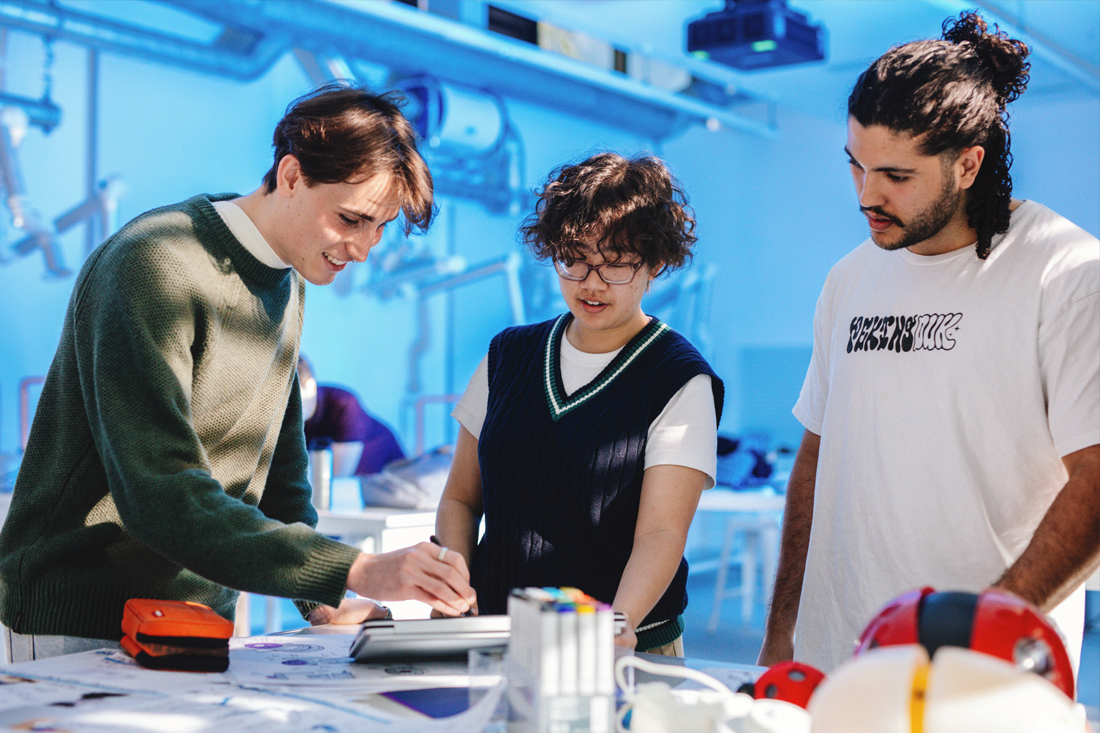
Industrial design is all about the impact products can have on people's lives. From user research to digital sketching and manufacturing, you'll learn the skills to create the next big thing.
Connecting you with industry
Industrial design students at QUT have the opportunity to collaborate directly with industry partners in both studio and internship settings. Build your network while exploring the role of an industrial designer in various settings like health and transportation.
Switching to industrial design
'I was an industrial electrician by trade and was looking to move into a different career. I had friends that studied at QUT and I've always had an interest in design. I looked at the course outline online and found it fit with the way I wanted to learn. The teaching staff were brilliant. There's a lot of value in their connections to industry, and they bring a lot of their expertise back to the classroom.'
Bachelor of Design (Industrial Design)
Design with impact
'Throughout my degree, I’ve realised that industrial design is more about the impact that a product can have on somebody's life. What I enjoy about it is helping people, and seeing the impact that you can make on a person's day.'
Bachelor of Business (Marketing)/Bachelor of Design (Industrial Design)
Design that makes a difference
'Design to me means problem solving, primarily with a focus on having impact on either the planet or on people. Over the course of the degree, I worked on industry projects that were embedded within the coursework. This included the Special Olympics Flame of Hope Torch, robotics with BMW Group, and a 3D printed surgery guide with the Herson Biofabrication Institute.'
Bachelor of Design (Industrial Design)
Industrial Design at QUT
Industrial design is all about the impact products can have on people's lives. From user research to digital sketching and manufacturing, you'll learn the skills to create the next big thing.
Connecting you with industry
Industrial design students at QUT have the opportunity to collaborate directly with industry partners in both studio and internship settings. Build your network while exploring the role of an industrial designer in various settings like health and transportation.
Switching to industrial design
'I was an industrial electrician by trade and was looking to move into a different career. I had friends that studied at QUT and I've always had an interest in design. I looked at the course outline online and found it fit with the way I wanted to learn. The teaching staff were brilliant. There's a lot of value in their connections to industry, and they bring a lot of their expertise back to the classroom.'
Bachelor of Design (Industrial Design)
Design with impact
'Throughout my degree, I’ve realised that industrial design is more about the impact that a product can have on somebody's life. What I enjoy about it is helping people, and seeing the impact that you can make on a person's day.'
Bachelor of Business (Marketing)/Bachelor of Design (Industrial Design)
Design that makes a difference
'Design to me means problem solving, primarily with a focus on having impact on either the planet or on people. Over the course of the degree, I worked on industry projects that were embedded within the coursework. This included the Special Olympics Flame of Hope Torch, robotics with BMW Group, and a 3D printed surgery guide with the Herson Biofabrication Institute.'
Bachelor of Design (Industrial Design)


Highlights
-
Study at a university ranked #1 in Queensland for art and design (QS World University Rankings by Subject, 2025).
-
Create innovative, attractive, sustainable and user-friendly products and systems.
-
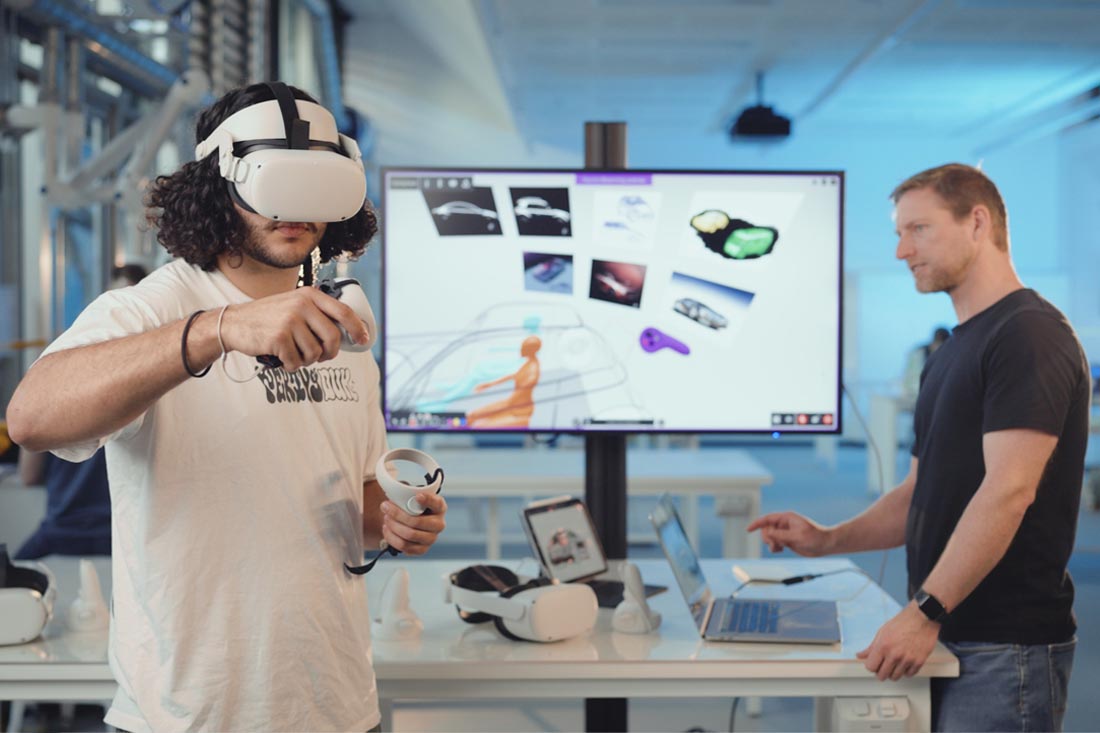
Learn the technical aspects of design, design management, CAID (computer-aided industrial design) technology, business, ergonomics, aesthetics, visualisation and design leadership.
-
Graduates work as industrial designers, service designers, usability experts, interaction or interface designers, user-experience designers, corporate identity designers, new product developers, model makers, special effects producers, design researchers and computer aided design experts.
Highlights
-
Create innovative, attractive, sustainable and user-friendly products and systems.
-
Learn the technical aspects of design, design management, CAID (computer-aided industrial design) technology, business, ergonomics, aesthetics, visualisation and design leadership.
-
Graduates work as industrial designers, service designers, usability experts, interaction or interface designers, user-experience designers, corporate identity designers, new product developers, model makers, special effects producers, design researchers and computer aided design experts.
Why choose this course?
As emerging materials and technologies develop, industrial designers are discovering better ways to create the products, services and systems that improve people’s everyday life, positively impact the environment and tackle complex problems. Industrial design covers the creative and technical process of determining and defining a product's form and features prior to production. It also envisions new ways for design to positively influence the problems we face in the 21st Century. So, if you want your designs to have an impact in the real world, this degree could be just what you need.
Why choose this course?
As emerging materials and technologies develop, industrial designers are discovering better ways to create the products, services and systems that improve people’s everyday life, positively impact the environment and tackle complex problems. Industrial design covers the creative and technical process of determining and defining a product's form and features prior to production. It also envisions new ways for design to positively influence the problems we face in the 21st Century. So, if you want your designs to have an impact in the real world, this degree could be just what you need.
Real-world learning
You will be prepared for your career with a range of activities and opportunities such as hands-on design units, project presentations, international study tours, entrepreneurial incubation programs and real-world internships. You’ll also graduate work ready through QUT's strong collaborative links with global companies including BMW, Bombardier, Techtronics Industries, IDEO and many local companies.
Visit the student and graduate blog to find out more about what it’s like to study design and where a QUT degree can take you.
Real-world learning
You will be prepared for your career with a range of activities and opportunities such as hands-on design units, project presentations, international study tours, entrepreneurial incubation programs and real-world internships. You’ll also graduate work ready through QUT's strong collaborative links with global companies including BMW, Bombardier, Techtronics Industries, IDEO and many local companies.
Explore this course
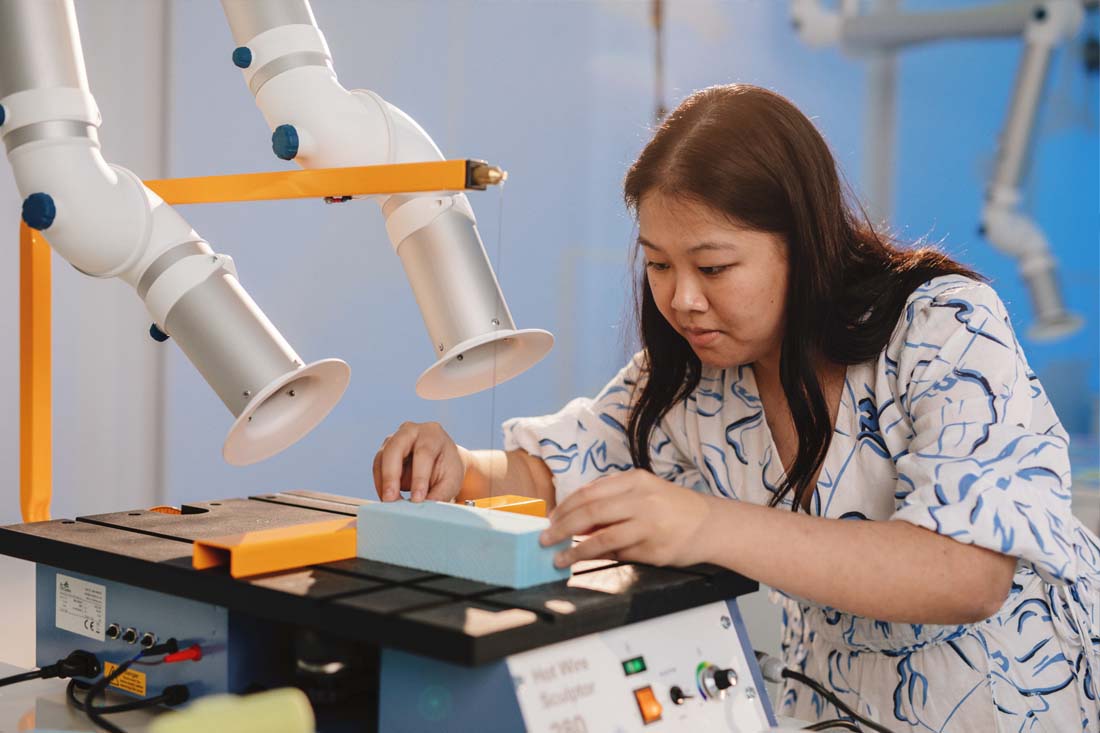
Finding a balance between beauty and practicality takes expert knowledge. That’s why this hands-on program gets you involved with the design of realistically detailed products suitable for manufacture with a focus on real-world industry engagement.
Your degree will begin with introductory and shared impact lab units where, working with students from other disciplines, you’ll focus on problems and social issues, and identify potential solutions connected to industry and community. Your introductory studies include learning the creative design process, technical aspects of product design, design management and computer-aided industrial design (CAID) technology.
You will progress to a deeper understanding of systems design including human factors and ergonomics, design research, coupled with innovation, aesthetics, marketing, cultural and social values, and design leadership. Later in your degree you will be able to transfer skills and knowledge to a workplace or professional context and gain practical work experience with work integrated learning.
Double degrees
Combine your degree with a second degree to gain a broader range of skills and knowledge, a competitive advantage and enhanced career flexibility. Choose a double degree with:
- Business to create your future in industrial design management, strategic design, creative business ownership, entrepreneurship and business start-up ventures, across fields such as product, interface or usability design.
- Engineering to gain skills creating and developing innovative, attractive, sustainable and user-friendly products and systems, you may work in fields such as mechanical engineering, transport, service development or manufacturing.
Overseas exchange
Travel overseas and be on pace with international design trends as part of your studies. Enjoy a full year of studies oversees at one of our international partner universities in the UK, Sweden, Denmark, Hong Kong, the US and Canada. Study industrial design with a Bachelor of Design - International (Industrial Design) to enhance your opportunities to work in diverse design careers internationally.
How much will it cost?
While you're on exchange, you'll continue to pay your QUT tuition fees and you won't have to pay any tuition fees at your exchange university.
We support many students with generous bursaries to help with your expenses, and scholarships are also available for particular countries through Australian Government initiatives like the New Colombo Plan.
Overseas exchange
Travel overseas and be on pace with international design trends as part of your studies. Enjoy a full year of studies oversees at one of our international partner universities in the UK, Sweden, Denmark, Hong Kong, the US and Canada. Study industrial design with a Bachelor of Design - International (Industrial Design) to enhance your opportunities to work in diverse design careers internationally.
How much will it cost?
While you're on exchange, you'll continue to pay your QUT tuition fees and you won't have to pay any tuition fees at your exchange university.
Careers and outcomes
Graduates have an outstanding record of achievement nationally and internationally in diverse careers for companies such as British Airways, Boeing, Adidas, Marvel Studios and Doctors Without Borders. Many graduates work as industrial designers in industrial design consultancies or design departments of product manufacturers, or as entrepreneurs.
Graduates qualify for Graduate Membership of Design Institute of Australia (DIA). The course is an educational member of the World Design Council.
Professional recognition
Our graduates qualify for membership at the Design Institute of Australia (DIA), the professional body for Australian designers.
Members have exclusive access to a range of services, products and discounts to advance their careers.
Possible careers
- Automotive designer
- Computer-aided designer
- Design researcher
- Design strategist
- Interaction designer
- Interface designer
- Model designer
- Movie concept designer
- Service designer
- Sustainability design consultant
- Usability expert
- Visualisation expert
In order to complete this course you must complete a total of 288 credit points, made up of:
- Core units - 60 credit points
- A Design major - 96 credit points
- A Capstone unit option - 12 credit points
- QUT You - 24 credit points
- Complementary studies - 96 credit points, made up of a combination of second majors, minors, Design specialisation unit options, university-wide unit options, and Creative Industries WIL unit options.
Study overseas
Study overseas while earning credit towards your QUT creative industries degree with one of our worldwide exchange partners.
Overseas study can be for one or two semesters (or during the semester break) and the units you take can be in a creative or non-creative discipline area, depending on how they match with your QUT course.
In order to complete this course you must complete a total of 288 credit points, made up of:
- Core units - 60 credit points
- A Design major - 96 credit points
- A Capstone unit option - 12 credit points
- QUT You - 24 credit points
- Complementary studies - 96 credit points, made up of a combination of second majors, minors, Design specialisation unit options, university-wide unit options, and Creative Industries WIL unit options.
Study overseas
Study overseas while earning credit towards your QUT creative industries degree with one of our worldwide exchange partners.
Overseas study can be for one or two semesters (or during the semester break) and the units you take can be in a creative or non-creative discipline area, depending on how they match with your QUT course.
- ATAR/selection rank threshold
- 70.00
These thresholds are the lowest adjusted scores to which QUT made an offer in Semester 1, 2026.
Don't have a ATAR/selection rank?
- Course code
- DE43
- QTAC code
- 412346
- CRICOS code
- 096565B
-
- Kelvin Grove
-
- Kelvin Grove
- 3 years full-time
- 6 years part-time
- 3 years full-time
- February and July
- February and July
Assumed knowledge
Before you start this course, we assume you have sound knowledge of the subject/s listed below. If you don't have the subject knowledge, you can still apply for the course but we strongly encourage you to undertake bridging studies to gain the knowledge:
- English, or Literature, or English and Literature Extension, or English as an Additional Language (Units 3 & 4, C)
Year 12 early offer scheme
If you're a current Queensland Year 12 student, you may be eligible to receive an offer for this course on the last day of Queensland Year 12, before receiving your ATAR or selection rank.
Find out more about the QUT Year 12 Early Offer Scheme
Helping you to get into your course
If you don't think your ATAR or selection rank is high enough to get into this course, you can guarantee your entry with guaranteed advanced standing by upgrading through one the following programs which you can select as one of your QTAC preferences:
QUT College Diploma in Creative Industries
As a QUT College Diploma in Creative Industries graduate you will automatically receive an offer to start the Bachelor of Design within one week after completion of the diploma. You will also automatically receive up to 1.0 year (96 credit points) credit transfer and be able to complete the degree in 2 years as a full-time student (or equivalent part-time).
Find out more about the QUT College Diploma in Creative Industries
Offer guarantee
If you achieve an ATAR or selection rank of 70.00 or higher (including any adjustments) and satisfy all other admission requirements, you are guaranteed an offer for this course in the Semester 1 offer rounds, up to the main offer round in mid-January.
VET guarantee
If you have completed an AQF certificate IV, diploma or higher, and satisfy all other admission requirements, you are guaranteed an offer for this course in the Semester 1 offer rounds, up to the main offer round in mid-January.
Deferment
You can defer your offer and postpone the start of your course for one year.
Select the country where you completed your studies to see a guide to the grades you need to apply for this course.
If your country or qualification is not listed, you can still apply for this course and we will assess your eligibility.
I completed secondary school in Australia
- ATAR/selection rank
- 70.00
Offer guarantee
If you completed secondary school in Australia and achieve an ATAR/selection rank of 70.00 or higher (including any adjustments) and satisfy all other admission requirements, you are guaranteed an offer for this course.
VET guarantee
If you have completed an AQF certificate IV, diploma or higher, and satisfy all other admission requirements, you are guaranteed an offer for this course.
Minimum English language requirements
Select the country where you completed your studies to see a guide on meeting QUT’s English language requirements.
Your scores and prior qualifications in English-speaking countries are considered. Approved English-speaking countries are Australia, Canada, England, Ireland, New Zealand, Scotland, United States of America and Wales.
If your country or qualification is not listed, you can still apply for this course and we will assess your eligibility.
We accept English language proficiency scores from the following tests undertaken in a secure test centre. Tests must be taken no more than 2 years prior to the QUT course commencement.
| English Test | Overall | Listening | Reading | Writing | Speaking |
|---|---|---|---|---|---|
| IELTS Academic / One Skill Retake | 6.5 | 6 | 6 | 6 | 6 |
|
Cambridge C1 Advanced
You must share your results with QUT through the Candidate Results Online website. |
176 | 169 | 169 | 169 | 169 |
| LANGUAGECERT Academic (LCA) | 67 | 57 | 60 | 64 | 70 |
| Michigan English Test (MET) | 58 | 56 | 55 | 57 | 48 |
| PTE Academic | 59 | 50 | 50 | 51 | 54 |
| TOEFL iBT Australia Test (120 scale) | 79 | 16 | 16 | 19 | 19 |
Don't have the English language score you need? We can help!
We offer English language programs to improve your English and help you gain entry to this course.
When you apply for this course, we will recommend which English course you should enrol in.
Your actual fees may vary depending on which units you choose. We review fees annually, and they may be subject to increases.
2027 fees
2027: CSP $10,700 per year full-time (96 credit points)
2027 fees
2027: $42,800 per year full-time (96 credit points)
2026 fees
2026: CSP $10,500 per year full-time (96 credit points)
2026 fees
2026: $41,400 per year full-time (96 credit points)
Student services and amenities fees
You may need to pay student services and amenities (SA) fees as part of your course costs.
HECS-HELP: loans to help you pay for your course fees
You may not have to pay anything upfront if you're eligible for a HECS-HELP loan.
Student services and amenities fees
You may need to pay student services and amenities (SA) fees as part of your course costs.
You can apply for scholarships to help you with study and living costs.
QUT Excellence Scholarship (Academic)
QUT's premier offering for students with outstanding academic achievement.
- Scholarship eligibility
- Academic performance
Equity scholarships scheme
A scholarship for low-income students studying in any faculty.
- Scholarship eligibility
- Struggling financially
QUT Elite Sport Scholarship
Supports national-level athletes from recognised sporting pathways.
- Scholarship eligibility
- Sporting excellence
International Merit Scholarship
A high achievement scholarship for future international undergraduate and postgraduate students.
- Scholarship eligibility
- Academic performance
International Talent Scholarship
A new scholarship for 2026 that covers tuition fees, with eligibility based on your prior academic achievements.
- Scholarship eligibility
- Academic performance
Keep up to date
Ready for your next step?
Finishing school?
Everything you need to know about choosing a uni straight from school.
How to apply
We'll break down the application process, from QTAC to accepting your offer.
Ready for your next step?
How to apply
We'll break down the process, from applying to accepting your offer.
Flexible study
Explore the options that could make postgraduate study work for you.
QUT courses for you
Like to save your courses?
Please enter your first name and email so we can save your courses for you