 Apply now
 How to apply
 Save course for later
 Send me a PDF copy
 I want more info
Real-world experiences in QUT law
What makes our law degree unique is our balance between legal principles and practice. While you study, you could travel overseas on exchange or short-term study tours, participate in mooting, undertake a clerkship or prepare for the modern world of law with our unique law, technology and innovation minor.
Career change
'My path to law wasn’t conventional. Initially, I pursued a degree in industrial design and marketing while serving part-time as a reserve combat engineer in the Australian Army. My degree in industrial design led to a career as a product manager in the automotive industry, however, I felt something was missing. I wanted a new challenge that combined creativity and critical thinking, and that’s when I discovered law. In my opinion, law is highly creative - crafting persuasive arguments, simplifying complex ideas, and engaging with people. With credit from my previous studies, I enrolled in QUT’s Bachelor of Laws – Graduate Entry program. The shorter study duration made returning to university an easy decision.'
Associate at HopgoodGanim Lawyers
Law, technology and innovation minor
Our law, technology and innovation minor explores how emerging technologies such as artificial intelligence and robotics are impacting the legal industry. You'll learn about the legal, ethical, and social challenges raised by these technologies, as well as design thinking techniques that enable you to respond to legal challenges from a human-centred approach.
Inspired to help others
Witnessing bad practices in the fashion industry inspired me to fight for people who have been wronged. The legal industry caught my attention because I wanted a career that was always evolving and was about protecting and helping people. QUT has given me a great platform to start my legal career with the law graduate entry course. Having already completed a creative industries degree, I am able to complete my law degree in three years instead of four.
High-quality teaching staff
‘The down-to-earth and approachable engagement of the academic staff has been a highlight for me. I found the staff to be genuinely helpful and show a genuine interest in shaping their programs to maximise both the learning potential and enjoyment of students. It was refreshing to engage with high-end academics in such an easy and accessible way.’
Real-world experiences in QUT law
What makes our law degree unique is our balance between legal principles and practice. While you study, you could travel overseas on exchange or short-term study tours, participate in mooting, undertake a clerkship or prepare for the modern world of law with our unique law, technology and innovation minor.
Career change
'My path to law wasn’t conventional. Initially, I pursued a degree in industrial design and marketing while serving part-time as a reserve combat engineer in the Australian Army. My degree in industrial design led to a career as a product manager in the automotive industry, however, I felt something was missing. I wanted a new challenge that combined creativity and critical thinking, and that’s when I discovered law. In my opinion, law is highly creative - crafting persuasive arguments, simplifying complex ideas, and engaging with people. With credit from my previous studies, I enrolled in QUT’s Bachelor of Laws – Graduate Entry program. The shorter study duration made returning to university an easy decision.'
Associate at HopgoodGanim Lawyers
Law, technology and innovation minor
Our law, technology and innovation minor explores how emerging technologies such as artificial intelligence and robotics are impacting the legal industry. You'll learn about the legal, ethical, and social challenges raised by these technologies, as well as design thinking techniques that enable you to respond to legal challenges from a human-centred approach.
Inspired to help others
Witnessing bad practices in the fashion industry inspired me to fight for people who have been wronged. The legal industry caught my attention because I wanted a career that was always evolving and was about protecting and helping people. QUT has given me a great platform to start my legal career with the law graduate entry course. Having already completed a creative industries degree, I am able to complete my law degree in three years instead of four.
High-quality teaching staff
‘The down-to-earth and approachable engagement of the academic staff has been a highlight for me. I found the staff to be genuinely helpful and show a genuine interest in shaping their programs to maximise both the learning potential and enjoyment of students. It was refreshing to engage with high-end academics in such an easy and accessible way.’





Study at the top university for law in Queensland
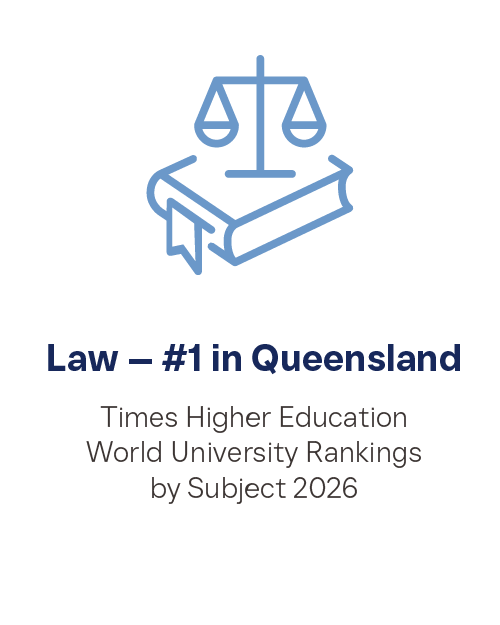
For the second year in a row, law at QUT has been ranked no. 1 in Queensland in the 2026 Times Higher Education subject rankings for law.
Our strong performance reflects our innovative, real-world learning, our strong connections with industry and our world-class research, and is demonstrated by rankings including:
- no. 1 in Australia for research quality
- no. 1 in Queensland for industry engagement
- no. 1 in Queensland for teaching quality.
In this course you will
- Leverage your previous study and graduate sooner.
- Become a highly sought-after legal professional that is prepared for the modern world of law.
- Acquire knowledge in various areas of law, including contract law, legal research, equity and trusts, constitutional law, administrative law, as well as commercial and personal property law.
- Gain digital expertise in artificial intelligence, robotics, legal tech and design thinking to remain adaptable in today's rapidly evolving digital age of law.
- Benefit from flexible study options, such as part-time study, classes outside of work hours, online study and summer semesters that allow you to balance your academic commitments with other responsibilities and obligations.
- Be taught by expert academics and industry leaders who bring valuable real-world experience to the classroom.
In this course you will
- Leverage your previous study and graduate sooner.
- Become a highly sought-after legal professional that is prepared for the modern world of law.
- Acquire knowledge in various areas of law, including contract law, legal research, equity and trusts, constitutional law, administrative law, as well as commercial and personal property law.
- Gain digital expertise in artificial intelligence, robotics, legal tech and design thinking to remain adaptable in today's rapidly evolving digital age of law.
- Be taught by expert academics and industry leaders who bring valuable real-world experience to the classroom.
Explore this course
At QUT, we prepare our students for the modern world of law. What makes our law degree unique is our balance between legal principles and practice.
With our practical, hands-on approach to teaching, you will gain a comprehensive understanding of the Australian legal system and the core areas of law required for admission to legal practice in Australia.
You’ll gain a strong foundation in key areas of law, including:
- contract law
- legal research
- equity and trusts
- constitutional law
- administrative law
- commercial and personal property law.
In addition to these established areas of law, you’ll have the opportunity to explore emerging areas of legal practice, such as:
- environment, social and governance (ESG) issues
- law, technology and innovation
You'll also develop a comprehensive knowledge of Aboriginal and Torres Strait Islanders perspectives on law and the legal system, preparing you to work in culturally diverse contexts.
Real-world experience
Throughout your degree, we will provide a diverse range of experiential legal experiences. These opportunities will allow you to develop real-world legal skills while working with industry professionals in various areas of law. With over 600 industry partners, we offer placements in a variety of settings, including community legal centres, in-house legal teams, law firms, and governmental and non-governmental organisations. We also offer specialised placements focused on assisting First Nations communities. If you are already engaged in legal work you can undertake a self-organised placement, allowing you to gain academic credit for work undertaken in your job.
Whether through placements in legal practice, research projects or community engagement, our programs are designed to bridge the gap between legal education and professional practice.
Law, technology and innovation minor
Beyond the core curriculum, you can choose to explore how technology is transforming the legal industry in the law, technology and innovation minor. The legal industry is experiencing rapid evolution due to significant advancements in data-driven technologies. As a result, lawyers are increasingly required to develop new skills and capabilities to adapt to the changing nature of law and legal work. In this minor, you will:
- Explore how emerging technologies such as artificial intelligence and robotics are impacting the legal industry.
- Learn how legal professionals use and respond to cutting-edge technologies, such as generative AI.
- Gain knowledge of the legal, ethical, and social challenges raised by these technologies.
World-class lecturers
When you study law with us, you will be taught by the best in the legal field. Our law teaching staff consist of award-winning academics and industry-leading professionals who bring a wealth of real-world experience and theoretical knowledge to the classroom.
Designed in close collaboration with industry partners, our honours-level law courses are modern, relevant, and uphold industry standards.
Careers and outcomes
Pursue a career as a legal practitioner, with opportunities to specialise across a broad range of areas, or take your career beyond traditional legal practice. Our law degree opens up a world of exciting career possibilities and provides the foundation for a career in government, community organisations or business.
Professional recognition
The Bachelor of Laws (Honours) is a Legal Practitioners' Admissions Board (LPAB) approved law degree, meaning you are eligible for admission to the Australian Legal Profession. To become a solicitor, you must also complete LPAB approved Practical Legal Training. We are one of the few Australian Law Schools to offer approved Practical Legal Training through our Graduate Diploma in Legal Practice. To work as a Barrister there are additional training requirements after you are admitted to the legal profession.
Possible careers
- Barrister
- Commercialisation officer
- Contract administrator
- Corporate secretary
- Crown law officer
- Digital economy lawyer
- Government officer
- In-house lawyer
- Lawyer
- Legal academic
- Legal risk manager
- Legal technology specialist
- Policy officer
- Solicitor
- ATAR/selection rank threshold
- 93.00
These thresholds are the lowest adjusted scores to which QUT made an offer in Semester 1, 2026.
Don't have a ATAR/selection rank?
- Course code
- LW39
- QTAC code
- 417651
- CRICOS code
- 083020J
-
- Online
- Gardens Point
-
- Gardens Point
- 3 years full-time
- 6 years part-time
- 3 years full-time
- February and July
- February and July
Entry requirements
You must have a completed recognised bachelor degree (or equivalent) with a minimum volume of learning of 1.00 year full-time (or equivalent) that is not an Australian law degree/Juris Doctor.
Completed graduate diplomas, masters and/or doctorates are the accepted equivalents with a minimum volume of learning of 1.00 year full-time (or equivalent).
Selection ranks
You will be considered solely on the basis of the selection ranks from all of your prior degree studies plus any postgraduate studies you may have undertaken. Your other qualifications and experiences may be allocated selection ranks for entry to other QUT courses, but will not be considered for this course.
Find out more about how to Apply with Higher Education Study
Automatic Advanced Standing (credit)
If admitted to the graduate entry program you will automatically receive a mandatory one year of advanced standing which will entitle you to complete the degree in three years (full-time).
If you wish to study the full 4 year law degree you need to apply for QUT - Bachelor of Laws (Honours)
Offer guarantee
If you achieve an ATAR or selection rank of 93.00 or higher (including any adjustments) and satisfy all other admission requirements, you are guaranteed an offer for this course in the Semester 1 offer rounds, up to the main offer round in mid-January.
Advanced standing
If you have prior studies or work experience, you may be eligible for advanced standing (credit). You can apply for advanced standing once you've been accepted to QUT. If you're in your first semester of study, you must apply for advanced standing within 10 days of receiving your offer.
Deferment
You can defer your offer and postpone the start of your course for one year.
More about deferring your offer
Adjustments to your ATAR/selection rank
Any adjustments you receive to your ATAR or selection rank will be applied to this course.
Find out if you’re eligible for an adjustment to your ATAR or selection rank
Offers we made to school leavers in Semester 1, 2026
This course is not open to current year 12 students. Selection ranks are only allocated for degree (or higher) studies. Thus no offers were made on the basis of ATAR.
You can find out more about your fellow students’ backgrounds with this course’s student profile.
Other admission options
If you are of Aboriginal or Torres Strait Islander descent, you may be eligible for admission through our Centralised Assessment Selection Process (CASP).
Entry Requirements
You must have a completed recognised bachelor degree (or equivalent) with a minimum volume of learning of 1.00 year full-time (or equivalent) that is not an Australian law degree/Juris Doctor.
Completed graduate diplomas, masters and/or doctorates are the accepted equivalents with a minimum volume of learning of 1.00 year full-time (or equivalent).
Automatic Advanced Standing (credit)
If admitted to the graduate entry program you will automatically receive a mandatory one year of advanced standing which will entitle you to complete the degree in three years (full-time).
If you wish to study the full 4 year law degree you need to apply for QUT - Bachelor of Laws (Honours)
Minimum English language requirements
Select the country where you completed your studies to see a guide on meeting QUT’s English language requirements.
Your scores and prior qualifications in English-speaking countries are considered. Approved English-speaking countries are Australia, Canada, England, Ireland, New Zealand, Scotland, United States of America and Wales.
If your country or qualification is not listed, you can still apply for this course and we will assess your eligibility.
We accept English language proficiency scores from the following tests undertaken in a secure test centre. Tests must be taken no more than 2 years prior to the QUT course commencement.
| English Test | Overall | Listening | Reading | Writing | Speaking |
|---|---|---|---|---|---|
| IELTS Academic / One Skill Retake | 6.5 | 6 | 6 | 6 | 6 |
|
Cambridge C1 Advanced
You must share your results with QUT through the Candidate Results Online website. |
176 | 169 | 169 | 169 | 169 |
| LANGUAGECERT Academic (LCA) | 67 | 57 | 60 | 64 | 70 |
| Michigan English Test (MET) | 58 | 56 | 55 | 57 | 48 |
| PTE Academic | 59 | 50 | 50 | 51 | 54 |
| TOEFL iBT Australia Test (120 scale) | 79 | 16 | 16 | 19 | 19 |
Don't have the English language score you need? We can help!
We offer English language programs to improve your English and help you gain entry to this course.
When you apply for this course, we will recommend which English course you should enrol in.
Applying for this course

Applying for this course
Your actual fees may vary depending on which units you choose. We review fees annually, and they may be subject to increases.
2027 fees
2027: CSP $18,000 per year full-time (96 credit points)
2027 fees
2027: $46,600 per year full-time (96 credit points)
2026 fees
2026: CSP $17,400 per year full-time (96 credit points)
2026 fees
2026: $44,800 per year full-time (96 credit points)
Student services and amenities fees
You may need to pay student services and amenities (SA) fees as part of your course costs.
HECS-HELP: loans to help you pay for your course fees
You may not have to pay anything upfront if you're eligible for a HECS-HELP loan.
Student services and amenities fees
You may need to pay student services and amenities (SA) fees as part of your course costs.
You can apply for scholarships to help you with study and living costs.
International Merit Scholarship
A high achievement scholarship for future international undergraduate and postgraduate students.
- Scholarship eligibility
- Academic performance
International Talent Scholarship
A new scholarship for 2026 that covers tuition fees, with eligibility based on your prior academic achievements.
- Scholarship eligibility
- Academic performance
Keep up to date
Ready for your next step?
Finishing school?
Everything you need to know about choosing a uni straight from school.
How to apply
We'll break down the application process, from QTAC to accepting your offer.
Ready for your next step?
How to apply
We'll break down the process, from applying to accepting your offer.
Flexible study
Explore the options that could make postgraduate study work for you.
QUT courses for you
Like to save your courses?
Please enter your first name and email so we can save your courses for you