First published 25 July 2026
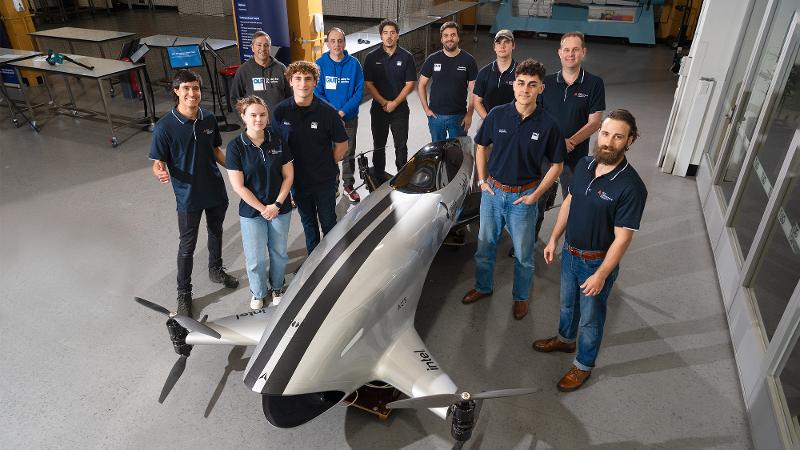
Visitors to QUT Open Day this Sunday will get a chance to see the Airspeeder Mk3 up close after the university was named one of the first partners of Team Australia racing in the global electric flying car series, Airspeeder.
Founded in 2016, Airspeeder is using the excitement of motorsport to accelerate the development of electric vertical take-off and landing (eVTOL) aircraft and the technologies underpinning the future of advanced air mobility.
As one of the foundational members of the Australian racing team, QUT will bring together a multidisciplinary research group from the QUT Research Engineering Facility and the Faculty of Engineering alongside the QUT Aerospace Society (QUTAS), and give students the opportunity to tackle the same engineering challenges facing the emerging industry, from lightweight aircraft design and autonomous flight to battery performance and advanced sensing.
QUT research engineer and technical project lead Dr Julian Galvez said that while the aircraft were purpose-built for racing, the technology behind them had much broader potential.
“Yes, it looks like a flying car, but it's something even cooler. It’s a platform to advance the safety of future crewed electric aircraft, accelerated by racing in much the same way Formula One accelerated innovation in cars over the past century.
“Now we’re giving our students the chance to not only work with technology that's pushing the boundaries of what's possible in aerospace engineering but compete in a nationally represented team against other countries."
The team will work with Ilaria Angeli, Head of Program Management at Airspeeder, on the Mk3, a four-metre-long performance octocopter capable of speeds up to 150 km/h designed and built by Alauda Aeronautics.
"Motorsport has always accelerated innovation, and Airspeeder is doing the same for electric flight,” Ms Angeli said.
Drawing on research expertise in robotics, autonomous systems and aerospace engineering, joining Team Australiapositions QUT at the forefront of one of aviation's fastest-evolving fields.
“We’ll be solving real engineering challenges, from aerodynamic design to developing pit-stop strategies around a 9 to 11-minute battery life,” Dr Galvez said.
The QUT project team also comprises Professor Felipe Gonzalez and Professor Jonathan Roberts.
Airspeeder co-founder Jack Withinshaw said as one of the first partners of the Australian racing team, students would have the opportunity to contribute to one of the world’s most exciting emerging industries.
“When Julian surprised us at our facility in Adelaide with a huge smile on his face and started pointing out the Airspeeder pilots by name, I knew QUT was meant for Team Australia,” Mr Withinshaw said.
“That level of passion is exactly what we're looking for. It showed us QUT wasn't simply interested in observing what we're building, they wanted to be part of it.”
Professor Clinton Fookes, Head of the QUT School of Electrical Engineering and Robotics, said the Airspeeder partnership reflected the School’s broader strength across robotics, autonomous systems and aerospace.
“This is one part of a much bigger picture for us – our researchers are already pushing the boundaries in autonomous systems, advanced sensing, machine learning and renewable energy, and partnerships like this give our students a direct line from that research into a real, fast-moving industry.”
The Airspeeder Mk3 will be on display and open to the public during the 2026 QUT Open Day on Sunday, July 26, from 9am to 3pm in O Block at Gardens Point, and on campus through to Friday, July 31.
The 2026 QUT Open Day will be held from 9am to 3pm, Sunday, July 26. Check out the Open Day program online and create your personalised plan for the day with our Open Day Planner.
Media contact:
Lauren Baxter
QUT Media
media@qut.edu.au
07 3138 2361 / 0407 585 901 (After Hours)