
Faculty/School
Faculty of Engineering

Topic status
We're looking for students to study this topic.

Primary Supervisor
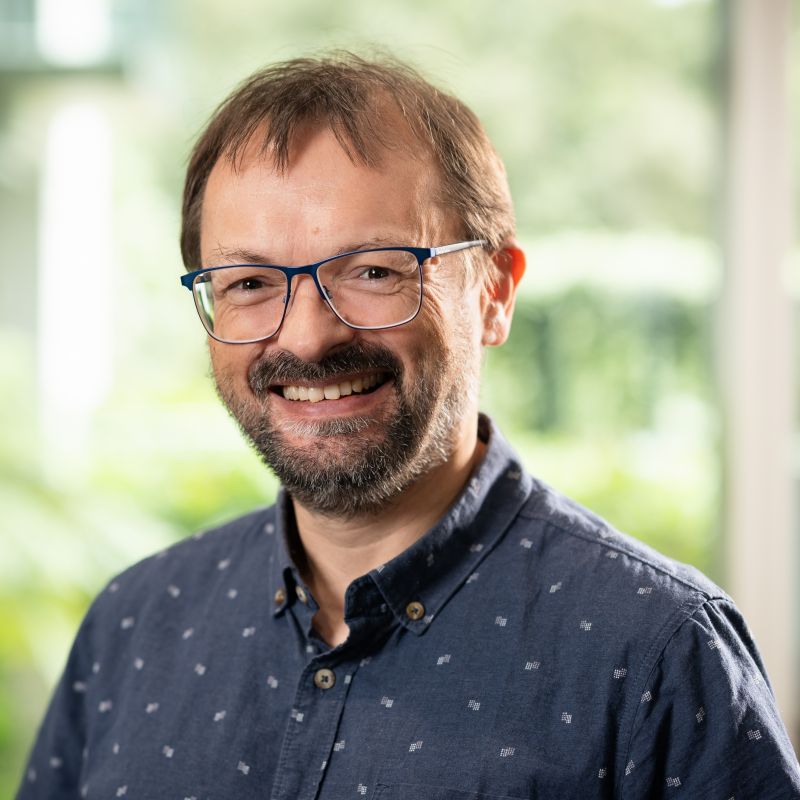
- Position
- Professor and Chair in Manufacturing Robotics
- Division / Faculty
- Faculty of Engineering
External supervisors
- Dr David Howard, CSIRO
Overview
It has hypothesised that one of the barriers to Artificial General Intelligence is the lack of the ability to abstract concepts in AI systems. For example, a robot could learn to move a 'red block behind a blue sphere' but would struggle to then "move a blue block in front of a red sphere" as its AI has no abstract concepts of behind/in front or that objects have properties independent of their colour. Recently, the Abstraction Reasoning Corpus has been introduced by Chollet (cf their work on Kaggle and Keras) to provide a benchmark to accelerate such learning (cf ImageNet for computer vision).
This project will build on the notion of sensor-action movement to build up abstractions from the environment. The first task was to create a physical abstraction reasoning corpus using a simulated platform that an agent explored to learn about abstract concepts. Now Evolutionary Computation and Reinforcement learning will be used to learn about relationships and properties of the environment and how these change as objects are manipulated, such that higher order patterns can be identified. Continual learning systems can also be investigated for this task. Once a core tasks has been learnt, it can then form part of a more complex behaviour.
Research engagement
Lab-based work on the robot manipulation and programming of the ML/AI systems.
Research activities
This work continues both doctorate and undergraduate study on the ARC challenge from a sensorimotor perspective. Hence, academic papers, a thesis and Capstone project reports will be provided to quickly align the researcher with the problem domain.
Python coded simulators will be provided that can be interrogated and adapted by the researcher to suit the needs of this project. There is a potential to move to Julia programming for the continuous learning aspects if the researcher has experience in this language.
A robotic arm, S9 or S11, will be available for the researcher to test the learnt AI in the simulation in real-world scenarios.
The machine learning and AI deployed in this project will be based on deep learning and evolutionary computation techniques.
Research skills
The researcher will gain experience in programming ML/AI systems. Then adapting the resulting methods to real-world systems
Outcomes
An ML/AI system platform to test advanced learning in complex abstract tasks, both in simulation and the real-world.
Skills and experience
Experience in ML and AI system design is ideal. Furthermore, the ability to program manipulator robotics is desired.
Start date
2 November, 2026End date
19 February, 2027Location
GP-S11
Contact
Contact the supervisor for more information
3138 2311
will.browne@qut.edu.au