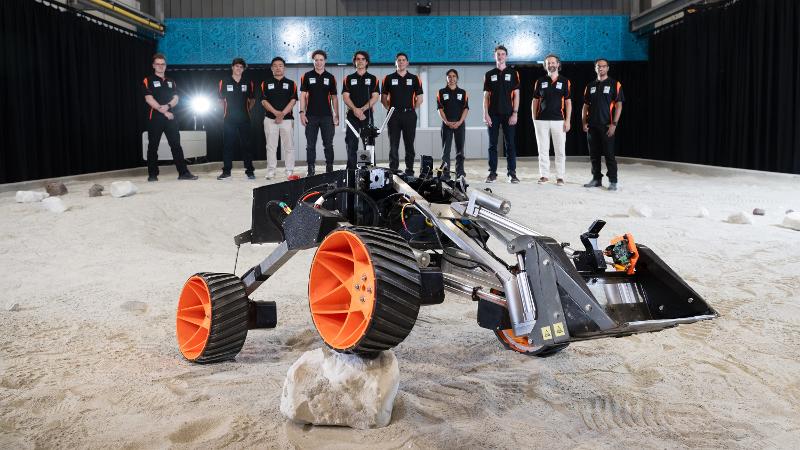
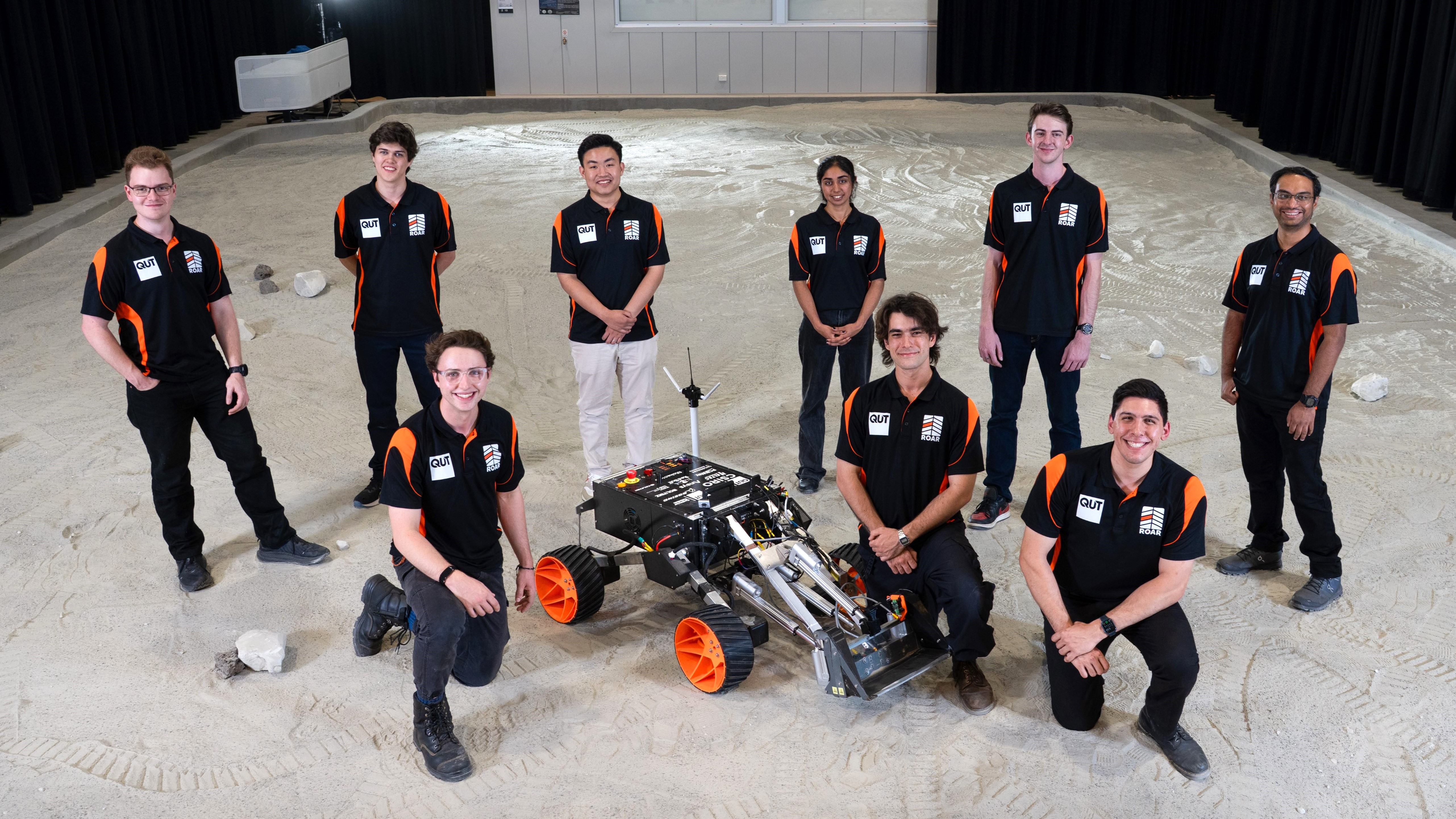
A team of QUT students and their lunar construction robot ‘Perseus’ are in Florida competing in the first NASA International Lunabotics Championship – a prestigious invite-only rover contest for just seven top uni teams from around the world.
Held at the Florida Space Institute in Orlando until Friday, the event is testing how well student-built rovers can perform simulated moon tasks including autonomously navigating lunar terrain and excavating samples.
NASA chose seven teams to take part, with QUT and UTS representing Australia and taking on teams from India, the United Kingdom and the United States.
The space agency holds an annual Lunabotics Challenge for American students only, but the International Lunabotics Championship is the first time the competition has gone global.
QUT ROAR (Remote Off-world Autonomous Robotics) and their four-wheel Perseus rover received a sought-after invite thanks to their strong excavation work at the Australian Rover Challenge earlier this year. Excavation is a highly desirable skill for lunar rovers, as it’s seen as a key task to support potential future lunar exploration and stays.
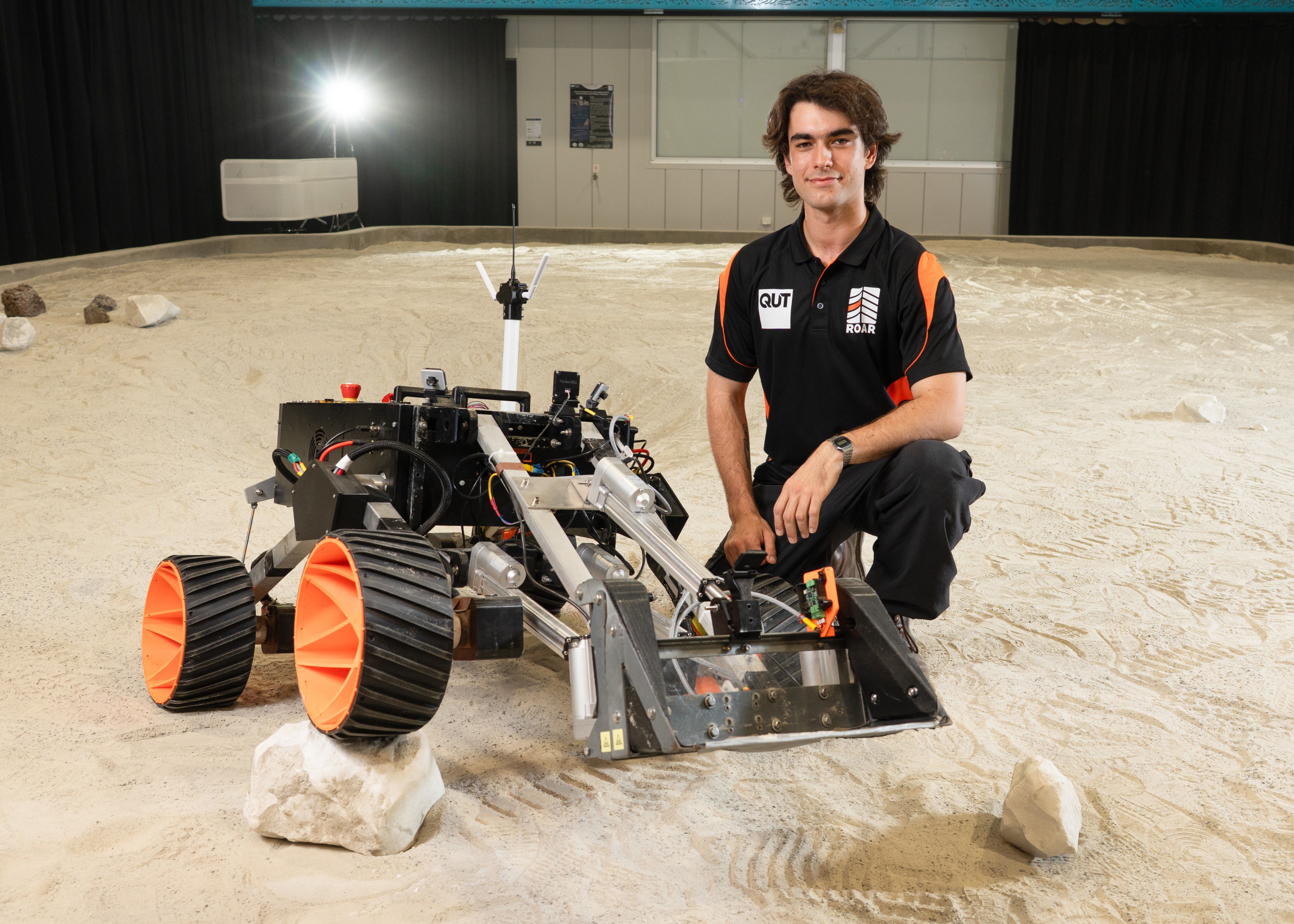
Team leader and QUT engineering (mechatronics) and mathematics student Luca Lubrano Lavadera said the students were excited to be competing at a NASA event.
“Every one of our student engineers who’s travelled to the US for Lunabotics, and our other team members watching from Brisbane, are all space and robotics nerds through and through,” he said.
“Just having the opportunity to say we have been involved in a NASA competition is enough to keep us going through the trials and tribulations of fully integrating our completely custom designed and manufactured rover.
“We are aiming high. We have been studying the American competition closely and believe our rover is extremely competitive in the autonomous space.”
The team carefully dismantled their distinctive orange-wheeled rover for the trip and rebuilt it on the other side of the Pacific, ready for ‘moon’ duty this week.
“Perseus is a prototype of a construction and mining robot that could one day be used on the moon,” Luca said.
“Our mission at the NASA International Lunabotics Championship is for Perseus to drive across a simulated lunar terrain while dodging obstacles, find and excavate simulated lunar regolith (rocky moon soil), transport it, and then deposit it to build a protective berm fully autonomously.
“One of the reasons we were invited to Florida is that we performed very well at the Australian Rover Challenge in the EXTERRES Crater Challenge that involved digging up and transporting lunar resources.
“Everyone on the team is excited to put our rover through its paces in front of NASA engineers and show off the months of hard work put in to get the rover where it is today.
“We hope to represent the potential of Australian engineering and make everyone back at home proud!”
The team, which is part of the QUT Robotics Club, also caught NASA’s eye last year when they became the first international team to be invited to the USA to demonstrate at the US-only Lunabotics Challenge, unofficially placing 4th out of 36 teams.
This year, they have returned to officially compete in the new global competition.
Perseus was designed and built following strict NASA engineering guidelines and is regularly tested at Australia’s national science agency CSIRO’s Outdoor Lunar Test Yard at Pullenvale.
It has also been on the terrain at QUT’s Yandiwanba facilty at Kelvin Grove – Australia’s largest covered lunar testing and space robotics field.
The rover has a light-weight aluminium chassis, is about 1.5m long, and carries out its work with a 4-in-1, semi-autonomous excavation bucket.
Like the Greek mythology hero it’s named after, Perseus is also equipped with a marsupial-like secret feature called Kibisis – but in this case it’s not a magical knapsack to carry Medusa’s head.
Instead, it’s a smaller, two-wheeled "cyclops-like" secondary robot engineered to venture out from inside Perseus to support field tasks.
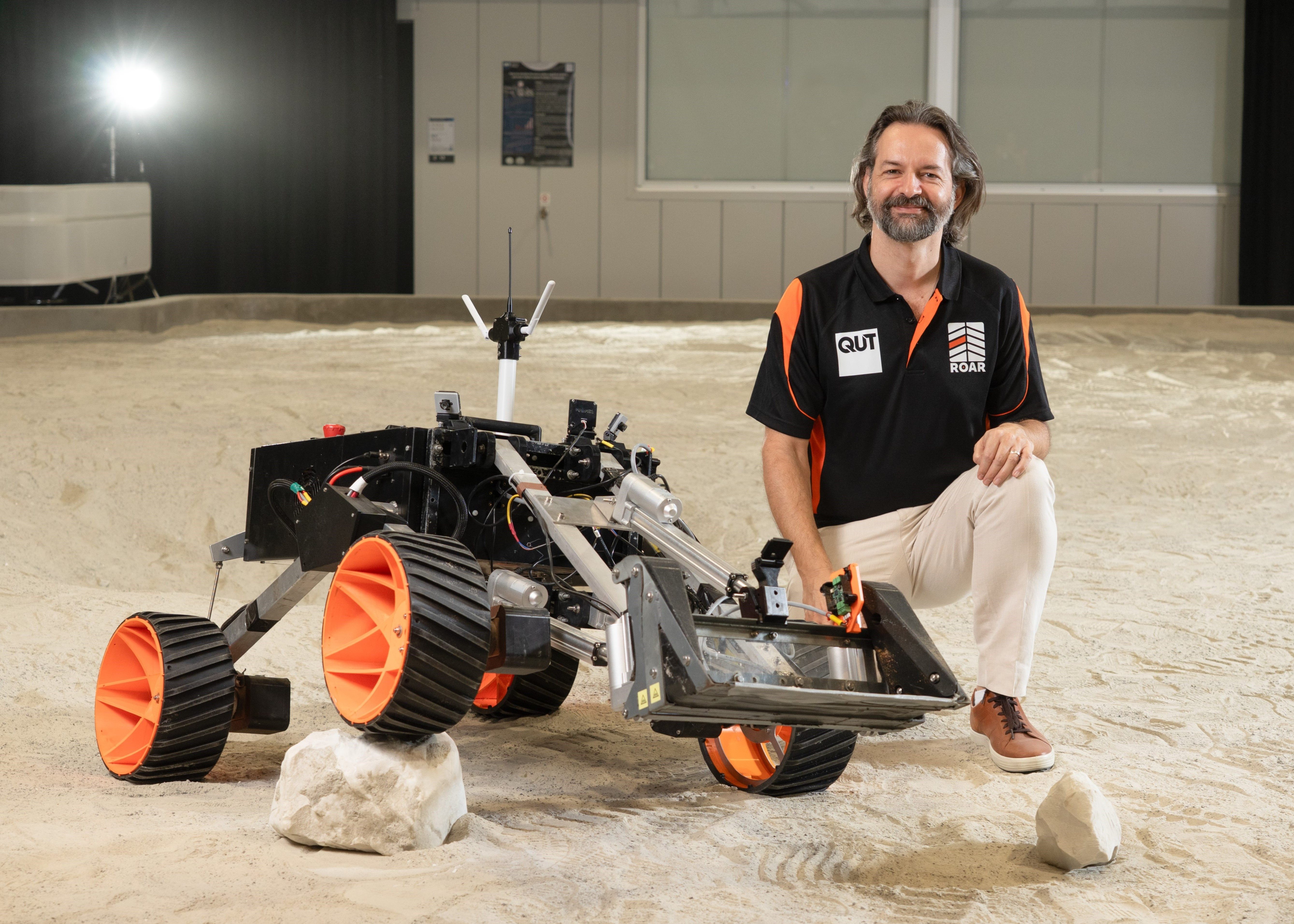
QUT robotics researcher Associate Professor Thierry Peynot is also in Florida this week with the team.
“As academic champion of the team since its creation in 2022, I am very proud of them heading to the first NASA International Lunabotics Championship,” he said.
“This competition is excellent training for the kind of projects our future QUT graduates will be involved in during their careers in robotics, mechatronics and aerospace.
“Through their hard work, these students have developed a rover capable of semi-autonomous and remote operation from scratch.
“It’s an amazing showcase of the advanced skills in mechatronics, mechanical design, electronics systems design, and computer science that they have developed while at QUT – and how these skills can be applied to a real-world scenario.
“It’s a complex project that has required excellent organisational and management skills, as well as their exceptional technical skills.”
Luca said his love of engineering, robotics, and space had been with him for as long as he could remember.
“It has always been my dream to pursue space-related fields of engineering,” he said.
“Watching shows like Star Trek in my early years helped build a lot of the desire to explore the unknown and face the final frontier.
“When I graduate, I hope to complete a PhD in the field of field robotics and power-efficient SLAM.”
The QUT Faculty of Engineering, QUT School of Electrical Engineering and Robotics, and QUT Centre for Robotics provide financial support for QUT ROAR, the development of their rover and their travel to the USA competition, as well as providing mentoring from experienced robotics researchers and academics.
Pictured at top: QUT Roar team members with their rover Perseus at QUT’s Yandiwanba lunar testing and space robotics field
Media contact: Mechelle McMahon, media@qut.edu.au


