The future of change-makers and visionary leaders starts here. At QUT Business School, our programs are shaped by those who live and lead in the real world — award-winning academics and industry professionals who bring practical insight to every learning experience.
As part of our Meet the Experts series, we’re spotlighting the people who teach into our programs and make an impact in their fields — sharing their career journeys, industry insights, and how they’re helping to prepare the next generation of leaders.
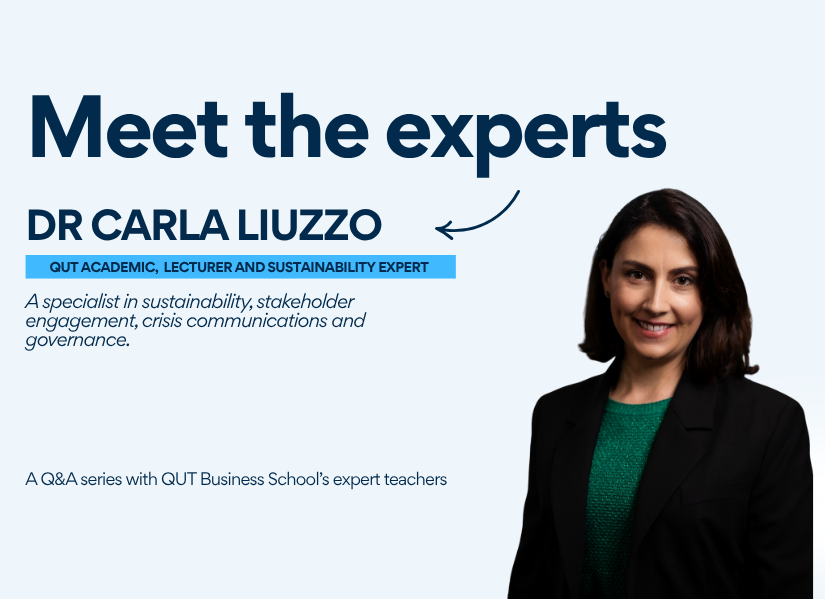
This week, we caught up with Dr Carla Liuzzo — a QUT Business School academic, lecturer, and sustainability expert. Here’s what she had to share:
What does a typical day look like for you?
Lots of hats, lots of running around, like every working parent can relate to.
What song would play in the background of your workday highlight reel?
This is too hard! Would it be wrong to say 9-5 by Dolly Parton?
Do you have a go-to productivity hack or daily ritual that helps you stay on track?
A few years ago, someone whose opinion I greatly respect gave me a valuable piece of advice: reserve your most productive hours exclusively for ‘thinking work’ so I block out my diary during those hours - no meetings, no distractions, just focused time to think deeply!
Your research focuses on sustainability in business. What drew you to this area?
I studied business and spent many years working in the corporate world, and I have always been deeply moved by the power and beauty of our planet—the plants and animals that sustain life. Put the two together and there you have it!
Why does degrowth matter for sustainability?
I recently wrote in an article for The Conversation about sustainable development and “green growth”. Both are based on the idea that we can continue to grow gross domestic product (GDP) globally without continuing to grow emissions. It’s a “have your cake and eat it too” promise. Unfortunately, it is becoming increasingly clear that this is not possible, and we are living unsustainably. Degrowth offers a different perspective, moving beyond ‘sustainability-as-usual’ by prioritising well-being over economic growth. It is an important alternative viewpoint to consider in sustainability, and I think students are interested in this.
Carla’s expertise has also led her to contribute to broader conversations about the future of business education. She’s leading a project to embed a sustainability-first approach across QUT’s MBA suite, ensuring each unit includes sustainability-focused learning outcomes.
In a recent article with MBA News, she shared:
“My role across the QUT MBA and Executive MBA programs, as well as the entire QUT Graduate School of Business, is to elevate the importance of sustainability and ensure it is viewed through the lens of innovation and entrepreneurship. There are huge opportunities if you are not thinking of businesses being there for profit maximisation alone.”
How QUT is Redefining its MBA Suite for a More Sustainable Future
Discover how QUT is evolving its MBA programs to meet the needs of future-focused leaders — with a sharper emphasis on sustainability, ethical leadership, and long-term impact.
👉 Read the full article
How do you bring your research into the classroom?
My research is on degrowth and what we can learn from the emergence of new forms of organising and organisations. I am integrating this into my subjects through new approaches to concepts like value, profit, business models and a bunch of other cool ideas.
Do you see yourself as a disruptor or a builder? Or both?
I like the idea of both, I think we do need to disrupt some of the systems that are no longer serving us, but I also see the need to build alternatives. That requires collective action, it needs both elements of disruption and (re) building.
You’ve worked across Australia and the Gulf—how has that international experience shaped the way you teach?
Those experiences taught me there are other worldviews than the Western mindset, we are shaped by our place. I try to teach the idea of plurality, that there are many realities and worldviews that can exist at the same time. Sounds deep but it just means looking at alternative perspectives for solutions and other ways of doing things!
What’s one thing you wish more students knew about your subject area?
That the economic system we have today is not fixed or immutable. Like everything else, it can be changed to be more in service to us and future generations, rather than the other way round!
💬 Quick fire with Carla
We took a quick break from this Meet the Experts Q&A to ask Carla 12 rapid-fire questions at the QUT Executive Education Centre — from the song that gets her motivated in the morning to the biggest misconception about business she loves to challenge.
What’s one leadership trend you think will define the future of work?
Compassionate leadership. We’ve heard a lot about empathy in recent times, but compassion is more action oriented.
If you could bottle one skill or quality and give it to every graduate, what would it be?
Critical thinking, it sounds like a cliché, but it is a skill!!
You teach across a mix of programs—from our MBA suite to professional development short courses and microcredentials. For professionals ready to level up, what’s your go-to piece of advice?
I recently heard the saying ‘working at the speed of trust.’ I loved this because I think it speaks to the need for leaders to slow down and develop trust, only then can we make changes happen!
What gives you hope about the future of business and sustainability?
The growing numbers of networks, cooperatives, and collective movements around localisation and minimalism in food production, housing, fashion and across all number of industries.
What do you hope students take away from your classes — beyond the subject matter?
To believe in their own (and others) power to affect change. There’s a lot of concentrated power in the world right now but that doesn’t mean collectively and individually people don’t have power because we do and if we lose sight of that then things get a bit hopeless!
Inspired by Carla’s take on leadership and sustainability?
Keep up with her latest thinking and research by connecting with her on LinkedIn.