Gift in Will takes Shashank's research vision to the world
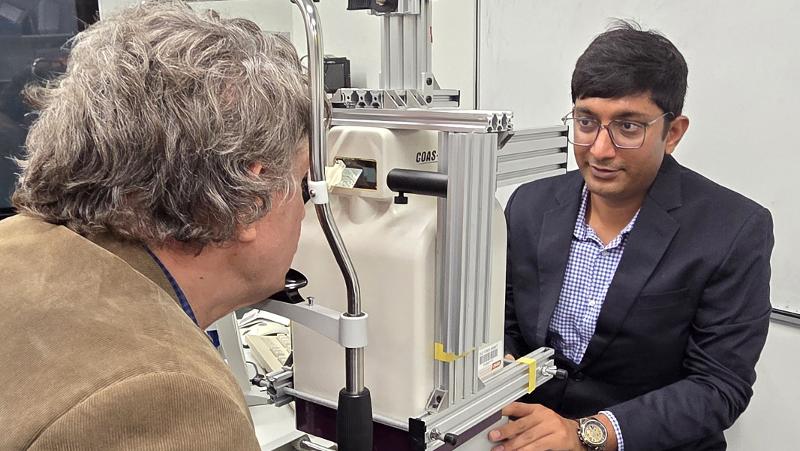
For a young researcher aspiring to make a real-world difference for future generations, an opportunity to present your work on a global stage can be invaluable.
Courtesy of a perpetual endowment from a generous QUT donor and bequestor, Shashank Bhandary has recently returned from showcasing his research at the Association of Research in Vision and Ophthalmology (ARVO) conference .
Nearing the end of his three-year PhD exploring environmental factors behind myopia (short-sightedness), Shashank Bhandary joined more than 11,000 delegates in Denver for the annual international conference - which attracts experts from diverse fields including optometry, ophthalmology, biochemistry, psychology and biomedical engineering.
Shashank said his poster presentation format created an ideal environment for feedback and collaboration.
“Being in such a big, well attended conference, you get to meet many other scientists from around the world. You are able to interact, talk about related research and clinical trials, plus explore new research and clinical instruments,” he said.
“There were many networking opportunities with people related not just to my field of research, but with people who may be combining myopia research with other research areas such as glaucoma and other eye diseases.”
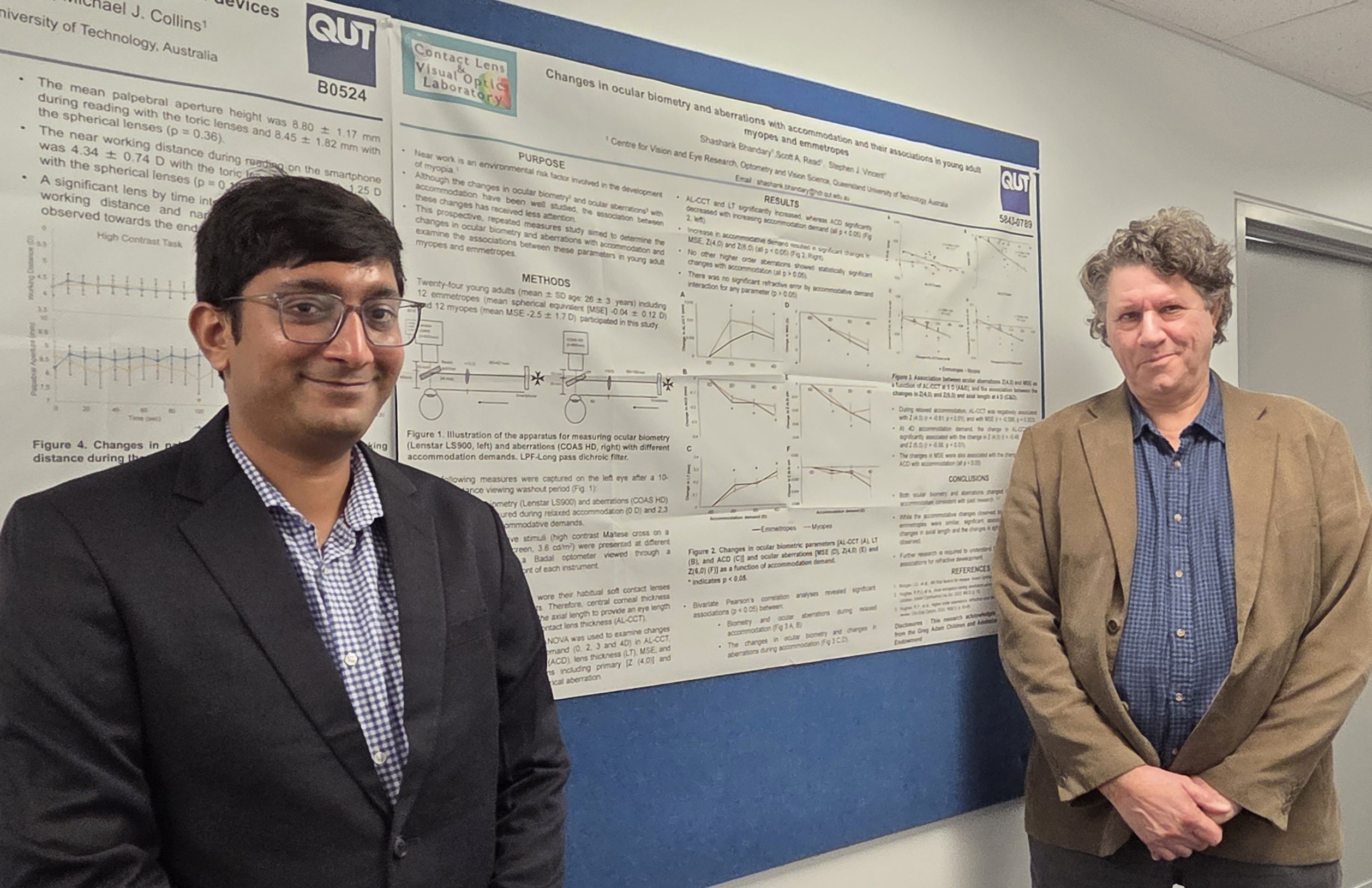
Shashank is exploring how “near work” (short-distance reading and screen use) affects myopia, working alongside Professor Michael Collins (QUT School of Optometry and Vision Science) and research fellow Dr Rohan Hughes, who is also exploring risk and treatment options.
Together, they want to better understand what causes myopia, along with how to slow its progression to avoid sight-threatening eye complications in later life.
Professor Collins said research was informing a growing range of treatment options, many of which were shared at the ARVO conference.
“There were many presentations about spectacles which children can now wear to slow down their myopia,” he said.
“Old-style spectacles would give a child clear vision and correct their myopia - but they would not slow it down. The new ones have extra optical components in the periphery that (actually) slow the progression.”
“This area of myopia research is taking off around world because it is fairly easy to implement … drugs and contact lenses are both tricky options for kids, but spectacles are pretty easy. Kids can wear them and then easily take them off if they need to.”
Shashank’s Denver presentation summarised his research comparing emmetropes (people with “normal” sight) to myopes (short-sighted people needing glasses), when both groups were reading at long and near distances.
He investigated how much eyes “accommodate” (adjust power to maintain focus on objects as distance varies); and associations between changes in eye structure (dimensions) and aberrations (imperfections which prevent light from focusing perfectly onto the retina, leading to blurred vision).
How the eye changes to accommodate near work
While changes in accommodation were similar for both myopes and emmetropes, the research found “significant associations” between changes in axial length and aberrations.
“The crystalline lens of the eye focuses (accommodates) for near targets,” Shashank said.
“When the object is nearer - when you are putting a book closer towards your face, or you are reading closer - the lens thickness inside the eye increases along with other changes in the eye.”
Other factors investigated included how much light is entering the eye, how that light is dispersed, the impact of working indoors compared to outdoors, and how many rest breaks may be required. The study group consisted of 24 young adults - 12 emmetropes and 12 myopes.
Previous studies have found that moving to a higher education level correlates to myopia progression (needing stronger glasses), due to an increase of near work. Shashank’s ongoing research will look to identify ways to counteract this risk.
Professor Collins said the ARVO conference – where Shashank was among several students and staff from QUT Optometry and Vision Science presenting – also showcased emerging treatments such as red light therapy, plus global health issues as more people age with myopia.
“If you're 50 years of age and your myopia is still progressing, you're getting into the territory where you start to get a high risk for pathology at the back of your eye,” Professor Collins said.
“There will be a push to start looking for treatments that work on older folks who have progressive myopia, because they're starting to end up with partial blindness as a result of retinal problems.
“It's considered a major public health problem - particularly in countries such as China, where up to 90 per cent of the children are myopic.”
- Shashank’s trip to Denver for the ARVO conference, along with his PhD scholarship and the work of research fellow Dr Hughes, has been enabled by a perpetual endowment from Greg Adam, through generous gifts over many years and a gift to QUT left in his Will.
- A gifted young sportsman, Mr Adam started having difficulty with his sight as a late teen related to developing myopia. As his understanding around myopia grew, he realised how many children were diagnosed with short-sightedness and wanted to make a difference regarding its impact on young lives.
For more information about a gift to QUT in your Will, contact Heath Mackay - Development Manager (Gifts in Wills) - on 07 3138 7525 or heath.mackay@qut.edu.au