By Amanda Maslin, 28 August, 2025
What do you get a friend who’s obsessed with tracking flights? If you’re IT and Maths student Michael Robertson, you build them a real-time flight radar from scratch.
What started as a simple birthday present became one of Michael’s most rewarding and technically impressive projects yet.
We caught up with the QUT student ambassador and double degree student to find out what inspired the idea, how he pulled it off, and what he learned along the way.
About the Project
Can you give us a quick overview of your Nearby Flight Radar project in your own words?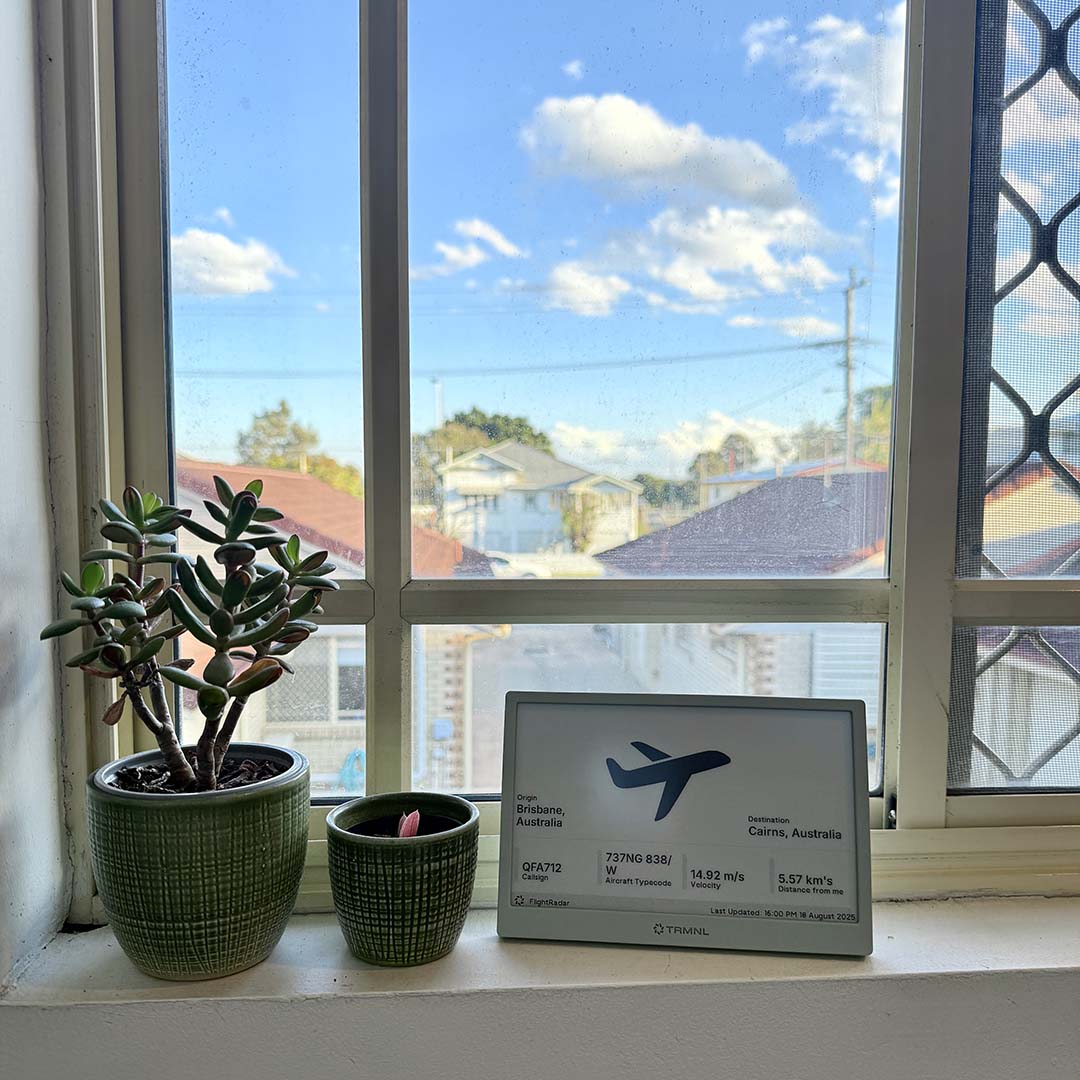
The Nearby Flight Radar displays the closest airplane currently flying above you, along with details about the flight and the aircraft itself. It works by querying a real-time air traffic data API for the aircraft’s code, velocity, and coordinates. These are then compared against the translated geographical coordinates. The system then compares these data points with your street address’s geographical coordinates to find the flight closest to you. To identify the flight’s origin and destination, I use a programmable search engine to pull information from popular flight-tracking websites. Once all the data is collected, it’s sent to a TRMNL e-ink dashboard - the same screen technology as a Kindle, which makes it a clean, distraction-free display.
What originally inspired you to build it - and how did it go from a birthday gift idea to a fully-fledged system?
The inspiration came from my best friend, who loves commercial aircrafts and often checks Flightradar24 whenever she spots a plane overhead. Two months before her birthday, I realised I had both the opportunity and the skillset to create a really thoughtful, personalised gift.
The project started slowly, with much of my time spent researching different options - comparing documentation, data specifications, costs, and availability. Once I mapped out what I thought was the best approach, I began building.
With a project that has so many moving parts, it can feel daunting to know where to start. To manage this, I adopted a modular development strategy: focusing on one component at a time, making sure the inputs and outputs matched the requirements. This modular approach ensured that when it was time to integrate everything, the process was as seamless as snapping Lego bricks together.
What were some of the biggest technical challenges you ran into, and how did you overcome them?

One of the earliest challenges that had a huge impact on the direction of the project was the absence of flight model and route details (origin and destination) from the real-time air traffic API. This forced me to think creatively and led me to discover Google’s Programmable Search Engine. Thanks to the interconnected nature of online data, I was able to take the limited snapshot of information I had — such as the callsign and aircraft code — and, by linking it with other systems and datasets, reconstruct a much clearer picture of the actual flight.
What new skills or knowledge did you gain from this project that you didn’t expect from the start?
One of the biggest areas of learning was in making sense of incomplete data. The flight information I started with was just a small snapshot, so I had to explore ways of enriching it by using other systems to create a fuller picture. Along the way, I also learnt how important it is to build for resilience, and designing the system to handle missing data, rate limiting, and unexpected downtime. These problem-solving skills around data and reliability weren’t what I expected to focus on, but they became some of the most valuable outcomes of the project.
How did your studies at QUT prepare you for tackling a project like this?
My double degree in Information Technology and Mathematics at QUT has really nurtured my passion for problem solving. To me, problem solving isn’t just about having the theoretical knowledge to answer a question - it’s about knowing how to apply that knowledge within real-world constraints.
Through QUT’s project-based learning, I’ve had the chance to work on coding projects that required modular design, systems integration, and debugging under pressure - all skills that became essential in this project.
On the mathematics side, my education in applied mathematics and modelling gave me the tools to approach complex, dynamic systems, and break them down to simpler, solvable components. Together, these experiences prepared me to tackle a project like Nearby Flight Radar with both creativity and technical precision.
Were there any particular units, projects or experiences at QUT that gave you the confidence or technical foundation to pull this together?

Most notably, my first year unit IFB104 Building IT Systems provided me with a hands-on introduction to building systems with Python, where our final project included reading news articles from live news websites and displaying them on a simple user-interface, a foundational concept which I built from when grabbing live flight route details in my Nearby Flight Radar.
It’s awesome to see how you can create these complex systems by building from those simple concepts that I learned so early on.
What advice would you give to other QUT students who want to turn a side project into a big learning opportunity?
"The best time to plant a tree was 20 years ago. The second-best time is now.” I spent over three years waiting for the confidence to start my own projects, thinking I wasn't smart enough yet. Now I realise that feeling uncertain is the perfect time to start.
You don't need to know everything to begin; you just need to be willing to learn. You don't need a completed Bachelor's degree to start investing in yourself - just a growth mindset. Jot down that passion project, break it into individual components, pick one, and just start. It's about taking that first step and trusting that with each small success, your knowledge and confidence will grow.
What’s next on your horizon? Another similar project? Or career goal?
My next step is to continue my journey of self-driven learning by diving into more complex, passion-fueled projects. I'm also planning to further explore a future in applied mathematics through QUT’s Vacation Research Experience Scheme (VRES) program.
My ultimate goal is to find a career where I can combine my love for problem solving, my analytical skills in mathematics, and my creativity in building systems that make sense of real-world data. I want to build things that matter, and I'm always on the lookout for a new challenge.