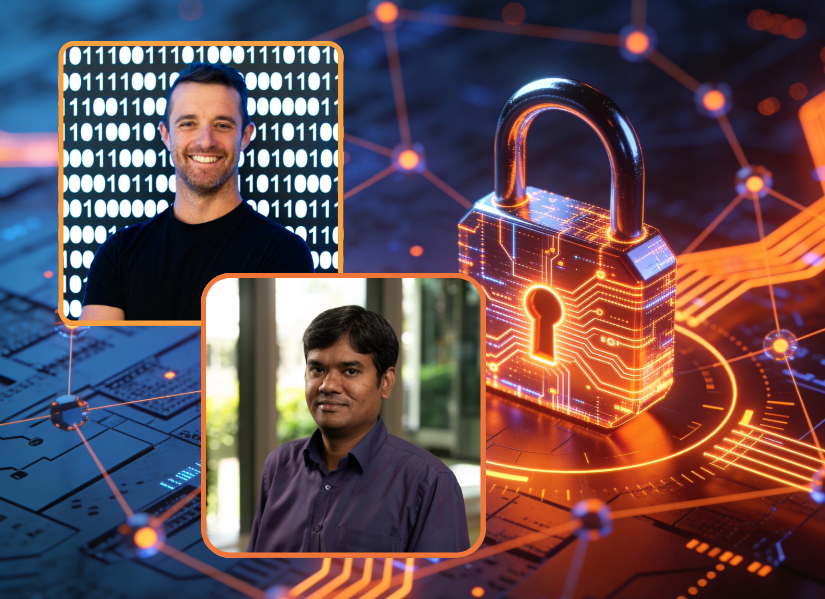
By Emelie Dahlskold, 27 October, 2026 | Professor Craig Costello and Dr Gowri Ramachandran
From AI-powered phishing to the human mistakes that bypass sophisticated security, today’s cyber threats are changing fast. QUT cyber security experts Craig Costello and Gowri Ramachandran explain what’s changing, and why the people protecting our digital world need to keep changing with it.
Artificial intelligence is transforming how we work, communicate and solve problems.
It’s also changing cyber security.
Attackers can use increasingly sophisticated technology to make scams more convincing and personalised. At the same time, organisations continue to rely on people to make good decisions when something doesn’t look quite right.
For cyber security professionals, that creates an interesting challenge: how do you stay one step ahead when both technology and human behaviour are constantly changing?
It’s a question QUT researchers are tackling now.
AI is making familiar threats harder to spot
Dr Gowri Ramachandran, Senior Lecturer at QUT, recently told SMBtech that autonomous AI agents are making phishing and social engineering attacks increasingly sophisticated. These systems can collect personal information and use it to create highly personalised messages that appear legitimate.
His warning goes beyond phishing.
As people increasingly rely on AI chatbots for information and advice, he argues that digital literacy also needs to evolve.
"People need to understand AI’s limitations, question seemingly authoritative responses, and recognise that a convincing, empathetic chatbot is not necessarily a trustworthy adviser," Gowri said.
That highlights a bigger shift for anyone considering their future in cyber security.
Technical knowledge matters, but so does understanding how people interact with technology, where trust can break down and how emerging technologies create new risks.
Gowri Ramachandran’s own research reflects that changing landscape, spanning software security, web infrastructure and distributed systems. His work includes research into malicious open-source software packages and cyber risk modelling using generative AI.

Deepen your cyber security expertise
Develop the advanced technical, analytical and professional capabilities needed to help organisations manage cyber risk and protect their information and systems.
Sometimes the easiest system to hack is a person
While Gowri Ramachandran points to increasingly sophisticated AI-enabled threats, QUT Professor Craig Costello highlights a deceptively simple problem.
As a cryptographer, Craig Costello researches ways to make encryption harder to break. But as he recently observed in SMBtech, criminals don't necessarily need to defeat the mathematics behind encryption if they can persuade someone to pay a fraudulent invoice instead.
His advice to organisations is straightforward: make verification normal.
"One of the most useful things a small business can do is give people permission to be a little annoying. Call the supplier to check their new bank details using a number you already trust. Question the urgent payment request, even if it appears to come from the boss. A familiar email address doesn’t prove who’s behind the keyboard," Craig said.
It’s a useful reminder that cyber security isn't only about building stronger technology. It’s about designing systems, processes and behaviours that are harder to exploit.
And the next security challenge is already emerging
For Craig Costello, another challenge sits further over the horizon: quantum computing.
His research focuses on post-quantum cryptography and the mathematics and algorithms behind secure digital communications. He has contributed to the development of quantum-resistant cryptographic systems and teaches cryptography, algorithms and cyber security at QUT.
In April 2026, he warned that advances in quantum hardware and algorithms mean quantum computers may be capable of breaking widely used forms of cryptography sooner than previously expected.
The technology might sound futuristic. The preparation isn't.
Organisations and governments are already considering how today's digital infrastructure will need to adapt as quantum computing advances.
For someone building a career in cyber security, that makes the field compelling: you're not only responding to today's attacks. You're preparing for problems that technology is creating next.
Build skills for what’s next
AI-enabled scams. Human behaviour. Software vulnerabilities. Quantum computing.
Cyber security is no longer a narrowly defined technical problem, and the skills required to address it keep evolving.
That’s what makes postgraduate study particularly relevant for professionals with technology experience who want to deepen their cyber security capability.
At QUT, students can learn from and alongside researchers such as Craig Costello and Gowri Ramachandran, whose work addresses contemporary cyber security challenges spanning cryptography, AI, software, and digital systems.
If you're ready to deepen your expertise and take on the security challenges shaping our digital future, explore postgraduate cyber security study at QUT.

Save more than 70% on course fees with CSP
Studying one of our postgraduate Commonwealth Supported Places (CSP) courses can reduce your fees by more than 70%. This is great news for professionals or current undergraduate students looking to boost their careers with a Master of Cyber Security.