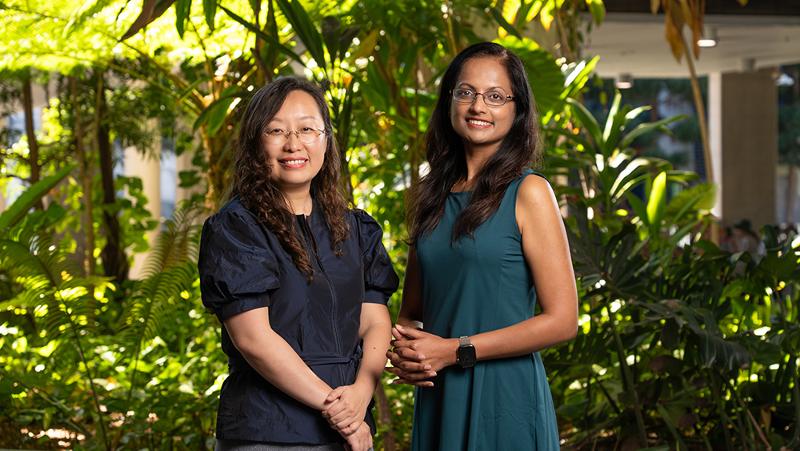
QUT researchers have developed a short, practical scale that measures how people experience empathy, distinguishing between understanding another person’s feelings and sharing either their positive or negative emotions.
First author MPhil graduate Nilani Gunasekara (picture above, right) said the scale captured three distinct dimensions of empathy and could be used in psychology, marketing and behavioural science research.
“While empathy plays an important role in relationships, workplaces and society, existing empathy measures do not always capture the full range of emotions people experience when responding to others," Ms Gunasekara said.
"To address this gap, we developed a measure that considers both positive and negative emotions, as well as the intensity of those emotions.
“We also incorporated a broader range of empathic experiences, including understanding or sharing emotions such as calmness, interest, guilt or boredom.”
"Our VAES scale measures three dimensions of empathy:
Associate Professor Shasha Wang (above, left) said the researchers conducted three studies (an expert panel review, and two surveys) and found that the three empathy components were linked to personality traits and helping behaviours in different ways.
"For example, cognitive empathy and positive affective empathy were associated with stronger intentions to help others.
"In contrast, people who strongly shared others’ negative emotions were less likely to report prosocial behavioural intentions.
"We also found that people who are always prepared (high conscientiousness) tend to have a higher level of cognitive empathy and a lower level of negative affective empathy, while people who have a stronger faith in humanity tend to have a higher level of positive affective empathy."
Professor Wang said the VAES provided researchers and organisations with a brief and practical tool for studying empathy across a wide range of settings, including psychology, marketing, and the behavioural sciences.
“Clinical educators and trainers, studying or applying empathy in academic, clinical, and commercial settings could also benefit from using the scale.
“By distinguishing between different forms of empathy, the scale can help researchers better understand how empathy influences behaviour, wellbeing and social relationships,” she said.
The study, Development and validation of the valenced arousal empathy scale (VAES), was published in Personality and Individual Differences.