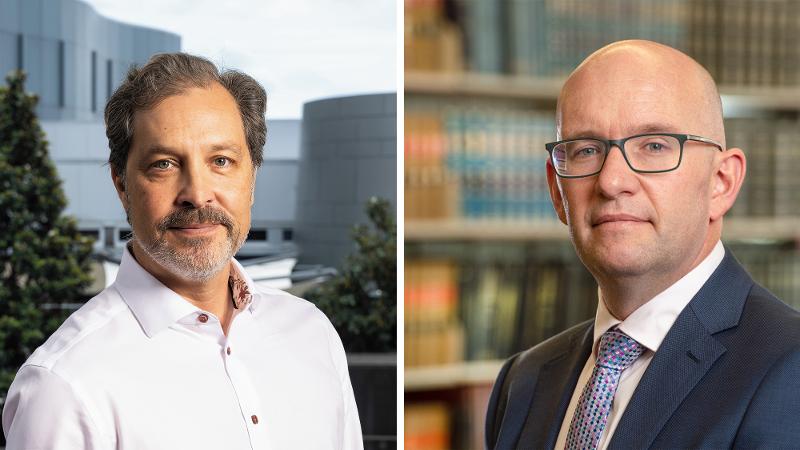
Distinguished Professor Ben White and Professor Greig De Zubicaray have been elected Fellows of the Australian Academy of the Social Sciences.
They join 41 newly elected Fellows whose contributions to research, policy, public life and the advancement of knowledge that benefits our society.
Academy President Professor Kate Darian-Smith said the 2026 cohort exemplified the vital role of social science research in addressing complex challenges and building a more informed, equitable and and prosperous society.
"From strengthening democratic institutions and improving public health outcomes to advancing economic opportunity and environmental sustainability, their work demonstrates the power of social science research to create positive change," Professor Darian-Smith said.
Distinguished Professor Ben White (pictured right) is Professor of End-of-Life Law and Regulation in the Australian Centre for Health Law Research and QUT's School of Law. His research focuses on end-of-life decision-making, particularly voluntary assisted dying (VAD).
''Professor White's research has influenced law, policy and practice and been adopted by parliaments, courts, tribunals and law reform commissions, state and national policy, and prompted changes to clinical education in universities, hospitals and health departments."
His work has contributed to VAD reform in all Australian states and territories and internationally and is also accessible through the End-of-Life Law in Australia website, which provides information for patients, families, health practitioners, policymakers, and the wider community.
Graduating with First Class Honours and a University Medal in Law from QUT, he was awarded a Rhodes Scholarship to complete a DPhil at Oxford University.
Before joining academia, Professor White worked as an Associate at the Supreme Court of Queensland and at Legal Aid Queensland. From 2005 to 2007, he served as full-time Commissioner of the Queensland Law Reform Commission and continued as a part-time Commissioner until 2010.
With interdisciplinary scholarship spanning law, regulation, medicine, bioethics, social policy and social science, Professor White was a foundation director of QUT's Australian Centre for Health Law Research (2013-2018) and continues to co-lead its end-of-life research program.
As part of interdisciplinary teams awarded more than $80 million, Professor White has conducted seminal research for end-of-life decision-making funded by the ARC, National Health and Medical Research Council, Commonwealth and state governments, and philanthropic organisations.
His six Australian Research Council (ARC) grants have examined law, policy and practice at the end of life, including the role of law in medical decision-making; doctors’ knowledge and compliance with the law; futile or non-beneficial treatment; wills and advance care planning; community understanding of end-of-life law; patients’ and families’ rights and responsibilities; optimal regulation of voluntary assisted dying; and how voluntary assisted dying operates in Australia.
He has produced more than 250 publications, including books, book chapters, and journal articles, primarily in health law and end-of-life decision-making.
Professor White is editor of Research Handbook on Voluntary Assisted Dying Law, Regulation and Practice, a collaboration of 58 authors from 14 countries which aims to chart VAD globally, and an editor of Health Law in Australia and International Perspectives on End-of-Life Law Reform: Politics, Persuasion and Persistence.
To translate this deep body of research into practice, Professor White with colleagues has developed funded education and research programs on end-of-life law including the mandated training for health professionals participating in VAD in Victoria, Western Australia and Queensland. He also leads End of Life Law for Clinicians, a Commonwealth-funded national program improving health professionals’ knowledge of end-of-life law.
Professor Greig de Zubicaray (pictured left) is a clinical and cognitive neuropsychologist in QUT's School of Psychology and Counselling who investigates the cognitive and neurobiological bases of language and its disorders.
"The field of neurolinguistics is a young and highly interdisciplinary field, with influences from fields such as psycholinguistics, psychology, aphasiology, cognitive science and neuroscience."
Professor de Zubicaray has also made significant contributions to the the interdisciplinary field of cognitive neuroscience.
His neuroimaging and neuromodulation work has identified brain regions associated with speech production and comprehension to advance knowledge about how word meaning is represented in the brain.
He has broadened clinical understanding of language recovery following treatment for brain tumours with significant contributions to multi-disciplinary research, identifying genetic and environmental influences on brain structure and function development including discovery of brain regions associated with polygenic risk for psychiatric and neurological disorders.
Professor de Zubicary has published more than 300 papers in leading general science journals (Nature, Science, PNAS), experimental and theoretical psychology journals , and neuroscience and cognitive neuroscience journals.
Professor de Zubicaray’s work has been funded continuously by the Australian Research Council (ARC) since 2003, and by the National Health and Medical Research Council (NHMRC), National Institutes of Health (NIH) in the USA, and philanthropic foundations.
He is a Fellow of the Australian Psychological Society and its College of Clinical Neuropsychologists. In 2016, he was elected Chair of the international Society for the Neurobiology of Language (SNL), the first Australian to hold this role.
A member of the ARC College of Experts in 2019 and the Medical Research Advisory Group in 2022, Professor de Zubiracay has been an action editor for leading journals in his field and serves on various editorial boards. He has been both editor and contributor to a key reference textbook for the field, the Oxford Handbook of Neurolinguistics.
QUT Media contact: media@qut.edu.au


