As tourism in Antarctica continues to grow at unprecedented rates, a QUT-led study offers new strategies to sustainably manage its impacts.
The research, led by Dr Valeria Senigaglia, a research fellow from the Antarctic research group Securing Antarctica’s Environmental Future (SAEF) and the School of Biology and Environmental Science, appears in the Journal of Sustainable Tourism and highlights how economic instruments can complement regulations to protect Antarctica’s unique and vulnerable environment.
The number of visitors to Antarctica has skyrocketed from under 8000 in 1993-94 to more than 120,000 in the 2023-24 season.
Forecasts developed in the study suggest that, without additional management, tourist numbers could quadruple over the next decade, reaching nearly half a million visitors annually.
“A core concern is that the cumulative impacts of tourism will interact with climate-change-induced shifts in weather patterns, ice melt, ocean currents and nutrient cycling, resulting in widespread habitat degradation and declines in wildlife populations and diversity,” Dr Senigaglia said.
The findings come as the Antarctic Treaty Consultative Parties (ATCPs) committed in 2023 to creating a comprehensive tourism framework.

“Managing tourism in Antarctica is uniquely challenging due to the region’s remoteness, its fragile ecosystems and the complexity of its international governance,” Dr Senigaglia said.
“Our research shows that combining site-specific regulations with broader economic strategies could offer a more effective, adaptive approach.”
The interdisciplinary team, which included experts in economics, ecology, governance and tourism, assessed a range of economic tools against two key criteria: their ability to curb environmental impacts and their likely acceptability within the Antarctic Treaty System.
Economic tools included visitor caps, tourism taxes, market-based certifications and behavioural nudges.
The findings revealed that while no single instrument could address all challenges, carefully selected combinations can substantially enhance protection efforts.
“For example, implementing visitor caps in the most sensitive areas, combined with targeted tourism fees and strengthened certification standards for operators would provide multiple layers of protection without stifling responsible tourism,” Dr Senigaglia said.
“To manage tourism sustainably, we need to operate at different level. We need regulations and site-specific guidelines but these cannot be the only method and applying more ‘global’ instruments might help in preserving not just biodiversity but the ecosystem services provided by Antarctica.
“We hope these findings will inform the ATCPs’ ongoing work to develop a tourism framework that not only manages visitor numbers but also preserves Antarctica’s value for future generations.”
Read the full article, Managing tourism in Antarctica: impacts, forecasts, and suitable economic instruments, published in the Journal of Sustainable Tourism online.
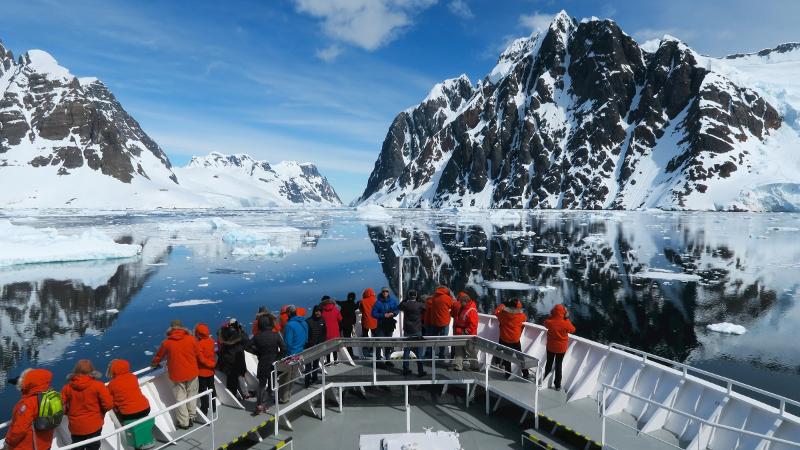
Main photo: A tourist group visits Antarctica. Photo by Freysteinn G. Jonsson (via Unsplash)
Media contact:
Lauren Baxter
QUT Media
media@qut.edu.au
07 3138 2361 / 0407 585 901 (After Hours)


