By Georgia Smith, 9 April, 2026
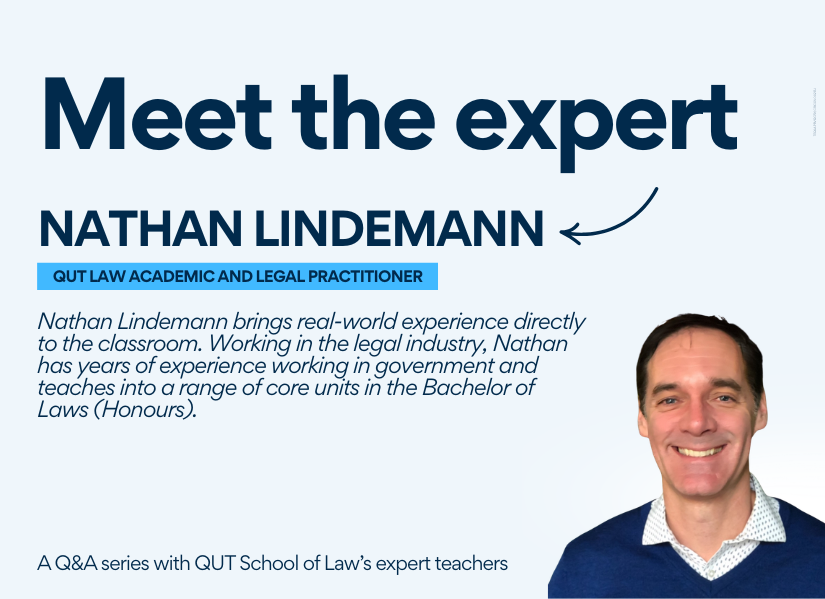
Nathan Lindemann brings real-world experience directly to the classroom. Working in the legal industry, Nathan has years of experience working in government and teaches into a range of core units in the Bachelor of Laws (Honours). We sat down with him to learn more about what he teaches, his career journey and his thoughts on the future of law.
What do you teach and what do you enjoy most about teaching in these areas?
I teach across a range of topics, including administrative law, equity and trusts, property law, and corporate law, which are all core units in the Bachelor of Laws (Honours).
I love teaching these areas because the content is so important, whether students become lawyers or use their legal skills in other careers. These units can be challenging, so it’s incredibly rewarding to see the concepts click for students.
What’s one thing you wish more students knew about the areas you teach in?
All the units I teach have real, practical applications. For example, even if you don’t end up working in government, the principles of Administrative Law are still so important and useful in everyday life. One of the key principles is procedural fairness (giving someone a fair hearing), which I think is something we should apply in all aspects of life.
You’ve had extensive experience as a practising lawyer, what roles have you enjoyed the most?
I’ve worked in government for many years in a variety of roles, but the ones I have enjoyed the most are those that combine law with another discipline. For example, I’ve worked on projects that merge law with IT and project management, influencing the design of IT systems to ensure they comply with the law while meeting client needs.
How does your real-world experience translate into the classroom?
My industry experience helps me bring a balanced perspective to the classroom, especially when analysing cases. There are always two sides to a legal matter, and working in government has given me insight into the decision-making process of government agencies. Bringing this knowledge with me into the classroom is very helpful, and hopefully insightful for the students.
Another way this translates into my teaching is that I am always thinking about why the law is the way it is and I encourage my students to do the same. I get them to think about not only how the law applies to matters, but why the law is drafted the way it is.
Can you walk us through your career journey?
After competing my Bachelor of Laws (Honours) at QUT, I enrolled in a Master of Laws at QUT and applied for graduate positions. At that stage my aim was to study full-time, I was not expecting to secure a graduate position, but I did and I decided to accept it, studying my masters part time while working full time. Since then, I’ve worked across different areas in government, developing my skills and opening doors to new opportunities.
Is there an achievement in your career you’re especially proud of?
Some of my proudest teaching moments are seeing former students succeed in their careers, knowing I played a small part in motivating them to pursue their goals.
What’s the biggest lesson you’ve learned in your career so far?
Say “yes” when you are asked to do something different. While it may take you out of your comfort zone, the person asking you believes that you have the skills needed, so don’t doubt your ability.
How is technology, like AI or legal analytics, changing the way you work?
My current work involves interpreting the law, and AI isn’t yet advanced enough to assist in resolving complex legal problems. One way it can be used is to translate complex principles into more user-friendly explanations; however, there is still work involved to ensure it is technically correct.
Quick-fire questions
To finish, we asked Nathan a few rapid-fire questions about his predictions for the future of law, advice for those starting out and much more.
What’s one area of law you think will grow significantly in the next few years?
Laws relating to technology. I think there will be changes to a lot of existing laws to accommodate changes in technology.
For someone wanting to get their foot in the door, what advice would you give?
Don’t compare yourself to others. Focus on what makes you excited and what you want to do in your career.
Do you have a go-to productivity hack or daily ritual that helps you stay on track?
I don’t live in my inbox. I sort emails hourly, prioritise and then work through them in priority order.
What are your go-to sources for staying informed in your field?
I’d recommend the weekly The Tax Institute newsletter, TaxVine, and the Work with Purpose podcast.
What's your favourite thing about working at QUT?
Definitely the people.
What’s one misconception people often have about working in law?
That the only way to work in law is to be a Solicitor or Barrister.
If you weren’t working in law, what do you think you’d be doing?
I would like to think something artistic, but in reality, it would be engineering.
What’s one legal concept you think everyone should understand, even if they’re not a lawyer?
The importance of the Constitution and the certainty it brings to our system of government.