By Georgia Smith, 19 December, 2025
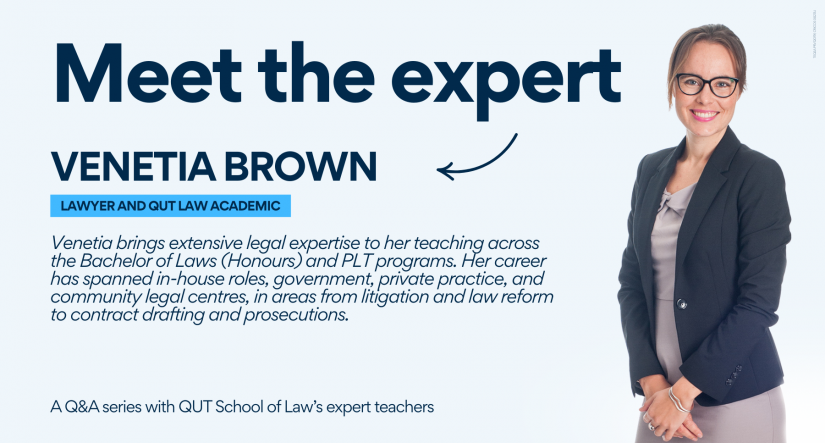
From shaping future lawyers in the classroom to tackling complex legal challenges in practice, lawyer and QUT Law academic, Venetia Brown, brings a wealth of experience and passion to her work. Venetia shares her insights on teaching, her career and the skills every law student should master, plus a few personal tips for staying inspired.
What do you teach at QUT?
I teach first-year units in the Bachelor of Laws (Honours) and coordinate the Employment Law elective in the Graduate Diploma of Legal Practice (PLT) course.
One of my favourite units to teach is the new Sustainability, Governance and the Law unit. It introduces first-year students to the way regulation (in its broadest sense) operates to affect behaviour. In many ways, it is an opportunity to explain what law really is. The focus on sustainability is close to my heart. It’s not just about ecological sustainability; it also includes social and corporate sustainability.
I love finding ways to help students feel engaged with the content in ways that align with their interests, whether it’s the corporate sphere, environmental protection, a more humanistic approach or a combination of all!
In the PLT program, I am the unit coordinator for the Employment and Industrial Law elective. Employment law is so complex we’d never be able to cover it all in one unit, but I enjoy teaching students how to best approach the practical tasks they need to complete. We can all benefit from knowing more of our workplace rights and it’s an incredible feeling helping people with workplace disputes. We know that workplace disputes can really impact an individual’s sense of self, so assisting in those instances is very rewarding.
You’ve had extensive experience as a lawyer—can you tell us a bit about where you’ve worked and what your favourite role has been?
I cannot possibly pick a favourite! I’ve worked in nearly every sector of the legal profession—in-house, government (both Commonwealth and State), boutique, medium and large law firms, and community legal centres, in London, Sydney and Brisbane. My work has spanned defence, prosecutions, law reform, litigation, contract drafting, workshop facilitation and visual communication. I’ve taught at three different universities and worked for three different judges. So, you see, I couldn’t possibly pick a favourite.
I’ve loved each role for different reasons, but a common aspect is taking complex ideas and explaining them simply.
How did you get to where you are today?
I was very lucky during university to be encouraged by those around me to pursue opportunities that I had no idea were possible. I was the first lawyer in my family, so I had no clue what I was doing, beyond just studying really, really hard.
Those early days of mooting competitions, high grades, judges’ associateships and clerkships set me up for my varied and exciting career.
I’ve always been on the lookout for new and exciting opportunities. I’ve generally worked more than one job at a time and been mindful of when a role was not a good fit.
How do you balance work and life?
A career shouldn’t be separate from the person living it. I’ve burnt myself out a couple of times, so developing a healthy respect for my physical and mental body has been really important. That comes first now (well, mostly). I’ve worked with psychologists to develop better coping mechanisms and a healthier approach to ‘working hard’. It’s all about understanding your priorities – and being flexible when this changes.
What’s a project or achievement in your career you’re especially proud of?
That’s tricky. In my last role at Caxton Community Legal Centre, I developed a visual diagram for lawyers and social workers to use when explaining workplace sexual harassment claims to victims. It’s a very complicated area of law, with so many different options, many of which are mutually exclusive. That felt like an A3-sized win.
What’s the biggest lesson you’ve learned in your career?
There are a few:
1. Take time to consider what you ‘want’ to do. Just because you can do something, doesn’t mean you should do it or that it's good for you.
2. Try new things and see if you like it!
3. Know how you work best. For me, mornings aren’t ideal, so a job that requires me at my desk every day at 8:30am is not the best for me. I can do it of course, but I work much better at night, and in peaks and troughs of intensity, with the freedom to take time off for things such as extensive volunteer work.
If you could add one essential skill to every law student’s toolkit, what would it be?
I helped develop the Law and Design Thinking unit and I wish all students would take that unit!
Design Thinking is a problem-solving approach that’s invaluable for tackling complex challenges, or any problem involving humans. It develops your empathy and teaches you to think broadly, beyond just legal solutions. You then go on to prototype and test solutions.
I wish more students thought more broadly about solving legal problems, given that is how good lawyers will approach legal problem-solving in the ‘real world’. I use a version of that method as a practising lawyer, particularly in my work at community legal centres, where we are generally dealing with intersectionality and complexity, which will not be resolved with a purely legal response.
For someone wanting to get their foot in the door, what advice would you give?
I’m not sure I’ve ever liked this question! Talk to 100 lawyers and you’ll end up with 100 different ways of doing it. Get off social media, stop comparing yourself to anyone else and just try lots of different avenues until one sticks.
I went through a period of being unemployed for 6 months when I was living in Sydney. I had graduated with First Class Honours, been an associate to 3 judges, clerked at a top-tier firm, and I couldn’t seem to get an interview with anyone. I couldn’t even volunteer with a Community Legal Centre because I didn’t have enough experience. AND my latte art wasn’t good enough to work in a café in Sydney. I ended up doing bits of legal research for a barrister and had my first experience tutoring (unpaid). I just had to keep applying and wait.
My point is: there’s no rhyme or reason sometimes. It can just take time and persistence.
Quick-fire questions
To finish, we asked Venetia a few rapid-fire questions about her habits, inspirations and predictions for the future of law
Do you have a go-to productivity hack or daily ritual that helps you stay on track?
Exercise, sleep and nutrition are non-negotiable for me. I also use a Curation Diary for quick journaling every night. And, to beat the procrastination monkey, ‘bread crumbing’.
What are your go-to sources for staying informed in your field—any newsletters, Substacks, podcasts, or thought leaders you’d recommend?
Keeping abreast of the law is one thing, but what I really tend to stay informed with are developments in psychology, particularly behavioural psychology, science, health... so, Brené Brown, Esther Perel, The Economist, Search Engine Podcast, Freakonomics, Huberman Lab.
And the Hamish and Andy Podcast, because life is too short not to be fully informed about the funny things in life.
If you could collaborate with any expert or company in the world, who would it be and why?
Margaret Hagan, a lawyer and designer based at Stanford University who is Executive Director of the Legal Design Lab and a lecturer at the Stanford d.school.
I admire her work and approach to tackling systemic legal problems.
What’s one area of law you think will grow significantly in the next few years?
Changes to our workplace laws in Australia and Queensland have strengthened protections for workers, so I imagine we’ll see more test cases and an increase in employers being held to account. We do need more employment lawyers willing to work pro bono though—shout out to anyone who can spare a few hours!