
By Jane Currie, Sandra Johnston, Christina Parker, Poppy Fratzeskos, 7 April, 2025
Studying primay care can give you the knowledge to improve services and deliver better care for people within your community.
Jump to:
- Why is primary care so important
- Opportunities in primary care
- Primary care graduate – Poppy Fratzeskos
- Government scholarships
What is primary care nursing?
Primary care is the backbone of healthcare. It is a philosophy of practice encompassing healthcare from the cradle to the grave.
Primary care often occurs within communities – within aged care, general practice, school, and custodial settings. It can also be delivered through outpatient health clinics, or as part of an acute healthcare attendance to the emergency department or ward settings.
It involves comprehensive health assessments to identify unmet need and then optimising access to care using a holistic approach.
Why is primary care so important?
Primary care is often the first contact someone has with the health system, so there’s a huge responsibility for health promotion – helping people to increase their control over and improve their health. There are also opportunities for illness prevention when working with patients.
Primary health also encompasses an understanding of the social, economic, cultural and political determinants of health.
The current healthcare system has significant pressures such as emergency departments being overwhelmed by avoidable hospital presentations; delays to patients accessing routine preventative screening, chronic disease management or wellbeing checks; as well as soaring demand for wellbeing and mental health support service.
A well-equipped primary care workforce has the potential to alleviate some of these pressures and provide valuable services to the community.

What are the opportunities in primary care in Australia?
In Australia, the community’s healthcare needs are growing quickly. By 2035, the primary healthcare sector is projected to experience an undersupply of 21 765 primary care nurses.
Graduates from courses like the Graduate Certificate in Nursing (Primary care) will make a significant contribution to the distribution of the nursing workforce to meet future healthcare demand.
Primary care is such an important area of nursing practice and there are very few post-graduate programs in this area. QUT identified the need to provide education that prepares nurses to provide primary care nursing in their area of practice.
What are the advantages of studying primary care nursing?
At QUT the content of the primary care program is pitched towards preparing nurses with skills that will help them to optimise access to health care for their patients and the people they care for.
The course is flexible so you can shape your program of study to meet your individual needs. Assignments are based on students’ area of interests or their work area, which allows students to apply their learnings to their own individual work setting.
What are QUT’s strengths in the area of primary care?
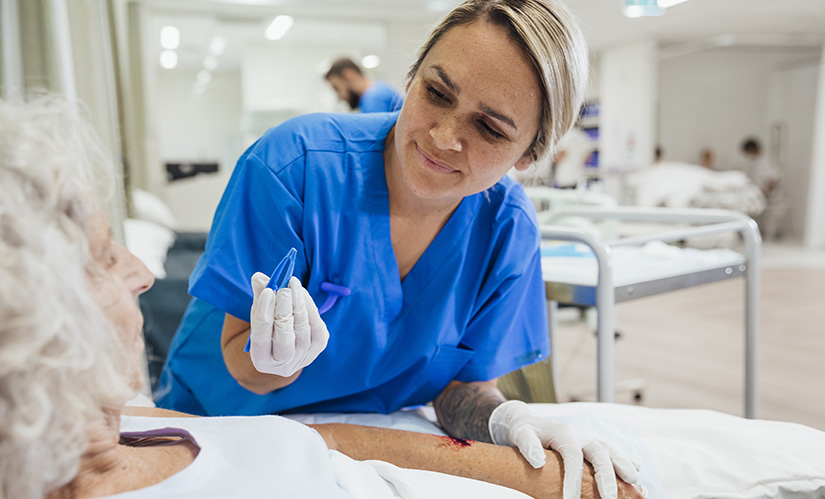
A key strength of the QUT primary care nursing program is that the nurses that teach this program are clinically current in wound care, community care and primary health nursing.
For example, Professor Jane Currie is a practising nurse practitioner in the area of homeless health and the mainstay of her role is provision of primary healthcare.
Associate Professor Christina Parker is a wound care specialist, which is a fundamental component of primary healthcare, especially in community and aged care settings.
Associate Professor Sandra Johnston is a collaborator on the Planetary Health for Nurses and Midwives group that aims to provide leadership in planetary health research and education to improve the health and wellbeing of individuals, communities and the planet.
What it’s like to study primary care: Poppy Fratzeskos
I began my career in haematology and oncology nursing at Cairns Hospital, then worked in infectious diseases, cancer care, acute medicine, and intensive care nursing at the Royal Darwin Hospital.
I am currently working in primary care nursing in rural Northern Australia, where I am able to utilise all of my skills and knowledge.
What was a highlight of your studies?
One of the most exciting and meaningful moments in the course was taking on challenging healthcare topics in Northern Australian nursing, which resulted in positive feedback from the nursing faculty.
I found it rewarding to engage my assessment pieces with real-world workplace scenarios, exploring ways to improve healthcare and medicine in resource-limited environments.
What do you enjoy about your primary care nursing role?
I enjoy my job because it allows me to practice both clinical medicine and holistic healthcare in a multidisciplinary environment. I particularly enjoy the diversity of challenges I face daily, and the opportunity to overcome them, leading to quality health outcomes for our clients.
I look forward to seeing where my nursing career takes me over the next 10 years, as primary care and critical care nursing continue to experience rapid growth in Northern Australia.

Support for students studying primary care
The Australian Government is offering a Primary Care Nursing and Midwifery Scholarship Program to help support the training of a primary care workforce.
The program will provide 2 700 scholarships over four years from 2023 to 2027. It will support nurses working or intending to work in primary health care settings including general practice, aged care, Aboriginal community-controlled health services, community health centres, and independent private practice – like mental health practices.
The goal of the program is to improve the capacity, quality, and distribution of the primary care workforce. Check your eligibility for the Primary Care Nursing and Midwifery Scholarship Program.
QUT scholarships and bursaries
QUT offers a range of scholarships and financial support to students. There are scholarships to help you return to study, and scholarships for students studying in a particular area.
Search for scholarships on the QUT website to find out what’s available.
Authors

Professor of Nursing

Associate Professor of Nursing
Director of Clinical Partnerships

Associate Professor of Nursing

Graduate Certificate in Nursing (Primary Health Care)