By Georgia Smith, 23 April, 2026
⏳ Read time: 5 minutes 30 seconds
Each semester, QUT Business School partners with an iconic organisation through the Bachelor of Business final‑year capstone unit, Real World Ready, to bring a real industry challenge directly into the classroom. The unit is a culmination of their studies, designed to bridge theory and practice, allowing students to tackle real business problems and work alongside an industry partner.
In Semester 2, 2025, we partnered with iconic Australian beverage brand Bundaberg Brewed Drinks. Bundaberg Brewed Drinks currently exports to more than 60 countries worldwide and is exploring several potential new markets being evaluated for future expansion. As the business explores the potential of expanding into another global market like Japan, they challenged our students to consider what a go-to-market approach might look like and apply their learning in a real-world context.
We spoke to Bachelor of Business/Bachelor of Laws (Honours) student Abby Gauld and Bachelor of Business student Taylor Tran about their experience and what they gained from the unit.
What is a capstone unit? A capstone unit is a mandatory unit typically taken in a student’s final year of study. It brings together the knowledge and skills developed across their degree and applies them to a real-world. |
The challenge: international expansion
Japan’s beverage market is one of the most mature and competitive in the world. In 2024, the market experienced significant growth, driven by a strong demand for unique and high-quality products.
For the purpose of this project, Bundaberg Brewed Drinks identified Japan as a hypothetical area to introduce their range of premium soft drinks to a new international audience. Their challenge to students was clear:
How can Bundaberg Brewed Drinks successfully launch and establish its brand in Japan?
Addressing the challenge
Working in multidisciplinary teams across the Bachelor of Business, QUT Business School students undertook extensive research and planning to develop a strategy.
“We had to consider Bundaberg’s unique selling points and the key barriers to entry within the Japanese market,” Abby explained.
Taylor echoed this complexity, “There were many facets to consider, including balancing their current business activities and existing models for further APAC expansion with their strong Australian heritage brand and logistical needs.”
Both students also spoke to the benefit of a multidisciplinary approach to the project.
“Although we were all studying business, our different majors brought a unique perspective and skillset that allowed us to develop and enhance our proposed strategy,” Abby told us.
For finance major Abby, she was able to bring finance and modelling skills to the table, while her peers came in with expertise in economics, accounting and management—that’s not even mentioning their assortment of double degrees.
“By intentionally leaning into each other’s strengths we produced a recommendation that was more polished, creative and realistic than anything we could have produced individually,” Abby shared.
Taylor had a similar experience. Her team included students specialising in marketing, finance and economics.
“We were able to draw on our diverse skillsets to produce a thorough and complex solution,” she shared.
For Taylor, her teammates became more than peers, “The supportive environment led to us forming friendships outside of just the unit itself, and we still keep in touch regularly.”
The solution: breaking into the Japanese beverage market
Abby’s solution: a three-phase approach
Abby’s team developed an innovative, staged approach focused on awareness, engagement and distribution.
“My team’s solution was the KEY strategy, a three-phase approach designed to unlock Japan’s critical international beverage market,” Abby explained.
“Ultimately, we proposed leveraging strategic social media marketing to drive awareness, bolstered by gamified product interactions to boost engagement, and brought to life through a multi-channel e-commerce and in-person distribution plan,” Abby said.
Taylor’s solution: a design competition
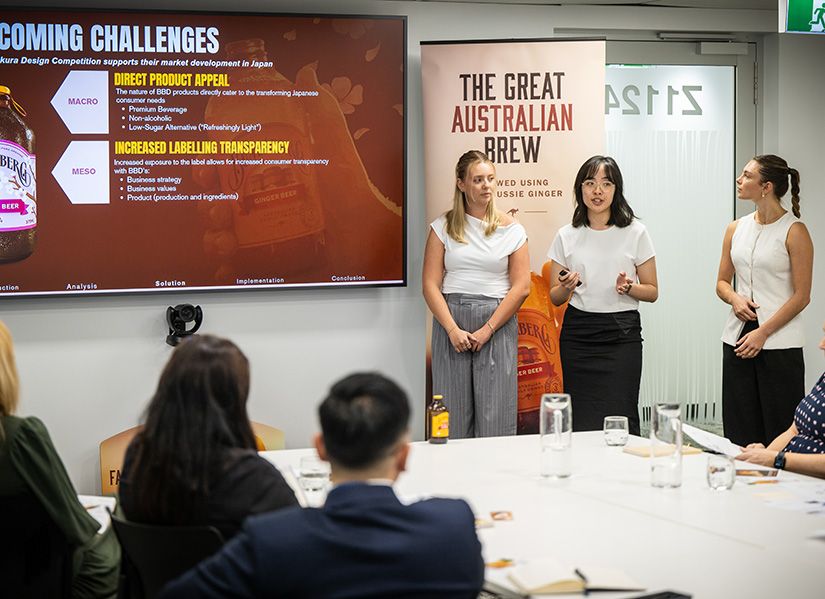
Taylor’s team took a completely different approach, focusing on creative marketing and engaging the public through a competition, ultimately building brand awareness.
“Our solution was called the ‘BBD Annual Sakura Design Competition’,” Taylor shared, “each Sakura season the Japanese public would be invited to design their very own BBD Ginger Beer Sakura bottle.”
The winning design, chosen by both Bundaberg Brewed Drinks and the public, would be produced as a limited batch of 1000 bottles available only on Japanese shelves.
“It keeps the iconic Ginger Beer as the centre of the campaign while allowing creativity and connection to flourish,” Taylor explained, “this aligned well with Bundaberg’s existing brand of family, Australian heritage and bringing people together.”
Presenting directly to Bundaberg Brewed Drinks
The top three teams were selected to present their strategies directly to some Bundaberg Brewed Drinks executives. Both Abby’s and Taylor’s teams were selected to present, providing them with an incredible opportunity to receive direct feedback from the company.
“It was surreal being selected as one of the top three teams and presenting our idea to executives and managers from Bundaberg Brewed Drinks,” Abby shared, “there was a mixture of nervousness and excitement, but also a strong sense of pride in how far we had come.”
Taylor agreed, “being selected was equally as exciting as it was nerve-wracking. It was rewarding to see that all our hard work had paid off, but pitching to a real company definitely raised the stakes.
“The opportunity to network, improve our pitching skills and get direct feedback from the BBD team was an amazing opportunity,” she said.
Abby echoed this sentiment, “Receiving feedback and industry expertise from the project partner about our strategy was invaluable, providing us with knowledge that will translate into future endeavours.”
The impact
Real-world learning is part of the fabric of QUT Business School, and the Real World Ready unit is a prime example. The unit gives students hands‑on industry experience, valuable networking opportunities and a final project that ties their whole degree together.
For Abby, the experience closely mirrored professional consulting, a career she is interested in pursuing, “collaborating with an iconic Australian brand and presenting directly to their executives was an invaluable experience that strengthened my presenting, problem-solving, time management, and teamwork skills, as well as my confidence.”
She continued, “these capabilities are critical for any future roles in consulting and business.”
For Taylor, the hands-on experience helped her contextualise the theory component of her studies and gave her real business experience in a simulated environment. She also drew so many valuable lessons from the Unit Coordinator, Dr Mazlan Maskor.
“We had a focused training session with Dr Maskor that was one of the most impactful learning experiences of the unit. He mentored us in professional communication skills, specifically how to read rooms and people, present with confidence to stakeholders and build crucial networking skills,” said Taylor.
The Bundaberg Brewed Drinks partnership highlights what sets QUT Business School apart: authentic, hands‑on learning that builds confidence, capability and connection. For students like Abby and Taylor, the Real World Ready unit didn’t just mark the end of their degree, it marked the beginning of their careers, equipping them with real experience and industry insight.
Keen to keep exploring?
- Find out more about the Bachelor of Business
- Read about our 2024 Real World Ready partnership with the Australian Grand Prix Corporation
- Discover all undergraduate business courses at QUT
- Find the right business course for you with our quiz
- Read about the international case competitions our business students participate in
Disclaimer
The project described in this article formed part of an academic capstone unit and was conducted in a simulated, hypothetical context. Any markets, strategies or go-to-market concepts referenced were developed independently by students and are illustrative only.