By Ben Ready, 4 November, 2026
From advocating for Afghan refugees to championing disability inclusion, two remarkable women are using the QUT Executive MBA to strengthen their leadership skills and drive meaningful change in their communities.
For Shazia Ahmadi and Cheryl Mangan, leadership is about more than professional success. It means creating opportunities for others, challenging inequality, and driving lasting social impact.
While their personal and professional journeys differ greatly, both share a commitment to using education as a catalyst for change. They are also part of a growing number of women investing in executive education to strengthen their leadership capabilities and expand their influence.
At Queensland University of Technology (QUT), female participation in the Executive MBA has increased by 55% over the past four years, reflecting growing demand among women seeking to advance their careers and make a difference.
Delivered part-time over 23 months, the program combines hybrid learning with monthly Friday-to-Sunday intensive weekends in Brisbane, designed to fit around executive careers.
Each intensive weekend brings together experienced professionals from sectors as varied as healthcare, agriculture, government, defence, technology, sport and the not-for-profit sector, creating an environment where ideas are challenged, assumptions are tested, and students learn as much from one another as they do from their lecturers.
The degree is already helping Shazia and Cheryl turn their ambitions into action.
Finding courage through adversity
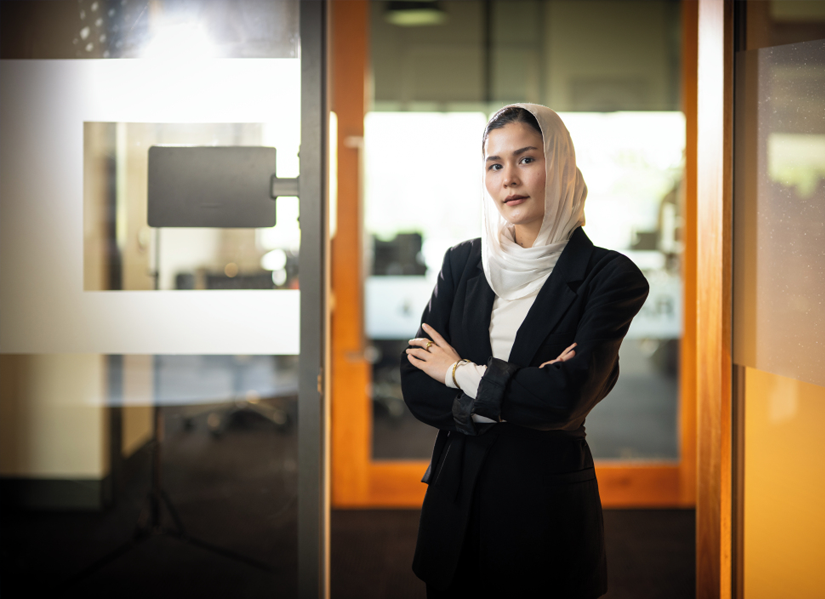
For Shazia Ahmadi, the journey to QUT’s Executive MBA began thousands of kilometres away in Afghanistan, where access to education and opportunities for women could never be taken for granted.
Shazia was studying business at the American University of Afghanistan on a fully funded scholarship when the Taliban returned to power in 2021. With students at the university facing threats because of its American connections, she and her family were forced to flee the country.
The return of the Taliban brought uncertainty, fear and profound challenges for Shazia and her family. While navigating different geographies, legal systems, and unfamiliar circumstances, she discovered a strength and resilience she had not fully recognised in herself.
“Moments of adversity can reveal strengths we never knew we had,” Shazia reflected.
These experiences shaped her determination to turn challenges into opportunities, not only for herself but also for other women facing barriers to education, independence, and a better future.
After settling in Australia, Shazia channelled that determination into creating opportunities for others. She founded Underestimated to connect refugee and migrant women with networks, resources, and opportunities. The organisation now has almost 300 members.
Having spent much of the past decade in the non-profit sector, Shazia has also transitioned into financial services. However, her ambition to support displaced women remains central to her future.
Through Underestimated, Shazia is working to ensure that refugee and migrant women are not defined by the barriers they face, but by the opportunities they can access. Its Women-for-Women community connects women across countries with mentors, practical resources, and opportunities to build their confidence and independence.
For Shazia, the next step is to turn this growing network into a more connected support system, bringing together community organisations, service providers, AI, and technology to make essential services easier to access. She hopes the Executive MBA will help her build the partnerships, business capabilities and leadership skills needed to turn this vision into a sustainable initiative with a wider impact.
She enrolled in QUT’s Executive MBA to bring together her professional experience, entrepreneurial ambitions, and commitment to social change.
“I have the knowledge, I have the experience, but I need that right ecosystem and right network to channelise those learnings and get the right support,” she said.
Shazia believes the network she is developing through the program will be particularly valuable in expanding Underestimated. Her long-term vision is to make it easier for refugees and migrants to access essential settlement services through a centralised AI embedded technology, including employment and entrepreneurship, housing, education, healthcare, and childcare.
Building leadership for greater social impact
Cheryl Mangan decided to pursue an Executive MBA after decades dedicated to improving outcomes for people with disability. Her career has taken her through frontline case management, community development, research, and policy before she progressed into senior leadership.
Now Managing Director of the Sylvia Rodger Institute, Cheryl is focused on creating equity and opportunity for autistic people and strengthening the knowledge, skills and inclusive practice that drives lasting change.

QUT Executive Executive MBA student Cheryl Mangan
Despite her extensive experience and postgraduate qualifications, she recognised that advancing into executive leadership would demand a broader set of business capabilities.
“Non-profits face the same pressures as any business, from financial sustainability to strategy and governance. I saw an Executive MBA as a vehicle to strengthen those capabilities and become a better leader, so we can make an even greater difference for the communities we serve,” she said.
She was particularly drawn to QUT’s cohort-based learning model, which brings experienced professionals from different industries together for intensive face-to-face study. Working alongside executives from construction, professional services, government, defence, and other sectors has challenged her assumptions about leadership.
“There is so much you can learn when you step outside your own field and engage with different industries, people and approaches,” she said.
Importantly, the program has helped her develop a stronger understanding of the leader she wants to become. Her ambitions extend beyond organisational performance to ensuring that people who have historically faced barriers to leadership have greater influence over the decisions affecting their lives.
Through initiatives such as the Institute’s Academy, which builds leadership and governance capabilities among autistic people, Cheryl is already helping create those pathways and opportunities.
“My commitment is wherever I go that I’ll continue to look to open doors for people with disability and other women, so they can take their rightful place as leaders in their organisations and communities” she said.
Supporting the next generation of female leaders
While Shazia and Cheryl have followed different paths, both recognise the importance of education, professional networks and mentorship in creating opportunities and driving meaningful change.
Both are recipients of QUT’s Women in Leadership Excellence Scholarship, supported by UN Women Australia, which helps women pursue executive education and strengthen their leadership potential.
For Cheryl, the scholarship made pursuing an Executive MBA possible. For Shazia, it represents a particularly meaningful opportunity after her education was disrupted by the Taliban’s return to power in Afghanistan.
Their experiences highlight how executive education can empower women to not only strengthen their own leadership capabilities, but also create opportunities for others and drive lasting impact in their communities.
Applications for the Women in Leadership Excellence Scholarship close 11.59pm Sunday 22 November, 2026. Learn more about the scholarship, eligibility criteria and how to apply on QUT’s Executive MBA scholarships page.
Ready to take the next step in your leadership journey?
Applications are now open for QUT’s Executive MBA January intake. Learn more and apply today.
This article is republished from MBA News. Read the original article here.
Author

Ben Ready founded MBA News in 2014 and is the Managing Editor. He is a former business and finance journalist with Australian Associated Press (AAP) and Dow Jones Newswires in London. Ben completed his MBA in 2012 and was awarded the QUT GMAA Entrepreneurship Prize. He is also the founder and Managing Director of RGC Media & Mktng (rgcmm.com.au).