First published 22 May 2025
There will be times in all our lives when we need somebody to lean on – and never more so than when grieving the loss of a loved one.
But finding a shoulder to cry on, a comforting voice or supportive ear to listen is not always possible, particularly in the middle of the night as an older person living alone.
Enter the concept for Grief Guide, Your 3AM Friend – an AI-driven app designed by a team headed by QUT Professor of Design Psychology, Evonne Miller.
Grief Guide leverages AI technology to engage users in therapeutic ‘conversations’ featuring personalised advice, advanced algorithms and natural language processing to create real-time, empathetic interactions.
Prof Miller said those dealing with grief will often want, and need, support at times when they do not have access to “traditional” means.
“It is unlikely a professional therapist will be taking your call at 3am - to talk, listen, advise and help you practise conversations,” she said.
“You wake up in the early hours of the morning, worrying and grieving - and you can't always ring your friends. This app can be there for you in the middle of the night - when you're awake and you're grieving.”
The QUT-led project is a step closer to reality, courtesy of a $260,000 grant from the Wicking Trust. It is one of two QUT research initiatives included in the latest round of funding, along with a resource hub covering end-of-life care options and regulations.
Prof Miller said the Wicking Trust funding would take Grief Guide from prototype stage to “actually being delivered to the people who need it”.
When a close work friend lost a husband to a heart attack, Professor Miller realised there was a critical gap in support options.
While not intending to replace professional therapy the Grief Guide app can provide immediate, compassionate and judgment-free support when traditional resources are unavailable.
It has been designed with a choice of customised avatars and tone to suit the use’s personality. Along with advice, it will also be a valuable support mechanism for practising emotive conversations - such as the first time the user has to tell another person that someone they love is dying or sick.
“It’s a bit like chat GPT but personalised and more attractive to use,” Prof Miller said.
“Australians typically don’t want to talk about death, and yet, when someone dies – that is all you want to talk about.
“Grief Guide provides a safe space for users to process their emotions.
“It can assist with funeral planning and legal matters, directing users to the right resources. And it supports users in re-imagining life after loss, helping them to adjust to new routines such as cooking for one, and offering guidance on moving forward while honouring their loved one’s memory.”
Backed by funds raised from QUT Industry Engagement and in collaboration with People Tech Revolution, the QUT team has developed a prototype, co-designing and testing in collaboration with palliative care and ageing experts, including Palliative Care Queensland, Council on the Ageing Queensland, the Good Death Impact Network, and Death Literacy Network.
Long term, the aim is for the app to be free and widely accessible, with the team also applying for a million-dollar Google accelerator grant.
“We see Grief Guide as being the first of many AI companions the team could develop to assist people through challenging phases of life,” Prof Miller said.
The QUT team collectively has research expertise and skills in co-design and psychology, death literacy and palliative care nursing, tech development, visual communication, and neuroscience.
It includes QUT academic staff Prof Glenda Caldwell, Prof Natalie Bradford, Prof Lisa Scharoun, Dr Heather McKinnon, Prof Selena Bartlett and Prof Sarah Holland-Batt, Holli Evans from QUT Industry Engagement and People Tech Revolution’s Simon Lowe and Leonie Sanderson.
- The funding from the J.O. & J.R. Wicking Trust, managed by Equity Trustees, is part of a $7m national round of grants to improve the experience of ageing, death and grieving, particularly for older Australians and their families.
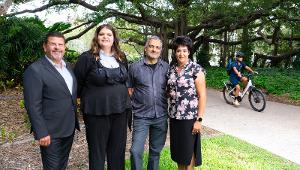
Main image (from left): Lisa Scharoun, Natalie Bradford, Evonne Miller, Glenda Caldwell and Heather McKinnon.