Skip to content
QUT
QUT - the university for the real world
  • Login
  • Contact QUTContact QUT
Study
Undergraduate
  • Architecture and built environment
  • Arts
  • Business
  • Communication
  • Creative arts
  • Design
  • Engineering
  • Diplomas and pathway programs
  • Health
  • Information technology and games
  • Justice
  • Languages
  • Law
  • Mathematics and data science
  • Science
  • Teaching
  • Mid-year entry
  • QUT College
  • New to QUT
  • Why choose QUT
  • Double degrees
  • Vertical degrees
  • Flexible study
  • Applying guide
  • Bridging programs
  • Fees, costs and scholarships
  • Relocating to Brisbane
  • Student life
  • Events
Postgraduate
  • Architecture
  • Business
  • Communication
  • Design
  • Education
  • Engineering
  • Health
  • Information technology and games
  • Justice
  • Languages
  • Law
  • Mathematics and data science
  • Project management
  • Science
  • Doctor of Philosophy
  • Master of Philosophy
  • Professional doctorate
  • Why choose QUT
  • Fast track to postgraduate
  • Scholarships
  • Applying guide
  • Flexible study options
  • Student life
  • Events
  • QUT Leadership Institute
Online study

Our collection of courses are taught entirely online, giving you the flexibility to study anywhere, anytime.

  • Our online undergraduate degrees
  • Our online postgraduate degrees

Browse by study area

  • Business
  • Creative industries
  • Digital capability
  • Education
  • Engineering
  • Health
  • Justice
  • Languages
  • Law
  • Leadership
  • Science
  • Transformation

Based on your professional level and experience, combined with your individual needs and motivations, there are several different study formats for you to choose from to help you achieve your career goals.

  • Learner’s Guide
International
students
  • Architecture and built environment
  • Arts
  • Business
  • Communication
  • Creative arts
  • Design
  • Engineering
  • English language and pathway programs
  • Health
  • Information technology and games
  • Justice
  • Languages
  • Law
  • Mathematics and data science
  • Project management
  • Science
  • Teaching and education
  • Student life
  • Student support
  • QUT in your country
  • Why choose QUT
  • Living in Brisbane
  • Scholarships
  • QUT College
  • Applying guide
  • Study abroad
  • Events
  • Ask us a question
  • Agent resources
Short courses and professional education

Bringing together knowledge from across the whole university to help you or your organisation getfuture fit, fast.

  • More about us
  • Contact us

Improve your performance, advance your career or make a change with real world short courses.

  • Browse all courses

Take your development further with advanced learning and award pathways.

  • Pathways to Politics for Women
  • Public Sector Management
  • Enterprise Leadership

Achieve exceptional business outcomes with co-designed executive education.

  • Tailored executive education
  • Corporate Bundles
Match My Skills

Create a personalised guide to reaching your dream career by taking our Match My Skills quiz.

Research
Why QUT
  • Our research vision
  • Equity and diversity
  • Support for researchers
  • Meet our experts
  • Ethics and integrity
  • Research jobs at QUT
  • Bioinnovation Research Facility
  • Central Analytical Research Facility
  • Design and Fabrication Research Facility
  • Digital Observatory
  • eResearch
  • Medical Engineering Research Facility
  • Research Engineering Facility
  • Samford Ecological Research Facility
  • VISER
  • Advanced Robotics for Manufacturing Hub
  • Herston Imaging Research Facility
  • Translational Cell Imaging Queensland
  • Translational Research Institute
Our research
  • Architecture and built environment
  • Business and law
  • Creative industries, education and social justice
  • Engineering
  • Health
  • Science
  • Browse all our projects
  • Explore open research projects

    Get involved with research projects that tackle real-world challenges.

We're invested in research identified as priorities for the world, the nation and the state.

  • Our strengths
  • Indigenous research
  • Sustainability
  • Research initiatives

See the stories behind QUT research. Read in-depth features and commentary about innovations that are shaping the world.

  • Read Real Focus
Study with us
  • Doctor of Philosophy

    Make a significant contribution to new knowledge in your field.

  • Master of Philosophy

    An ideal stepping-stone to a PhD.

  • Professional doctorate

    Integrate a research degree into your professional goals.

  • Find a supervisor
  • Find a research topic
  • Scholarships (Australian and New Zealand students)
  • Scholarships (international students)
  • Tuition and study costs
  • Supporting your research journey
  • Applying guide
  • e-Grad School
Partner with us
  • Our experts

    Search for a research supervisor, industry expert or collaborator.

  • Research jobs at QUT

    Integrate a research degree into your professional goals.

  • Engage with our graduate researchers

    Work with graduate researchers to help solve your real-world problems.

  • Research initiatives

    Learn about QUT’s involvement in collaborative research initiatives.

  • Plant genomics
  • Australian Centre for Health Law Research
  • Biorefineries for profit
  • CARRS-Q
  • PRIME Futures
Join a research study

Help our researchers develop solutions for real-world challenges by participating in research.

Engage
Industry and partnerships
  • Employment and mentorship

    Find graduate and student talent to employ, or mentor our students.

  • Work placements

    Partner with us to offer work experience opportunities to our students.

  • Sponsor scholarships and events

    Make a difference to students and the university.

  • Queensland Rugby Union partnership

    Learn more about our role as the Queensland Reds Education Partner.

  • Olympic and Paralympic Games 2032

    A once-in-a-lifetime opportunity to showcase SEQ's strengths to the world.

  • Research partnerships

    Start a collaborative research partnership with our experts.

  • Expertise for industry

    We can help with more than research. See how we can support your business.

  • Customised executive education

    Customised professional development solutions for your team.

  • Short courses and professional development

    Study a short course for personal or professional development.

  • QUT Leadership Institute
Giving
  • Ways to give

    Discover the different options to donate to QUT.

  • Donor impact

    Whether you've chosen to support students in need through a scholarship fund, want to help advance a vital research project, or give to build a stronger community program, your gift is making a real difference.

  • Support students

    Give the life-changing gift of education by contributing to a scholarship.

  • Support research

    Help shape a better world by giving to a research project.

  • Support community

    Elevate society by supporting community programs that foster meaningful connections.

Alumni
  • New graduates
  • Get involved
  • Grow your knowledge
  • Connect and engage at events
  • Industry-leading alumni
  • Indigenous Australian alumni
  • Alumni tools and FAQs
  • Discounts and offers
  • Alumni newsletter
Meet our outstanding alumni

See the diverse achievements and impact of alumni who are leaders in their professions and communities.

About QUT
Discover QUT
  • Our university

    Learn more about our history, campuses and facilities, leadership team, organisational structure, and governance and policies.

  • Faculties and schools

    Explore our faculties and schools and the real-world learning experiences and research they are engaged in.

  • Strategy

    Connections - the QUT Strategy 2023 to 2027sets out our shared purpose for the future of the university: to provide transformative education, student experiences and research relevant to our community

  • Indigenous Australians

    We're embedding Indigenous Australian cultures, knowledges and perspectives across everything we do.

  • Priorities

    We are working to improve our society and environment through our commitment to equity, diversity, inclusion, creativity, sustainability and improving health and wellbeing.

  • Achievements and recognition

    As one of Australia's leading universities, we are internationally recognised through rankings, and we are committed to celebrating staff and student successes.

  • Working at QUT

    Find job opportunities and learn more about working at QUT.

Campuses and
venues
  • Maps and getting here
  • Around campus
  • Libraries and learning spaces
  • Gym and sports facilities
  • Food and retail
  • Maps and getting here
  • Around campus
  • Libraries and learning spaces
  • Gym and sports facilities
  • Food and retail
  • QUT Art Museum
  • William Robinson Gallery
  • Science and Engineering Centre
  • The Cube
  • Old Government House
  • Gardens Theatre
  • Education Precinct
  • Creative Industries Precinct
  • Virtual tours
  • Science in 360°
  • Virtual reality projects
  • Street art on campus
News and events
  • All QUT news
  • Business
  • Creative industries
  • Education
  • Engineering
  • Health
  • Law
  • Science
  • Justice
  • Real Focus
  • Alumni
  • All QUT events
  • Alumni
  • Business
  • International
  • Staff profiles
  • Email: media@qut.edu.au
  • Phone: + 61 7 3138 2361
Take a tour

Explore the campus with 360⁰ videos and 3D tours of our facilities.

QUT Online
Match My Skills

Find your future with QUT's Match My Skills quiz. Create a personalised guide to reaching your dream career. It takes just 10 minutes.

Australia and NZ

News

  1. Home
  2. Study
  3. News
First published 23 April 2024

QUT researchers have developed a robot to count and capture images of baby tank-grown corals destined for the Great Barrier Reef.

The system will help keep the corals happy and healthy before they are deployed and save researchers thousands of hours of coral counting time.

Associate Investigator at the QUT Centre for Robotics and Research Fellow for the QUT School of Electrical Engineering and Robotics, Dr Dorian Tsai said the Coral Growout Robotic Assessment System (CGRAS) project was a collaboration involving the Australian Institute for Marine Science (AIMS), Reef Restoration & Adaptation Program (RRAP), and the QUT Research Engineering Facilities (REF) team. 

“AIMS researchers have knowledge of the biological processes involved and will be the eventual operators of the technology that we develop here in the CGRAS project,” Dr Tsai said. 

“One of the main interventions for RRAP is about developing mass coral aquaculture for coral conservation, adaptation and restoration.” 

Dr Tsai said most other coral restoration techniques were primarily focused on fragmenting existing corals - a technique known as coral fragmentation.

“This method is typically limited to approximately 50 fragmented corals per origin or donor colony, which has limited scalability,” Dr Tsai said. 

“We’re aiming to mass-reproduce corals via sexual reproduction, where parent colonies can produce over a million corals each, which allows us to ensure the corals can diversify and adapt to changing environments and has much better scalability.
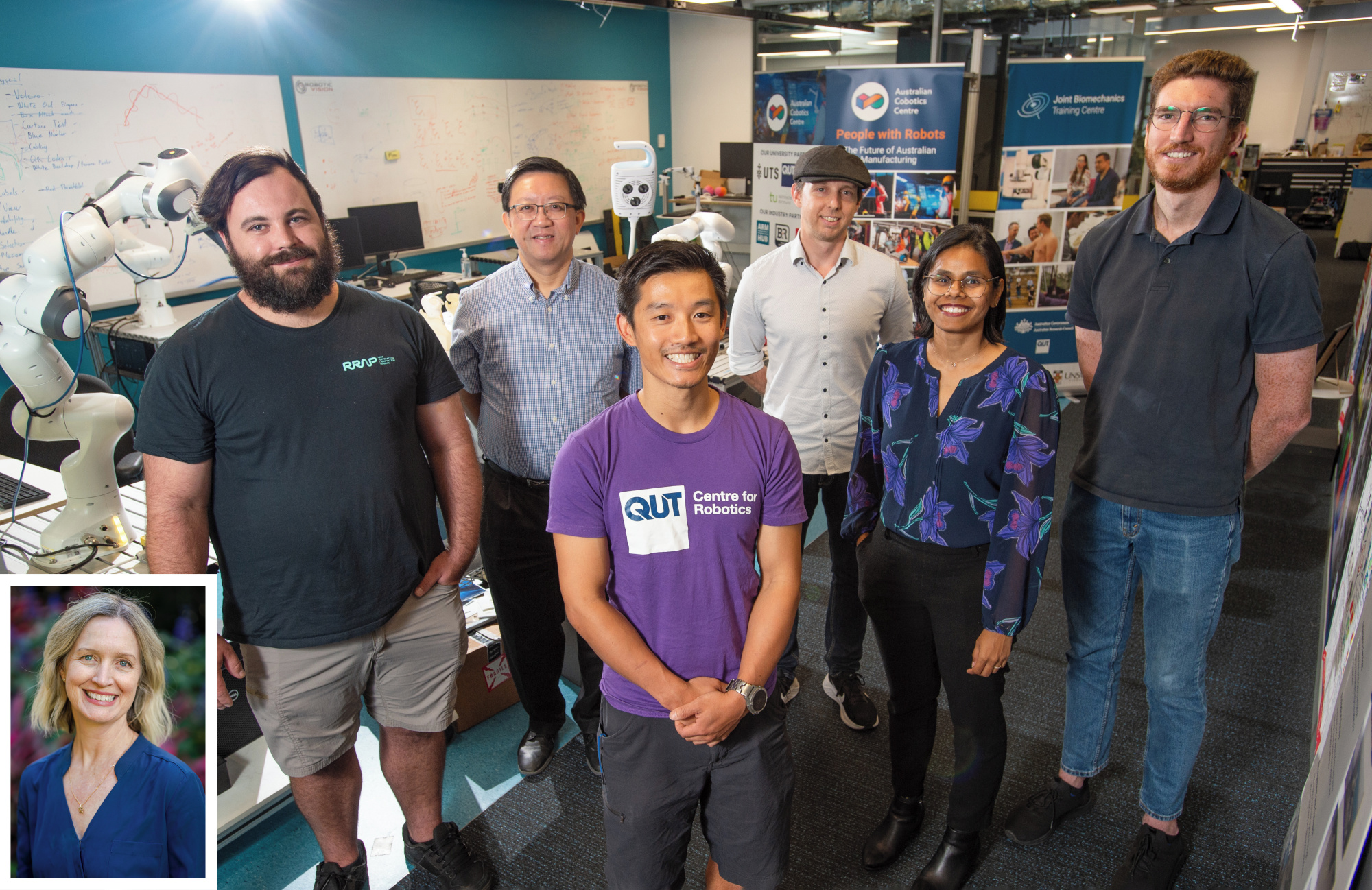
The QUT CGRAS team (from left) Karen Jackel, Riki Lamont, Dr Andrew Lui, Dr Dorian Tsai, Timothy Morris, Garima Samvedi and Joshua Esplin.

“The difficulty is that we have to then be able to grow and monitor these baby corals in order to keep the corals happy and healthy, which CGRAS aims to solve. 

“The challenge is that when we are growing corals en masse during their growout phase inside tanks on flat tiles, the corals are tiny, about 1mm in diameter.

“There are hundreds of thousands of these corals, and it takes on average 45 minutes for a trained expert to count a single coral tile, which is 28x28cm square. Eventually there will be over 9600 such tiles.” 

Dr Tsai said that would amount to over 7200 hours of coral counting time per week, which would be highly repetitive and completely infeasible to complete manually. 

“To do it manually, this would end up costing around $500k per week in labour, which amounts to easily $6 million/year over a 12-week growout period for just counting corals,” Dr Tsai said. 

“That's why we've developed a robot prototype to capture images of the baby corals in the tanks as they are growing in a repeatable, precise and flexible manner. 

“We're also leveraging state-of-the-art artificial intelligence algorithms to automatically detect and count these coral babies and track their growth over time. 

“This will allow scientists to have a much clearer correlation analysis between their treatment strategies and coral growth, leading to higher coral survival rates, which is higher coral yield, which will allow RRAP to reach their large-scale deployment scenarios of over a million corals out to the Great Barrier Reef each year.”

Dr Tsai is assisting a QUT research team that includes Senior Project Specialist in Industry Development, Karen Jackel, Research Engineering Facilities (REF) Team Principal Engineer Garima Samvedi, REF Senior Research Engineer, Riki Lamont, REF Senior Research Engineer, Timothy Morris, REF Senior Research Engineer, Dr Andrew Lui, and REF Research Engineer, Joshua Esplin. 


Dr Tsai said he was excited about the robot’s potential to restore reefs damaged by rising sea temperatures.

Ms Jackel said mass coral bleaching events had occurred more regularly.

“That is why we are trying to grow coral that will adapt and be more resilient to climate change,” Ms Jackel said. 

Dr Tsai said there was currently a bottleneck in the overall process because it was done manually, and that is what CGRAS aimed to resolve. 

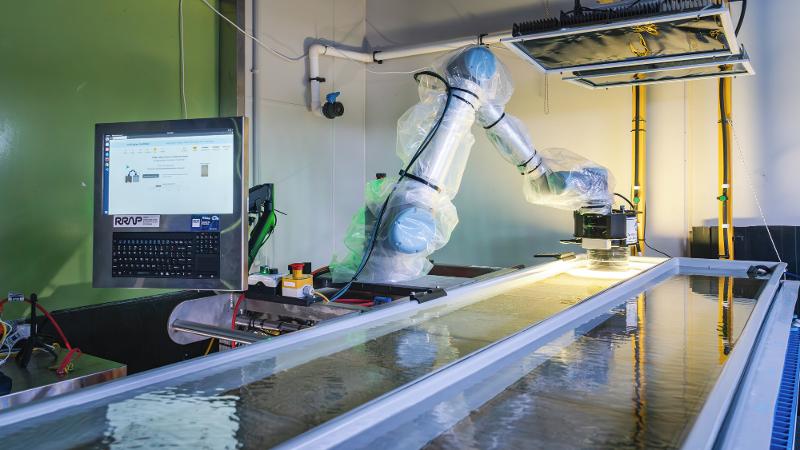
Mr Lamont said the current design of the robot prototype (pictured above) housed a high-resolution submersible camera with a macroscopic lens - basically a waterproof microscope - mounted at the end of a robotic arm. 

“The arm is wrapped up to prevent corrosion in the salt-water environment that is the aquaculture facility,” Mr Lamont said.

“The whole thing is mounted atop a mobile platform that moves manually and houses all of the computers.”  

Dr Tsai said although an ideal approach could be to build a fully autonomous robot that could drive itself through the aquaculture facility, that was not a cost-effective or necessary solution. 

“Moving the robot manually between tanks only costs a fraction of the time compared to imaging, interpreting the images and counting the corals,” Dr Tsai said. 

“Furthermore, the costs, challenges and risks of a fully-automated system for a still-developing coral conservation process are orders of magnitude more expensive than we currently have budget for. 

Spawning corals in a tank.

“Instead, we aim to hit the sweet spot of what is achievable with a compliment of robotics and humans together to maximise operational and developmental costs for coral yield. 

“By doing this, we can bring the camera to the corals repeatedly and accurately. 

“The design is a prototype to capture images and serve as a tool for developing the software pipeline.” 

Dr Tsai said the final design of the robot could look significantly different.

“But for now our current design allows us to move forward with development as the scientists and researchers continue to develop and uncover the underlying biological process of mass coral aquaculture,”Dr Tsai said. 

Dr Tsai said this program was different from the Coral Spawn and Larvae Imaging Camera Systems (CSLICS) or "nanny-cams" project. 

“That system was for the coral spawn when they were still eggs and embryos developing into coral larvae,” Dr Tsai said. 

“This CGRAS project focuses on a later stage in coral development, where the coral larvae have settled onto the bottom and have started to grow into coral polyps.” 

Dr Tsai said CGRAS was actively deployed in the National Sea Simulator (SeaSim) at AIMS near Townsville early this year, and its next iteration will be deployed for the next coral spawning in December 2025. 

AIMS Research Program Director of Reef Recovery, Adaptation and Restoration, Dr Line Bay said AIMS scientists are developing methods to assist the Great Barrier Reef better cope with the effects of climate change.

“Projects like CGRAS are essential parts of the technology toolkit needed to deliver scale in this work,” Dr Bay said.

“We clearly need strong emissions reduction to provide the best future for coral reefs. But with a fifth mass coral bleaching event since 2016 unfolding on the Reef research into restoration and adaptation is also important.

“Projects like this will turbo-charge R&D into conservation aquaculture methods that aim to help the Reef cope with increasing temperatures.”

More info on QUT Reef restoration and adaptation projects here

More info on the Reef Restoration and Adaptation Program (RRAP) here

Media contact: 

Pat Whyte, QUT Media, 07 3138 1150, media@qut.edu.au 

After hours: 0407 585 901   

Share on Facebook Share on X Email Share on Reddit Share on LinkedIn
Study Research Engage About QUT
  • Undergraduate study
  • Postgraduate study
  • PhDs and research degrees
  • Professional and executive education
  • International students
  • Study abroad and exchange
  • QUT College
  • Graduate success
  • Applying
  • Fees
  • Scholarships
  • Key dates
Whatever you want to study, our range of courses will give you the hands-on learning, industry connections and real-world perspective you’ll need to succeed.
Explore study at QUT
  • Why QUT?
  • Our research
  • Our experts
  • World-class facilities
  • Study with us
  • How to apply
  • Master of philosophy
  • PhD
  • Professional doctorate
  • Partner with us
  • Research jobs
Join us at the forefront of research and development. Access cutting-edge facilities and technology, work with world-renowned experts, and create real-world change.
Explore research at QUT
  • Industry and partnerships
  • Work with our students
  • Expertise for industry
  • Executive education
  • Give to QUT
  • Make a real impact
  • Ways to give
  • Alumni
  • Alumni benefits
  • Update alumni details
  • Alumni tools and resources
Connect with us and see how we can support you. We invite industry partners, alumni and our valued donors to join the vibrant, exciting QUT community.
Explore ways to engage with QUT
  • Our university
  • Our people
  • Achievements and recognition
  • Campuses and venues
  • News
  • Events
  • Jobs
  • Library
Learn what makes Queensland University of Technology (QUT) the university for the real world. Read about our goals for future growth, achievements and success, and the organisational structures that support us.
Explore QUT
QUT acknowledges the Traditional Owners of the lands where QUT now stands.
  • Login
  • Legal
  • Privacy
  • QUT on Facebook
  • QUT on Instagram
  • The QUTube
  • QUT on LinkedIn
  • QUT on TikTok
Our social media
Contact QUT
  • TEQSA Provider ID: PRV12079 (Australian University)
  • CRICOS No. 00213J
  • ABN: 83 791 724 622
  • Page updated: 15 April 2024

Book an appointment