About us
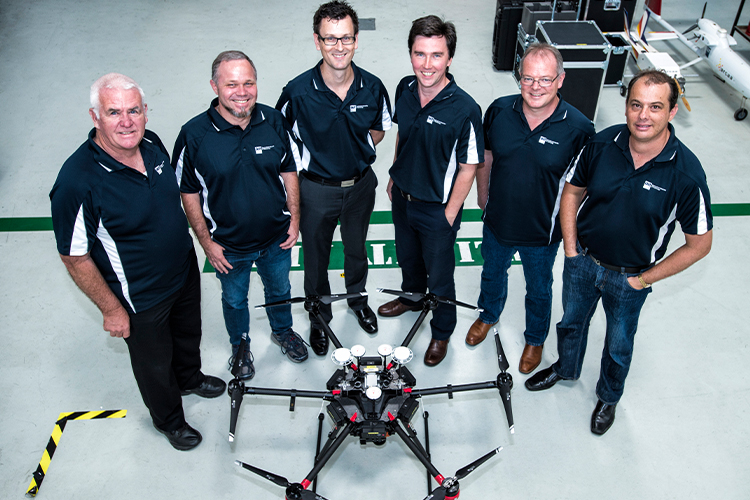
The Research Engineering Facility (REF) is a specialist engineering capability that supports applied research, technology development and industry engagement across domains such as robotics and autonomous systems, drones and remote sensing, and pilot scale engineering facilities.
REF’s focus is to provide cross-organisational research engineering services such as design, systems integration, and data collection and processing.
The team consists of:
- robotics and autonomous systems engineers
- AI and software engineers
- aviation specialists
- geospatial data analysts
- workshop, mechanical and electronics technologists
- project managers
- operations managers and specialists
They are complemented by supporting world-class infrastructure assets, including the Banyo Pilot Plant Precinct and the Yandiwanba Space Technology Precinct.
Services and equipment
We provide consulting and contract development services for academic, industry and government clients in a range of areas:
- experimental hardware design and fabrication
- systems integration
- mechatronic and software engineering
- data capture, post-processing, data management and analysis
- proof of concept validation and testing.
Capabilities
We provide consulting and contract development services for academic, industry and government clients in a range of areas.
Drones and aviation
REF’s RPAS and Remote Sensing Group provides advanced drone, aviation and remote sensing capabilities to support research, innovation and industry engagement. Operating from the Yandiwanba Space Technology Precinct, our CASA-certified flight operations team maintains an extensive fleet of remotely piloted aircraft systems (RPAS), advanced remote sensing instruments and supporting engineering infrastructure. We provide custom platform integration, specialised payload development, data acquisition and geospatial analytics to meet the unique requirements of research and industry projects.
Our multidisciplinary team includes remote sensing specialists, drone pilots, geospatial analysts, engineers, technologists and project managers who work collaboratively to deliver end-to-end solutions. From experimental design and sensor integration through to field operations, data processing and visualisation, we help researchers and partners achieve impactful outcomes through safe, compliant and efficient workflows.
For Researchers
REF enables researchers to access world-class drone and remote sensing capabilities without the need to develop and maintain their own operational platforms. Our team supports a broad range of research activities, including environmental monitoring, ecology, agriculture, infrastructure assessment, disaster management, mining, geoscience, aerospace and autonomous systems research.
Researchers can leverage our extensive fleet of aerial platforms and integrated sensing technologies, including LiDAR, hyperspectral, multispectral, thermal and high-resolution imaging systems. We provide support for data collection, geospatial analysis, digital twin development, AI-enabled workflows and advanced visualisation. Whether mapping coastal ecosystems, monitoring vegetation health, assessing infrastructure, characterising bushfire impacts or developing next-generation autonomous systems, our team can tailor a solution to support your research objectives.
For Industry and Government
REF partners with industry and government organisations to deliver innovative drone and remote sensing solutions for real-world challenges. Our team provides consulting, project delivery and contract research services across sectors including resources, agriculture, environmental management, infrastructure, transport, energy, defence and space.
As a CASA-certified RPAS operator, we conduct drone operations across Australia and can support specialised missions including sensor integration, advanced aerial data capture, geospatial analytics and technology validation. Our experienced pilots, engineers and analysts combine operational expertise with research excellence to deliver reliable, high-quality outcomes. We operate under rigorous safety, quality assurance and regulatory compliance frameworks, giving partners confidence that projects are conducted professionally and safely.
Through access to world-class facilities, engineering expertise and cutting-edge sensing technologies, QUT helps industry and government partners accelerate innovation, reduce risk and unlock new opportunities through the use of advanced aerial systems and data-driven decision making.
Robotics and autonomous systems
REF’s Robotics and Autonomous Systems Group (RASG) provides advanced robotics, autonomous systems and artificial intelligence capabilities to support research, technology development and industry innovation. RASG combines expertise in robotics engineering, mechatronics, software development, machine learning, computer vision and systems integration to transform research concepts into reliable, deployable systems that deliver real-world impact.
RASG supports the full technology development lifecycle, from concept design and prototyping through to field deployment, testing and operational support. Our multidisciplinary team of engineers and technologists works across autonomous platforms, robotic manipulators, intelligent sensing systems and AI-enabled applications, helping researchers and industry partners address complex technical challenges through rigorous engineering and scientific practices.
Our capabilities span robotic arms and collaborative robots, autonomous ground vehicles, machine learning and computer vision systems, simulation and digital environments, embedded systems, software engineering and bespoke mechatronic systems integration. We maintain a diverse portfolio of robotic platforms and enabling technologies to support a broad range of research and commercial applications.
For Researchers
RASG enables researchers to access specialist engineering expertise and advanced robotic platforms without the need to build and maintain those capabilities themselves. Our team works collaboratively with researchers to translate innovative concepts into robust experimental systems and operational prototypes, accelerating research outcomes while reducing technical risk.
Researchers can leverage RASG expertise across fields including robotics, automation, artificial intelligence, manufacturing, agriculture, environmental monitoring, logistics, mining, space technologies, healthcare and human-robot interaction. The team supports the design and integration of custom robotic systems, development of autonomous behaviours, machine learning model deployment, perception systems, simulation environments and data acquisition frameworks.
Whether developing autonomous field robots, designing robotic manipulation systems, creating digital twins, validating AI algorithms, integrating advanced sensors, or transitioning research prototypes into deployable systems, RASG provides the engineering capability required to move research beyond proof-of-concept and into real-world application.
For Industry and Government
RASG partners with industry and government organisations to develop, validate and deploy advanced automation and autonomous technologies that solve practical operational challenges. By combining research expertise with professional engineering practices, RASG helps organisations reduce technology adoption risk and accelerate innovation outcomes.
Our team provides consulting, contract research and technology development services across areas such as robotic automation, autonomous vehicles, intelligent sensing, computer vision, machine learning, industrial inspection, decision support systems and complex software development. We are experienced in integrating commercial and custom hardware, developing bespoke control systems and delivering field-ready robotic solutions capable of operating in demanding environments.
With expertise spanning system architecture, mechatronics, software engineering, machine learning and systems integration, RASG helps partners transform emerging technologies into operational capabilities. Through access to world-class research infrastructure, specialised engineering expertise and a strong focus on real-world deployment, we support industry and government organisations to improve productivity, enhance safety and unlock new opportunities through intelligent automation and autonomous systems.
Overview
We have access to purpose-built facilities and provide a wide range of energy and electrical systems testing and production services including: lithium-ion battery production with dedicated dry-rooms experimental testing and qualification of power systems energy testing of both high- and low-voltage devices characterisation of superconducting materials.
Details
Power and energy engineering
We perform testing of high-temperature superconducting (HTS) machines for maritime propulsion, power equipment and defence applications and advanced electric power system technology testing of both high- and low-voltage devices.
Lithium-ion battery fabrication
We established Australia’s first pilot plant facility producing commercial graded lithium-ion batteries. Our facility enables rapid prototyping of new battery formulations and cell types to improve the production and characteristics of lithium-ion batteries used in a wide range of applications.
Electrical and instrumentation workshop
Our team has access to assembly facilities for small Arduino projects including printed circuit board (PCB) design and construction. We enable data acquisition and instrumentation with a range of load cells, displacement sensors, laser and gauges.
Design and systems integration
Our team designs and produces custom solutions for niche applications, data acquisition and sensor integration across a variety of platforms.
Overview
We design and manufacture custom engineering solutions for niche applications for research, government and industry. With the ability to integrate a multitude of sensors to airborne and ground vehicles, we enable researchers to acquire data in ways not previously possible.
Our expertise in sensor and collection technologies allows us to extract the best performance from the systems we create. Our focus on ease of use and durability is key to achieving success in demanding environments. We take a holistic approach to how the systems operate out in the field to achieve the best result for our partners.
The team maintains compliance with regulatory authorities such as the Civil Aviation Safety Authority (CASA) for our airborne sensor integrations.
Structural engineering and testing
We have a scientific and industrial lab for heavy mechanical and structural testing, including high temperature and flame conditioning.
Overview
We have the space, equipment and technical expertise to support large specimen handling, manufacture and destructive testing of built environment structures, from individual components through to building systems.
Our capabilities include a strong floor and heavy steel framing, large capacity hydraulic actuators, instrumentation, and technical expertise to design, modify and fabricate custom test rigs and experimental setups.
Spaces and equipment
Our facility provides many testing spaces suitable for mechanical and structural engineering testing.
- Flexible test areas including:
- field sample preparation laboratory supporting materials science activities including surface analysis, thermal conductivity testing and precision sample preparation
- Civil engineering areas including:
- fire and wind testing for light steel structures (working with the QUT Wind and Fire Engineering Laboratory)
- timber testing
- concrete testing
We have access to a wide range of equipment to enable mechanical and structural engineering testing including:
- 5t gantry crane
- 2.5t forklift
- 100m2 of strong floor with testing capacity up to 500kN
- six-burner gas furnace that can deliver up to 1000°C.
Data acquisition and management
We provide a broad range of instrumentation and data acquisition capability to support experimental testing, including:
- load cells from 3 kN to 3 MN
- digital indicators with 10 µm precision
- laser sensors
- linear variable differential transformers
- thermocouples
- accelerometers
- vibration sensors
- LabVIEW and LabJack data acquisition systems.
Testing capabilities and equipment
- Four point bending testing
- Test loads from 1 kN to 3900 kN
- Gas and electrical furnaces
- Tensile coupon testing
- Custom designed and fabricated test rigs
Locations
We have access to a range of infrastructure and equipment to support research, teaching and learning and enable real-world results.
Our expertise encompasses the latest in digital technologies, to industrial engineering and scientific analysis.
Overview
The Banyo Pilot Plant Precinct (Banyo PPP) is a versatile pilot plant that supports large-scale or scaled-up research in traditional engineering disciplines, including structural, mechanical, and electrical engineering, as well as scientific applications and product testing, development and validation. The facility supports scaled research and development across traditional engineering, industrial biotechnology, energy storage, and broader scientific applications, including testing and validation activities.
The site comprises:
- Sheds 1 and 2, located on Lot 7, with areas of 1,500 m² and 1,000 m² respectively, equipped with specialised laboratories, workshops, and engineering infrastructure.
- Shed 3, located on Lot 6, with an area of 1,000 m², also fitted with specialised laboratories, workshops, and engineering infrastructure.
- Office space totalling 500 m², including hot desks, a meeting room, a conference room, and a technical library.
- An uncovered hard stand area of approximately 2,000 m².
The facility is designed to accommodate large scale, heavy engineering equipment, as well as small to medium pilot scale equipment with footprints of up to 200 m².
Research
Research projects include the development of pilot equipment and processes for industry partners as well as long-term monitoring of industrial products. The broad areas of research conducted at Banyo are:
- Mechanical and manufacturing engineering.
- Civil and structural engineering, including geotechnical and fire engineering.
- Energy storage research, including fundamental research, testing and qualification services in battery materials and systems across the entire battery value chain.
- Environmental and ecological materials processing
- Biofuels and bio-commodity production.
- Sugar research including biomass processing and instrument development.
Our state-of-the-art pilot plant allows for a range of research and discovery.
| Capability | Description |
|---|---|
| Structural testing | Supports large scale mechanical and structural testing, including custom test configurations, high temperature and flame conditioning. Capabilities include a strong floor, heavy steel framing, hydraulic loading systems, instrumentation, heavy lifting and the design and modification of custom test rigs. |
| Geological sample preparation and analysis | A dedicated geological preparation area supporting rock cutting and crushing, core preparation and logging, thin section preparation, soil analysis and preparation of geological samples for research and testing. |
| Data acquisition | Supports the development and operation of data acquisition systems, including LabVIEW and LabJack data logging, sensor selection and integration, instrumentation and custom data acquisition interfaces for research testing. |
| Mechanical workshop | Provides machining, fitting, fabrication and assembly capability to support research projects, including the design, manufacture and modification of custom test rigs, experimental equipment and components. Workshop capability includes machining, welding, hydraulic systems and practical experimental setup support. |
| Electrical workshop | Provides electrical, instrumentation and control support for research projects, including sensor selection and installation, custom electrical cabinets, data acquisition systems, equipment integration and development of software interfaces for experimental monitoring and control. |
| QUESTHub | Enables local manufacturing of key high TRL energy storage technologies needed to meet our clean energy targets by leveraging and value-adding to Queensland minerals. It focuses on a diverse range of energy storage technologies from lithium-ion batteries through to flow batteries. |
Using our services and equipment
The Banyo Pilot Plant Precinct provides services to QUT staff and students, external researchers and commercial organisations, ranging from basic technical support to commercial research. Specialist staff can provide technical advice and support with experimental setup, fabrication, instrumentation, equipment integration and testing, as well as training researchers to safely use equipment and facilities.
The Banyo Pilot Plant Precinct also offers consultancy and commercial testing services to researchers and organisations on a fee for service basis. Please contact us to discuss your needs.
QUT staff and students
If you’re a QUT staff member or student who needs to undertake research activities at Banyo PPP, please visit the page Working at Banyo PPP.
Australia’s largest covered lunar testing facility is located at QUT’s Kelvin Grove campus. The Space Technology Precinct includes a lunar testbed designed to test planetary rover missions in realistic conditions, as well as space equipment such as sensing.
Yandiwanba (Yan-dee-wan-ba) means ‘to go from below to above’, ‘from the ground to a higher place, or way way above’, in the Yagarabul language. The name was provided by Gaja (Elder) Aunty Kerry Charlton.
The lunar testbed area of the facility has the following specifications and capabilities:
- 19m x 11.4m rectangular yard filled with lunar regolith simulant (particle size distribution, soil composition as well as optical properties have been considered, while keeping the material safe to operate around).
- Overhead gantry crane covering the whole testbed area.
- 9 overhead cameras with combined field of view covering the entire testbed area
- Lunar-gravity-simulation mechanism (using the gantry crane to offset rover mass).
- Minimum ceiling height in the testbed space: 4m. Maximum: 8m.
- Option to operate with natural sunlight throughout the space, from ceiling and floor-to-ceiling large windows
- Option to operate in controlled-lighting conditions at nighttime, thanks to large black curtains all around the testbed and artificial sunlight (powerful point-source LED light at low incidence angle, mimicking the conditions of the lunar South Pole)
- Large doors over about half of the length of the testbed can be open on both sides, providing the option to extend the navigation testing area to the outside of the building.
- Walkway all around the testbed for easy access and observation.
- Fully equipped workshop adjacent to the test area, with direct access.
Case studies
Our staff

- Position
- Operations Manager, Banyo Pilot Plant Precinct
- Division / Faculty
- Research Portfolio
- kate.kollar@qut.edu.au

- Position
- Senior Research Engineer
- Division / Faculty
- Research Portfolio
- Research fields
- Artificial intelligence
- Electrical engineering
- dmitry.bratanov@qut.edu.au

- Position
- RPAS Technician
- Division / Faculty
- Research Portfolio
- j.galvezserna@qut.edu.au
- Position
- Senior Technologist (Pilot Scale Operations)
- Division / Faculty
- Research Portfolio
- m.pandullo@qut.edu.au

- Position
- Senior Software Engineer
- Division / Faculty
- Research Portfolio
- Research fields
- Artificial intelligence
- Information systems
- r.rasmussen@qut.edu.au
- Position
- Manager, Research Engineering Facility
- Division / Faculty
- Research Portfolio
- Research fields
- Artificial intelligence
- Electrical engineering
- a.keir@qut.edu.au
- Position
- Senior Technician (Workshop Operations)
- Division / Faculty
- Research Portfolio
- glenn.atlee@qut.edu.au
- Position
- Technical Lead, Research Infrastructure Strategic Initiatives
- Division / Faculty
- Research Portfolio
- navin.bhardwaj@qut.edu.au
- Position
- Senior Design & RPAS Technician
- Division / Faculty
- Research Portfolio
- gavin.broadbent@qut.edu.au

- Position
- Senior Research Engineer (Robotics & Autonomous Systems)
- Division / Faculty
- Research Portfolio
- kinghong.chung@qut.edu.au
- Position
- Senior Technician (Electrical, Instrumentation and Controls)
- Division / Faculty
- Research Portfolio
- cameron.creevey@qut.edu.au

- Position
- Research Engineer (Robotics and Autonomous Systems)
- Division / Faculty
- Research Portfolio
- josh.esplin@qut.edu.au
Our partners

