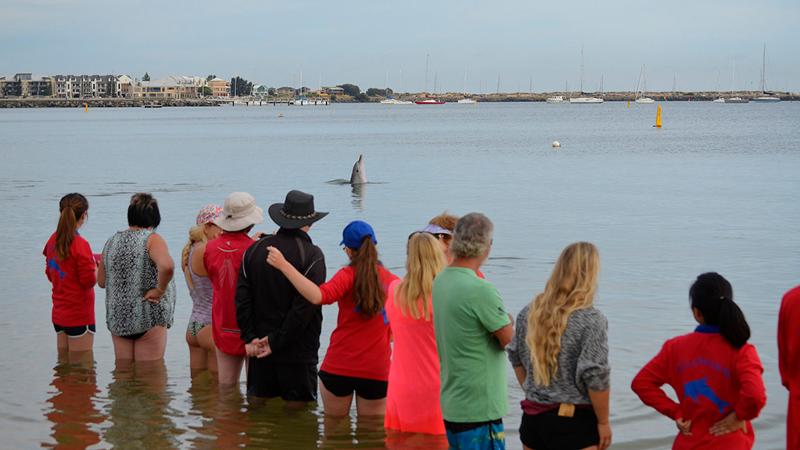
Feeding wild dolphins is among the causes of a predicted radical decline in a bottlenose dolphin population off Bunbury, Western Australia, a QUT-led international research team has found.
Study of humans feeding bottlenose dolphins in Bunbury, WA found that the practice doubles the probability of extinction of this population over the next 100 years.
Humans feeding wild dolphins shown to lower reproduction and survival of young
This practice along with climate change, boats, disease, possible algae blooms, oil spills and habitat degradation all a threat to survival.
Published in the journal OIKOS, “Forecasting the impact of food-provisioning and other stressors on a marine top-predator population”, found that without protective management, the Indo Pacific bottlenose dolphin population off Bunbury would fall from 350 to 8 in 100 years.
First author of the international study, Dr Valeria Senigaglia, from QUT’s School of Biology and Environmental Science, said it was well-established that wildlife tourism could affect animals' behaviour and sometimes impact their reproduction and survival but its impact at population level was less understood.
“While feeding wild dolphins is illegal in Australia, four locations have been granted permission from state regulators to provide limited food for tourism purposes,” Dr Senigaglia said.
"Feeding dolphins has been correlated with high levels of begging behaviour eg approaching vessels for handouts which leads to inappropriate food or injury, and the removal of bait from fishing gear that could lead to entanglement.
“While the practice of humans feeding wild dolphins has been shown to lower reproduction success and survival of their offspring, the impact of food-provisioning can't be quantified in isolation.
“This is because the dolphins face many other stressors from climate change, recreational watercraft, disease outbreaks and possible algae blooms, oil spills and habitat degradation.”
Dr Senigaglia said the researchers used a decade-long study of systematic monitoring of the Indo-Pacific bottlenose dolphin population in Bunbury and a Population Viability Analysis model to simulate population dynamics over the next 100 years.
"We compared scenarios containing the fed and non-fed dolphins with additional scenarios including an outbreak of morbillivirus disease, human disturbances known to increase calf mortality, and a cumulative effects scenario containing morbillivirus outbreaks, additional human disturbance, and 'catastrophes' like harmful algal blooms and oil spills," she said.
"The fourth scenario we devised was based on management measures taken in Moray Firth, Scotland which decreased calf mortality and doubled fertility of the local bottlenose dolphin population.
“This scenario predicted an increase in population growth, assuming that similar results would arise in Bunbury by stopping feeding and establishing a wide protective area and further limiting industrial and recreational water activity.
"While food provisioning is not the only reason for the projected decline under current conditions, an outbreak of morbillivirus (a likely occurrence) would be much more detrimental, the practice of feeding wild dolphins accelerates the decline.
“Our results indicate that dolphin food-provisioning increases the forecasted decline, doubling the probability of extinction over the next 100 years. Although, of note, differences in population trajectories with and without the food-provisioning were not immediately apparent within the first few years, they became evident after a decade.
“Stopping this practice might increase dolphins’ resilience and ability to withstand other, more severe, stressors."
The international research team comprised Dr Senigaglia, Dr Leslie New from Ursinus College, Associate Professor Oliver Manlik from the United Arab Emirates University, Dr Kate Sprogis, from the University of Western Australia, and Professor Lars Bejder from the University of Hawaií.
The study, Forecasting the impact of food-provisioning and other stressors on a marine top-predator population, was published in OIKOS.
(Main image: Dolphin-feeding session in Bunbury with volunteers from the Dolphins Discovery Centre)
QUT Media:
Niki Widdowson,
Media@qut.edu.au 07 3138 2361


