Artificial intelligence could predict an individual office worker’s risk of musculoskeletal injury in specific body parts, a study by QUT health and data scientists has found.
Study findings show distinct risk factors affect different body areas
Researchers tested six machine learning models to find which best predicted injury risk
Unlike other studies, the researchers incorporated not just physical risk factors, but also sleep and social support from managers and colleagues
First author of the study published in the journal Safety Science, PhD researcher Mehrdad Hassani from QUT’s School of Public Health and Social Work, said work-related musculoskeletal disorders (WMSDs) were a prominent occupational health issue, particularly among office workers who often spent hours sitting at a desk.
“The results of our study found that different body regions are influenced by distinct sets of risk factors, suggesting we need to design targeted interventions rather than one-size-fits-all solutions," Mr Hassani said.
“Many studies have reported a common pattern of shoulder, neck, upper and lower back issues, but most of them do not include all possible risk factors and are based on linear calculations to estimate risk.
“We analysed data on WMSDs of 810 office workers contained in four publicly available datasets with six different machine learning models to investigate which model best predicted injury risk across nine body regions.
“Our modelling included psychosocial, ergonomic and organisational influences because office workers’ workplace injuries are influenced by more than physical factors alone.
“We found that risk factors interact in complex ways: prolonged sitting without regular breaks, and poor posture are some of the most common factors for WMSDs.
“Importantly, psychosocial stressors along with organisational factors like high workloads, low job control, lack of defined work roles, poor social support are also associated with neck and lower back pain.”
The researchers looked at body-region-specific risk profiles and found that individual, physical and psychosocial factors contributed different weights to injury risk.
“Body Mass Index, height and weight, age, sleeping hours and work experience appeared as the top 20 per cent most influential risk factors,” Mr Hassani said.
“For example, sleeping hours ranked highly for lower back, hips and neck problems. This variable is rarely considered in ergonomic models, but growing evidence suggests poor sleep may impair tissue recovery and increase pain sensitivity.
“Worker height strongly influenced injury in wrists, upper back, knees and neck indicating the importance of accommodating workers’ body dimensions with adjustable workstation design or sit–stand desk options.
“While variables such as emotional demands, meaning of work, and social support from colleagues/supervisor were not dominant predictors in most body regions, they appeared with moderate importance for the upper back and shoulders.”
Mr Hassani said the study does not only show the feasibility of similar approaches but that it also provides a more nuanced, multi-factorial, and body-region-specific understanding of risk than most traditional assessment methods.
The research team comprised Mr Hassani, Associate Professor Nektarios Karanikas, Associate Professor Dimitri Perrin, and Professor Richi Nayak, all from QUT, and Dr Haroun Zerguine, SafeWork SA, Adelaide, South Australia, Australia.
The study, Feasibility and challenges in AI-driven risk assessment of musculoskeletal disorders (MSDs) in office workers, was published in the journal, Safety Science.
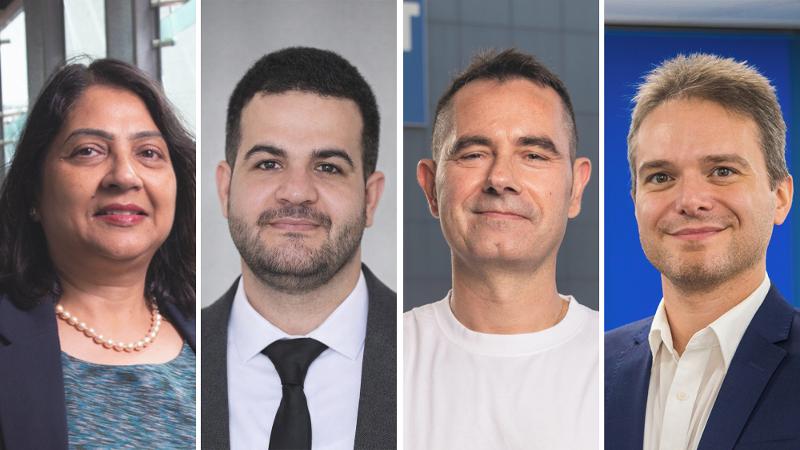
(Image, from left: Professor Richi Nayak, Mehrdad Hassani, Professor Nektarios Karanikas, Associate Professor Dimitri Perrin.)
QUT Media contact:
Niki Widdowson 07 3138 2999 or n.widdowson@qut.edu.au
07 3138 2361 / 0407 585 901 (After Hours)


