
Innovative possible designs for QUT’s campus of the future addressing childcare, waste management and the protection of native bees have won QUT students Gabrielle Renwick, Ethan Frawley, and Ruby Moehead United Nations Association of Australia Global Goals for Sustainable Development awards.
The awards were presented this week at the launch of Sustainable Futures 2050, Designing a Sustainable University – a showcase of student work from 2022 & 2023 which can be viewed on the screens of The Cube on QUT’s Gardens Point campus during December and January.
It’s the outcome of a partnership with ARUP, a global collective of engineering and sustainability consultants, designers, architects, and experts dedicated to sustainable development, and highlights the work of students from QUT’s Impact Lab 3 Planet.
Through a research-led design process, and embedded Work Integrated Learning students across seven design disciplines from QUT’s School of Architecture & Built Environment and School of Design applied the United Nations’ Sustainable Development Goals as a guiding framework for implementing QUT’s Sustainability Action Plan and Campus to Country positioning strategy.
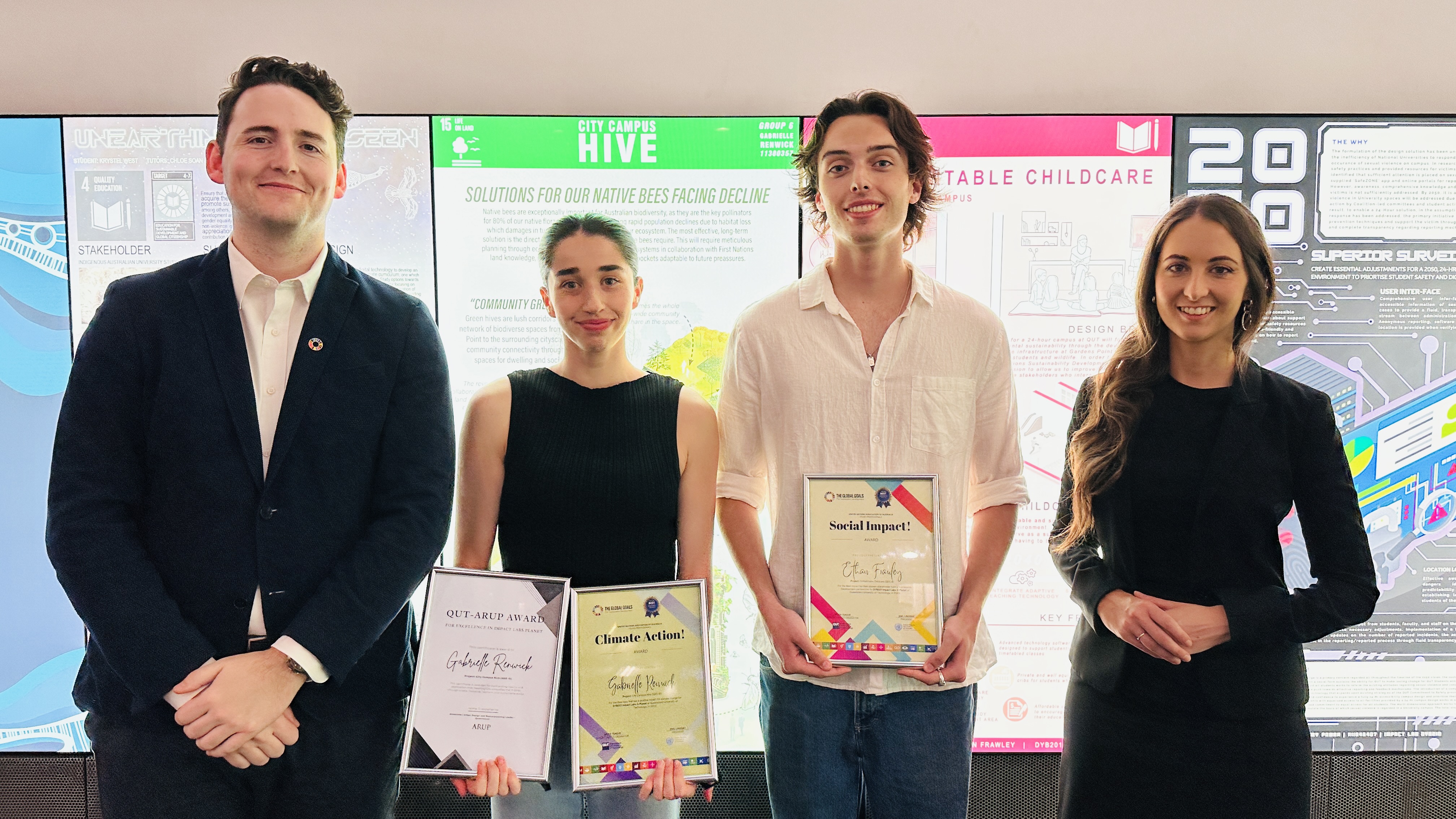
Unit coordinator Krissi Teague from QUT’s School of Architecture & Built Environment said regenerative design education was firmly on the agenda.
“We need to keep pushing sustainability into focus and embed those UN Sustainable Development Goals into framework for all facets of education. If we push our focus towards a whole systems approach, we can amplify positive impact to our planet, people, and place,” she said.
Gabrielle Renwick, second year Bachelor of Design - International (Landscape Architecture Major), was awarded both the United Nations Association of Australia Young Professionals Climate Action Award and the QUT-ARUP Award for Excellence in Impact Labs Planet Award for her concept of the Tech-Hive.
Presenting a solution for declining populations of native bees, Gabrielle created a new sustainable design in long-term management of them. Built with natural materials, the hive hosts a native bee colony with specialised indoor temperature control, safe entry points and chambers specifically designed to boost native bee occupancy and efficiency.
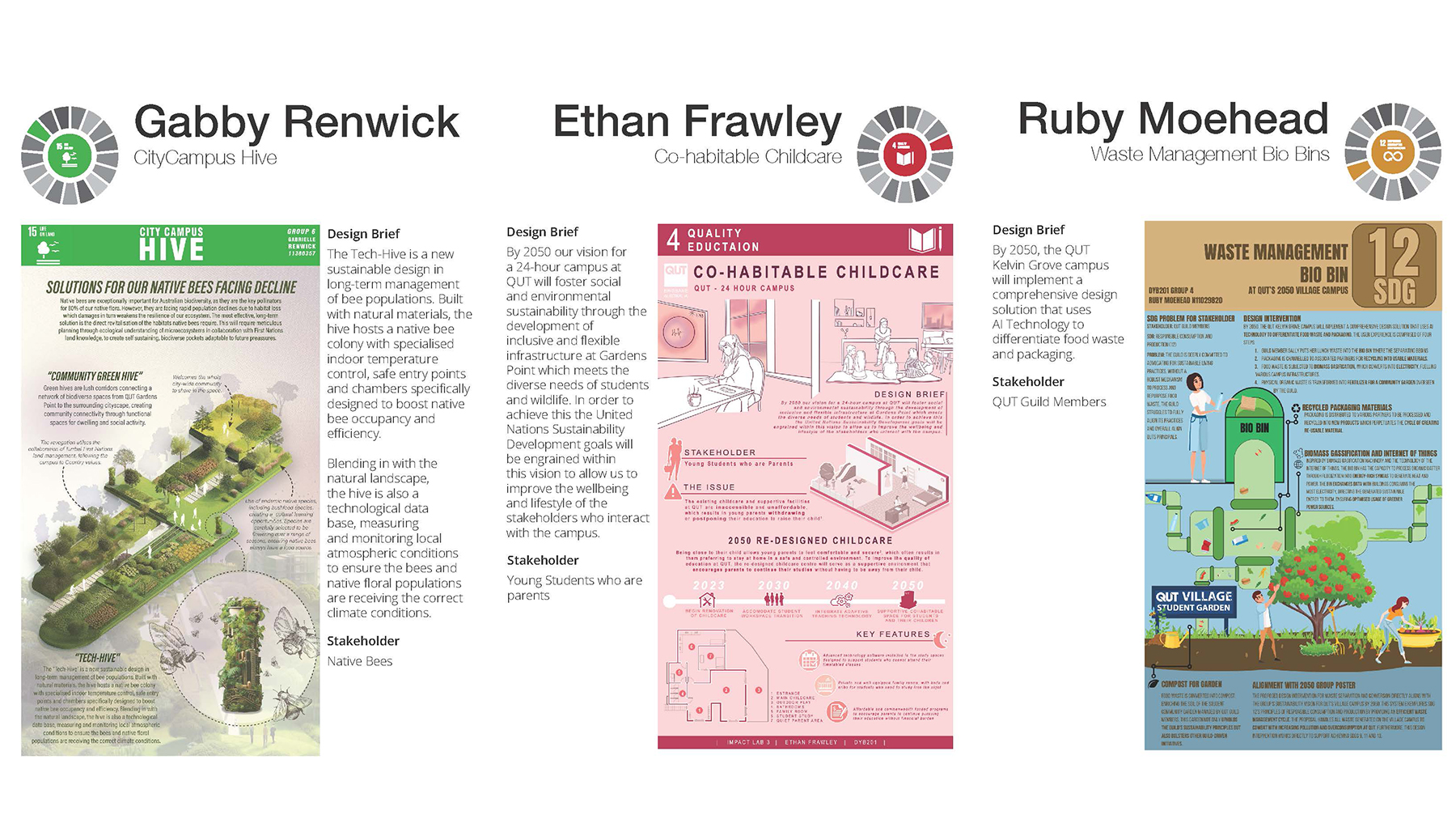
Ethan Frawley, second year Bachelor of Architecture Design, was presented with the United Nations Association of Australia Young Professionals Award for Social Impact. He chose to address the needs of young students who are parents, looking at the problem many face due to a lack of affordable of accessible childcare facilities at QUT which result in them having to withdraw or postpone their education.
Ethan’s Co-Habitable Childcare solutions include advanced software technology installed in study spaces to support students unable to attend timetabled classes, and private family rooms with cribs and beds for students who need to study into the night.
Ruby Moehead, third year Bachelor of Business (Marketing Major) / Bachelor of Design (Fashion Major), was unable to attend the event but was named winner of the United Nations Association of Australia Young Professionals Award for Innovation. Her Waste Management Bio Bins concept outlines a vision in which by 2050, the QUT Kelvin Grove campus could implement a comprehensive design solution using AI technology to differentiate food waste and packaging.
Ruby’s concept would see food waste subjected to biomass gasification to convert it into electricity to power campus infrastructure, and physical organic wastes transformed into fertiliser for a community garden overseen by the QUT Student Guild.
Associate Professor Janice Rieger from QUT’s School of Architecture & Built Environment said the work from the students was testament to the power of collaboration and its real-world value.
“The unit our students undertook created a critical learning lab for them to reflect on their shifting responsibilities and roles as designers, and to think holistically about the creative and ethical challenges in creating climate/social justice,” Professor Rieger said.
“Grounded in the knowledge that sustainability is inclusive of diversity, justice, and design for all, we are excited to see what a 2050 university will look like under this new generation of architecture and design leaders.”
Design educator and QUT sessional academic Rashan Senanayake who helped teach the unit described it as a critical piece of education for the betterment of the planet.
“We hope the thinking exhibited in 2019-2023 has yielded its results in 2050 and that the university has by then achieved more than we could’ve ever imagined,” he said.
“Ideally the QUT of the future will continue the legacy of teaching sustainable development to students of 2050 and preparing a world towards a real-world application for the 22nd century.”
Sustainable Futures 2050, Designing a Sustainable University – a showcase of student work from 2022 & 2023 can be accessed via QUT ePrints online.
Main image: The Cube display of Sustainable Futures 2050, Designing a Sustainable University – a showcase of student work from 2022 & 2023
Media contact:
Amanda Weaver, QUT Media, 07 3138 3151, amanda.weaver@qut.edu.au
After hours: 0407 585 901, media@qut.edu.au


