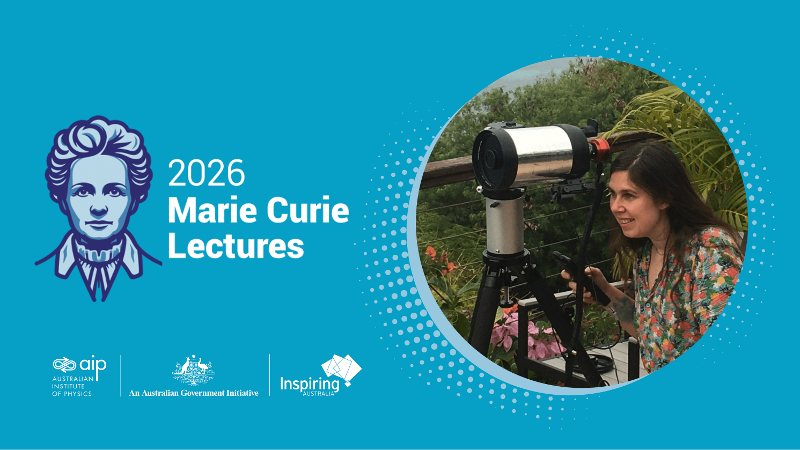
In this lecture, Dr Karelle Siellez beautifully combines sound, art, and astrophysics to tell the fascinating story of gravitational waves and the dramatic collisions that create the elements we cherish. Through exciting “multi-messenger” signals like kilonovae and gamma-ray bursts, we’ll discover how the universe shares its most intense and awe-inspiring events with us.
Join us for this public lecture presented by the Australian Institute of Physics's 2026 Women in Physics Lecturer as part of the Marie Curie Lectures.
Event details
26 Aug 2026
6:00 PM - 7:30 PM
QUT Gardens Point campus, Gibson Room (Level 10, Z-Block)
Tickets are FREE, but registration is essential.
Register to attend in person or watch the livestream
In 2017, the Universe spoke in waves and light—ushering in a new era of astronomy. In this lecture, Dr Karelle Siellez weaves together sound, art, and astrophysics to explore the story of gravitational waves and the collisions that create the elements we are made of. Through “multi-messenger” signals like kilonovae and gamma-ray bursts, we’ll uncover how the cosmos communicates its most violent events. Blending scientific insights with creative expression, this journey reveals how listening to the Universe—and protecting its silence—can connect science, nature, and humanity.
Dr Karelle Siellez is an astrophysicist and lecturer at the University of Tasmania. A specialist in multi-messenger astronomy, she contributed to the first detection of a gamma-ray burst and gravitational waves from the same cosmic event, recognised with the 2017 Breakthrough Prize. She is also an award-winning science communicator who integrates art, sound, and storytelling into her work, making complex astrophysics accessible and inspiring. Karelle has lived and worked in France, the USA, and now Tasmania—where she divides her time between telescopes, classrooms, and the wilderness of sea and forest.
Register now