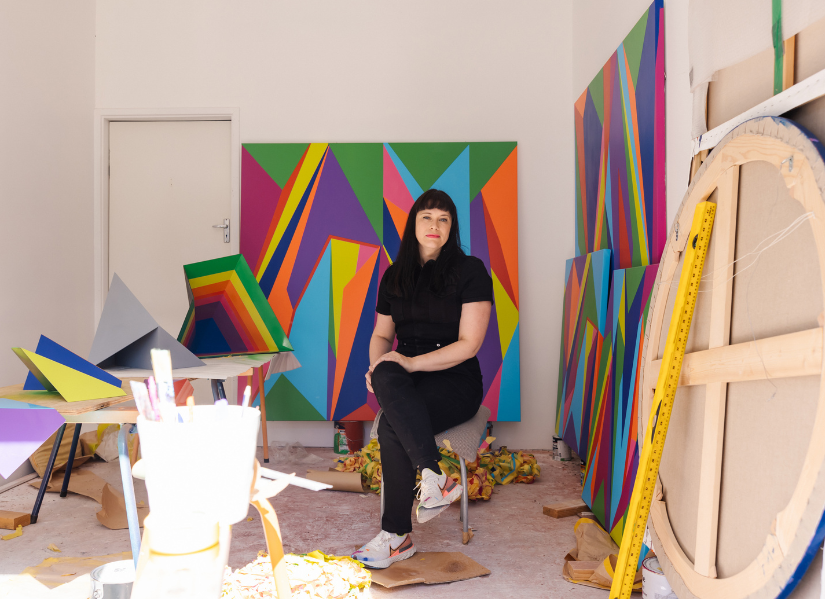
Photo by Jessica Tremp.
Emma Coulter’s practice moves beyond the canvas, transforming painting into a spatial, immersive experience shaped by architecture, colour and site. A QUT graduate who studied both Visual Arts and the Built Environment, Coulter has built a distinctive career that bridges disciplines, evolving from traditional painting into an expanded field spanning sculpture, installation and large-scale public art.
With a practice grounded in both intuition and structure, she uses colour as her primary language—layering conceptual systems with visceral responses to create works that shift how we perceive space. Her projects, commissioned nationally and internationally, are deeply responsive to context, embedding themselves within the rhythms of the built environment while remaining open to multiple interpretations over time.
Whether encountered in a gallery or woven into the fabric of everyday public spaces, Coulter’s work invites reflection, curiosity and connection, demonstrating the powerful role art can play in shaping how we experience and share the world around us.
Can you tell us about your career journey since graduating from QUT?
Having studied both a Bachelor of Visual Arts and a Bachelor of Built Environment at QUT straight out of school, I spent the first 14 years working across both fields. However, for the past 12 years, my primary focus has been my visual art practice, which has evolved from a predominantly painting-based practice into an expanded spatial field working across painting, sculpture, site-specificity, and public art.
Over the past two decades, I have been commissioned to create works nationally and internationally. Career highlights include major public commissions in Melbourne’s CBD, Yarrila Place, and site-specific works for Shepparton Art Museum, Museum of Brisbane, and QUT Art Museum, as well as acquisitions by Artbank and the ANZ Art Collection. My work has also been recognised through several awards and grants, including the Linden Art Prize, the Footscray Art Prize, and the Ian Potter Cultural Trust Grant.
Your work often operates in what you describe as the “expanded field” of painting, moving fluidly between canvas, architecture and public space. What first prompted you to push painting beyond its traditional boundaries?
My enquiry into architectural space as a conceptual concern within my practice evolved gradually through experimentation and opportunity, particularly during my Masters project at the Victorian College of the Arts. Over time, my paintings began to extend beyond the canvas, operating instead as installations within architectural contexts.
This shift prompted me to question the limits of painting itself. I became increasingly interested in painting as a spatial practice rather than simply a flat surface. Through painting and photography, I began translating spatial conditions into sculptural and conceptual outcomes, approaching the process as a form of deconstruction and reconstruction.
By distorting and re-imagining existing architectural conditions, architecture could simultaneously operate as image, structure, and support for painting. The intersection of these ideas, combined with the development of a serial colour palette, led to my numerical iterative series of spatial deconstructions. Through this process, I became increasingly interested in Rosalind Krauss’s postmodern concept of the, ‘expanded field.’
Colour is both the material and the language of your work. How do you balance intuitive, visceral responses to colour with the conceptual systems and constraints you set for yourself?
My approach to colour sits between instinct and structure. I often begin with intuitive responses, processed through text, drawings and photography. This process work sits behind my practice as research, which may not be immediately obvious through the refinement of the finished work. Having a system already established in my work actually provides me with the freedom to work across painting, sculpture and installation.
Having studied both visual art and the built environment, how does architectural thinking continue to shape the way you approach form, structure and symbolism in your work?
My processes are generally methodical and organised, which allows me to navigate the vastness of artistic practice without becoming overwhelmed by it. Scale, site, movement and spatial experience are all central considerations within my work. Through my site-specific practice, I approach artworks not simply as autonomous objects, but as contextual. Space and colour are both primary mediums within my practice, informed by a long familiarity with how they can be manipulated to generate particular spatial and perceptual outcomes. While my processes are grounded in logic and structure, they are equally guided by intuition.
Public artworks often become part of people’s everyday lives. How do you navigate the responsibility of making work that must coexist with community, infrastructure and time?
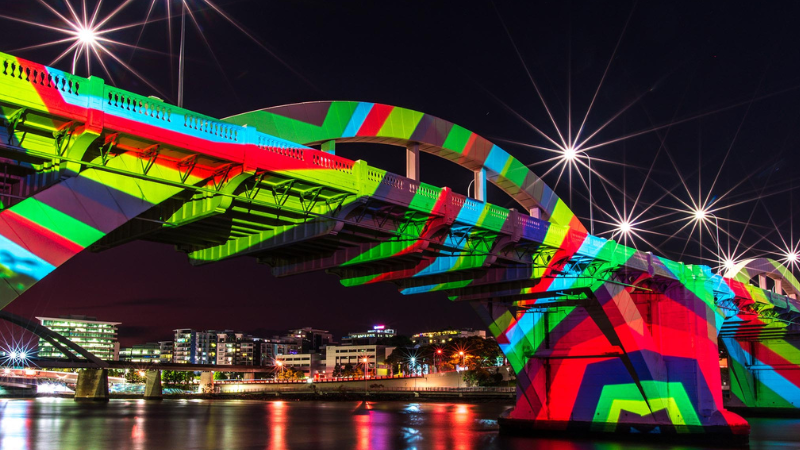
Through my art practice I am interested in taking art out of its usual institutional or commercial context, and placing it into every day space; acting both as a democratic statement, and to enliven the placemaking potential of shared public space for everyone.
Public art carries a unique responsibility because it exists within shared civic space and becomes part of people’s daily routines and memories. I try to create work that is visually engaging but also generous, work that can be encountered in multiple ways over time. This involves balancing artistic ambition with careful consideration of site, accessibility, longevity and the social and cultural contexts in which the work will exist.
Your selection for QUT’s Alumni Triennial marked a full-circle moment. What did that recognition mean to you personally and professionally?
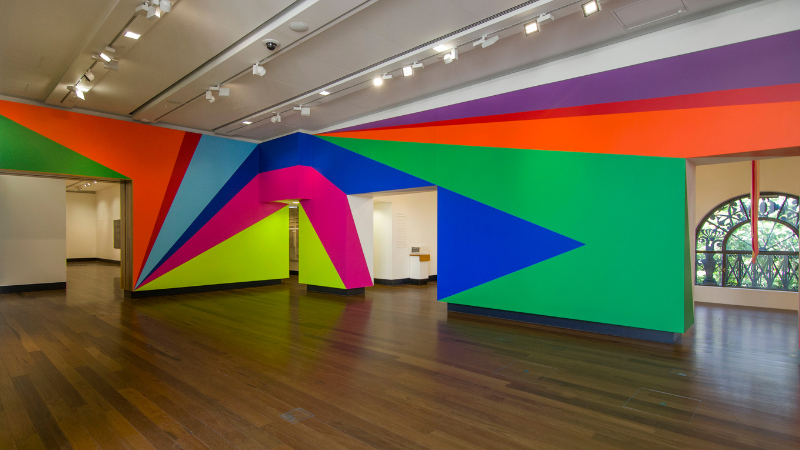
My trajectory towards recognition as an artist has come through a somewhat non-linear pathway, which is possibly what allowed me to develop my own voice and way of working. Being put forward as a candidate for the QUT Alumni Triennial, and then being selected, came at a pivotal moment when my work was also being recognised through several major public art commissions, so the timing felt particularly significant.
Studying at QUT provided a very strong conceptual and technical foundation, which was later deepened through postgraduate study at the VCA. Returning to exhibit within an institution that played such an important role in shaping my early thinking, prompted reflection on how much my work has evolved and I have grown as a person over time.
Professionally, it was rewarding to contribute to a broader dialogue alongside alumni from different generations and disciplines, and to reconnect with the university community from a very different position, not as a student, but as an established practitioner.
What advice would you give to emerging artists trying to balance creative ambition with practical career realities?
I think it’s important to recognise that creative practice is often built slowly over time through persistence, tenacity, experimentation and research. Emerging artists shouldn’t feel pressured to fit into a single category or career model, interdisciplinary practices can create unexpected opportunities. At the same time, learning how to communicate your ideas professionally, manage projects and sustain relationships is just as important as developing the work itself.
Can you share a project where your work reflected local history, culture, or identity—and why that mattered?
Although I work with a serial colour palette and a recognisable visual language, the underlying concepts are always shaped by community, site and collective experience.
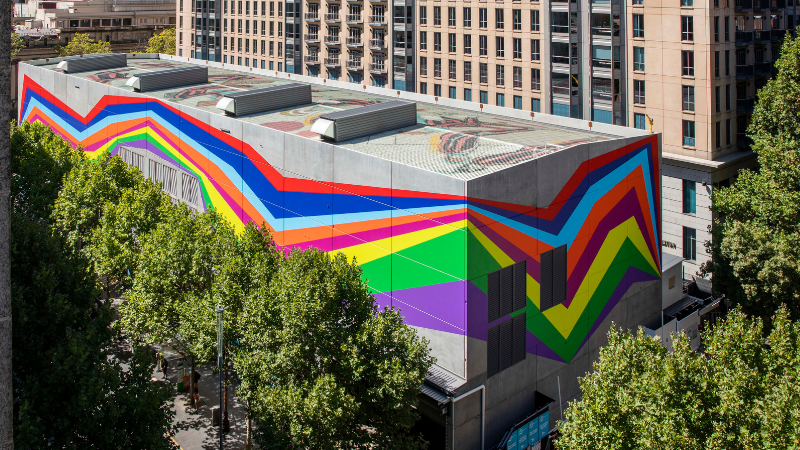
For example, my large-scale work spatial deconstruction #23 (resilience), located across the Swanston Street block bounded by Collins Street and Flinders Lane in central Melbourne, explored the idea of buoyancy and strength within the context of the city emerging from extended lockdowns. Installed in the aftermath of the pandemic restrictions, the work operated as a visual disruptor within the urban environment, responding to the profound social isolation and physical disconnection experienced across Melbourne’s communities.
What mattered to me about that project was the opportunity to create a work that could operate both psychologically and spatially within the public realm, something that interrupted the familiarity of the city while also reflecting a shared collective experience at a significant moment in Melbourne’s history.
How do you see public art contributing to community connection, inclusion, and a shared sense of place?
I truly believe that public art has the power to transform everyday environments into spaces of encounter, reflection and shared experience. It can create moments of recognition and connection across diverse communities by contributing to the emotional and cultural identity of a place. I think public art is most successful when it encourages openness and participation, when people feel a sense of ownership, curiosity or belonging in relation to the work and the spaces it inhabits.
Author

Jenni is an innovative communications, marketing and engagement specialist with fifteen years of industry experience. She is also a proud QUT alumnus with a Bachelor of Creative Industries (Interdisciplinary).