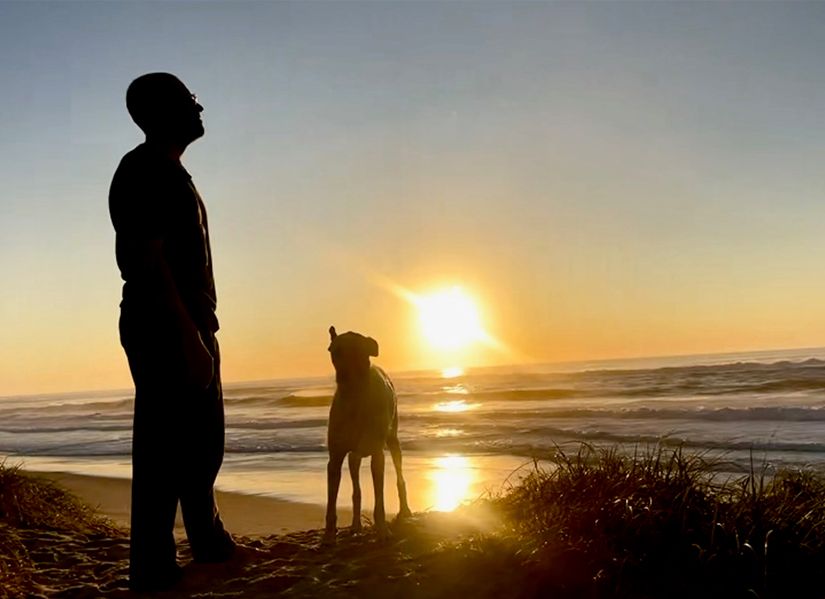
Philip Ascher spent more than 24 years building a successful career in finance, working with some of the biggest names in the industry. Then, he made the bold decision to become a registered nurse. Although accounting is often viewed as a technical field, insolvency practitioners like Philip must combine their expertise with strong communication and empathy—skills he now brings to his new vocation. As he prepares to graduate in late 2025, Philip isn’t just changing careers—he’s aligning his work with his values and the life he wants to lead.
The QUT Alumni team sat down with Philip to discuss his career, how he knew it was time for a career change, and living outside the box.
Can you share your career journey with us?
I spent over a decade as a Certified Practising Accountant (CPA) working in corporate insolvency, a field that’s highly technical but also surprisingly people-focused. Over time, though, I realised that while I was good at the work, it no longer aligned with how I wanted to live, or who I was. Eventually, I made the decision to leave. What followed was a couple of years of stepping back and sitting with that choice, figuring out what kind of work and life might feel more aligned. Nursing wasn’t part of the original plan, but once I started looking more closely, it felt like a natural fit. It’s meaningful, it’s human, and it challenges me in completely unexpected ways, particularly the level of emotional intelligence and presence it demands.
Looking back, what have been some of the most rewarding parts of your career?
In accounting, I found the most satisfaction in the investigative side, unpacking the financial affairs of failed companies or individuals and securing a recovery for financially affected creditors. I was often thrown at complex or contentious appointments, the ‘sledgehammer’, so to speak, and I took pride in negotiating outcomes that delivered something back to those who had lost out. It was rewarding work in its own way: precise, strategic, and often high-stakes. Nursing is different, a kind of penance, but still about being useful in hard moments. Only now, that usefulness comes through presence, care, and trust, and that shift in value aligns more closely with the person I want to be.
How did you know it was time for a career change?
I took a new role within a consultancy firm that shifted my work in a direction I didn’t enjoy, and that change forced me to take a proper look at where my career was heading. I realised that if I stayed the course, I’d be building a life I didn’t want, and becoming someone I didn’t want to be. I’d always told myself that when getting out of bed for work started to feel heavy, it was time to leave. Eventually, the drain of the job overtook the satisfaction I used to get from it, and that was my line in the sand. After I left, I took what ended up being a two-year sabbatical, and that time gave me the space to reassess who I was and what really mattered. That’s what set me on a different path, one that feels far more aligned with the life I want to lead.
What are your go-to methods for handling difficult or complex conversations?
I’m someone who feels things deeply, so I’ve had to learn how to pause, ground myself, and approach tough conversations with intention. In my personal life, I can be emotional, but professionally, I’ve developed a more measured approach, one that balances empathy with structure. Whether supporting a distressed business owner or a vulnerable patient, I try to focus on listening, slowing things down, and providing clarity without sugar-coating. Creating trust in these moments is what allows the real work to happen, and learning how to do that well is something I don’t think ever really ends.
What insights did you gain from your time at university?
I came to see that a university qualification, whether undergraduate or postgraduate, can open professional doors and support meaningful career change, provided it’s paired with real commitment. The Graduate Diploma of Business gave me the credentials I needed to enter the accounting profession and take that next step. Like any formal study, it’s a tool. What it leads to depends entirely on how you use it.
Can you tell us what emerging issue/s will have the greatest impact on healthcare in the next 5–10 years?
Artificial Intelligence (AI) will be the single biggest influence on nursing in the coming decade, and integrating it fully into nursing practice is not optional; it’s essential. Nurses are expected to hold enormous clinical knowledge and advocate for patients in complex, high-risk environments, often with only three years of formal training. At the same time, global nurse shortages have made the role more demanding than ever. AI offers a way forward. Imagine a nurse with real-time access to a system that can instantly analyse patient records, interpret visual cues, and provide decision support through an earpiece, not to replace the nurse, but to empower them. That kind of support could dramatically reduce errors, ease the training burden, and make nursing safer, smarter, and more sustainable.
Can you name some of the individuals who inspire you? What qualities in these individuals do you admire and seek to emulate in your own work/life?
To be honest, I’ve never really modelled myself on anyone else. I tend to be inwardly focused, not in a self-important way, but because most of my decisions are shaped by personal reflection and what feels right for me and my wife. In some ways, I think I’ve always prided myself on being different, outside the box, never quite fitting the mould. That’s where I draw direction from. I don’t envy success or chase status, and I’ve never felt the need to pattern my life on someone else’s. If anything, I admire people who’ve found their singular passion, something that shapes everything they do, and who live by it without apology. It could be anything, from pottery to mountain climbing. I’ve met free surfers who’ve structured their entire lives around waves, giving up career stability, money and certainty just to stay close to something they love. That kind of clarity, to know exactly what matters and to commit to it fully, is something I respect deeply.
Nestled amongst your impressive career resume is a two-year stint as a Tour Guide in South America. Can you tell us more about the experience and your favourite places to visit?
It was one of the best and hardest experiences of my life. I spent time running overland tours through Ecuador, Chile, Peru, Bolivia, Argentina, and Brazil, and while the landscapes and people were incredible, the real journey was internal. I had to lead, adapt, and survive in situations that tested me daily, sometimes physically, sometimes emotionally. It exposed strengths I didn’t know I had, but it also confronted me with parts of my character I hadn’t seen clearly before. I wouldn’t trade that time for anything. It changed the direction of my life, taught me that I can survive, that I land on my feet, and that sometimes the most uncomfortable experiences are the ones that teach you the most. Argentina, in particular, left its mark. From the moment I arrived, I felt at home, the people, the energy, the culture. They felt like my people. I also met my wife during that time—definitely worth it.
What is one skill you couldn’t live without and why?
I seem to thrive in unfamiliar environments, places and situations outside my comfort zone, where I need to be fully present and responsive. It’s something I first recognised in South America, and it’s shaped the way I approach change ever since. That ability has given me confidence in the face of uncertainty and taught me that I’ll usually find my footing, even when things don’t go to plan. I’m not chasing the top, and I’m not afraid of the bottom. I tend to sit somewhere in the middle, and I’ve come to understand the strength in the middle way.
QUT degree—Graduate Diploma of Business (2012).
Do you have a question for Philip? Connect with him on LinkedIn.
Author
Joanna is an integrated marketing communications specialist with an interest in the Faculties of Health, Business and Law. She holds a Master of Business, Bachelor of Mass Communication and Diploma in Business Information Systems.