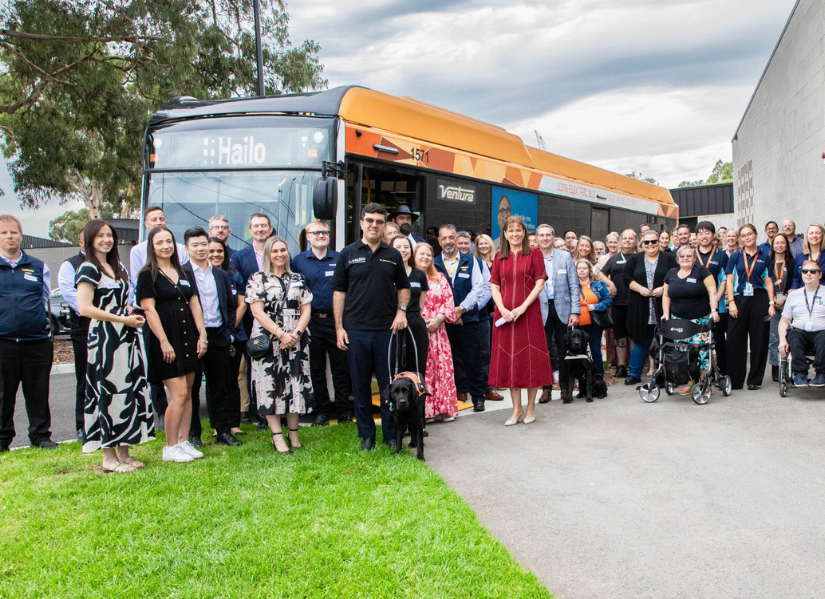
Catching a bus or train is something most of us take for granted. But for the more than one in five Australians who have a disability, it can present many challenges. Propelled by his own unsatisfactory experiences with public transport, QUT Alumnus Santiago Velasquez created Hailo – the world's first accessible travel app which just launched in Melbourne this month.
In 2018, Santiago missed a university exam because three buses drove straight past him. He was at the stop early, high-vis vest on, guide dog beside him, route number raised. But without a clear signal at the right moment, drivers focused on the traffic and didn't see him. That day cost him by adding six months to his degree. It wasn't the first time he was left behind. It wasn't the last time either.
More than one in five Australians have a disability. And over 1/3 experience difficulty using public transport.
Empowered by his personal experience with public transport and those of others, Santiago saw a gap in the market and by using skills and insights gained from his Bachelor of Electrical Engineering (Honours) he set out to find a solution to this issue where public transport could be accessible and work for everyone.
Skip forward a few years to March 2026 and Santiago’s app Hailo has just been launched in Melbourne, Australia - the world's first app that lets public transport passengers electronically hail a bus from their phone in real time.
The Alumni team sat down with Santiago this week to understand his experience developing an app and what advice he suggests for others wanting to start their own business or product.
Can you tell us a bit more about Hailo?
Created alongside my co-founder Jonathan Dalton and our Hailo Solutions team, Hailo helps bridge the communication gap between passengers and bus drivers. It lets public transport passengers electronically hail a bus from their phone in real time. No waving. No guessing. No getting left behind. And when you board, Hailo makes sure you're dropped at the right stop, every time.
Who can use Hailo?
Hailo is for everyone. If you're blind or vision impaired, you'll never be left behind at a stop again. If you use a wheelchair or pram, your driver knows what you need before they arrive. If you're a tourist visiting Melbourne and don't speak English, Hailo speaks your language. If you're just a regular commuter who's tired of missing buses, Hailo is for you too.
Can you tell us about the journey of coming up with the idea of Hailo and launching the app?
Being left behind by buses and knowing that public transport was unreliable, made me feel isolated. For myself, my co-founder Jon and the rest of the Hailo team, it was never an idea. It has always been a problem and Hailo the solution. By looking at Hailo as the solution to a problem we made bus drivers’ job a lot easier, travelers’ public transport journey better and public transport more accessible to everybody.
What advice do you have for designers, planners and policy makers to ensure that universal design and accessibility is incorporated in everything they do?
If we look at incorporating universal design into projects, products, systems and services, we can make them be better for more people. That is the social reason, but the business side of things cannot be ignored. We don’t think about the ramps on the footpaths, but when they are not there, we remember them. A project that has been design, tested and constructed using accessibility design principals in mind, is a project that will have a longer lifespan and people will use it more. Plus, it will be less likely to need an expensive retrofit in the future.
How has technology helped you in other areas of your careers and personal life?
Well-designed technology has helped me a lot in many everyday tasks that people often take for granted. For example, using technology to scan and read out documents, restaurant menus and signs.
What advice do you have for others wanting to start a business or initiative?
People are your greatest assets and supporters. Make sure you believe in what you want your business to do, surround yourself with people who have the skills to execute that vision and ask lots of questions. We don’t know what we don't know, but pretending that we do pushes us backwards, not forwards. Starting Hailo has been amazing, but lots of hard work has gone into it to make it what it is today, and lots more will have to go into it to make it have the impact we are aiming for.
What is one skill you couldn't live without and why?
Being aware of differences in perspective. As a migrant, I have been fortunate to see how different cultures perceive different things. Not assuming that everybody sees the world like you do has helped immensely.
What's next for you?
Hailo is just getting started. The reality of public transport being accessible for everybody is not hear yet. So, for myself, making sure Hailo succeeds is my next chapter. If people are visiting Melbourne, live in Melbourne, or even if they are not in a Hailo enabled region, downloading Hailo, using it and sharing it, it helps us show that public transport can be accessible for everybody.
How can people download Hailo or find out more about your work?
You can download Hailo via the following links:
- Apple App Store: https://apps.apple.com/au/app/hailo/id6746183060
- Google Play Store: https://play.google.com/store/apps/details?id=co.hailo&hl=en_GB
You can also connect with Hailo Solutions on LinkedIn or via the Hailo website.
Author

Jenni is an innovative communications, marketing and engagement specialist with fifteen years of industry experience. She is also a proud QUT alumnus with a Bachelor of Creative Industries (Interdisciplinary).