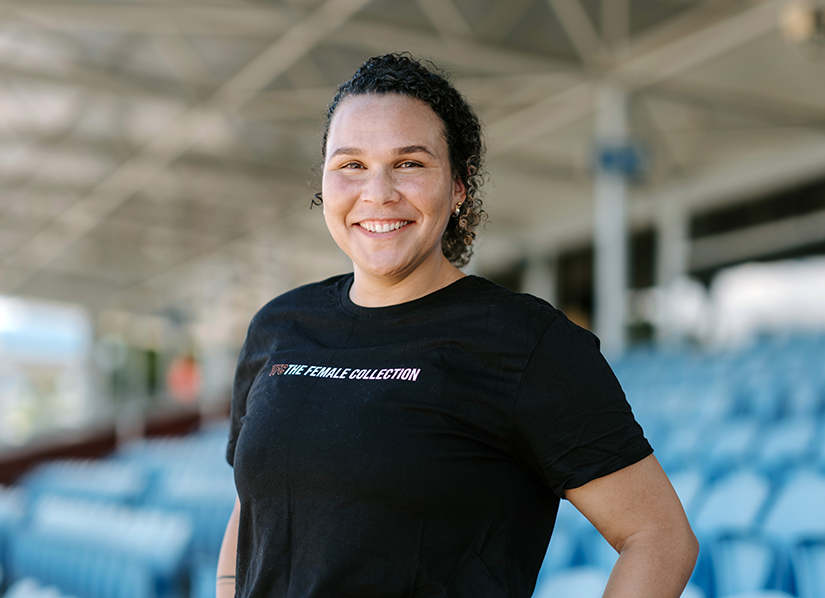
Libby is a Zenadth Kes woman from the Samsep clan on Erub Island, in the Eastern Torres Strait, with kinship ties to Badtjala country, K'gari and Hervey Bay.
In June 2023, she founded the Female Co, a not-for-profit organisation dedicated to empowering Aboriginal and Torres Strait Islander women and girls— particularly those in remote communities—through access to sport and education. The QUT Alumni team sat down with Libby to discuss her career, her views on stemming the decline in organised sport participation, and her vision for the future.
Can you tell us about your journey since graduating from QUT?
Since graduating from QUT, my journey has been anything but linear. I’ve worked across various sectors including state government, education, health, and the not-for-profit sector. Over the years, my career has focused heavily on working alongside Aboriginal and Torres Strait Islander communities and developing programs that create meaningful change. One of the most significant milestones has been founding The Female Co, an organisation focused on empowering young women and girls from regional and remote areas through sport, education, and leadership development.
What inspired you to start the Female Co?
The inspiration for The Female Co came from both lived experience and observation. Growing up in the Torres Strait and moving to the mainland for education and sporting opportunities, I understood first-hand the challenges regional and remote girls face. There were gaps in visibility, access, and culturally safe support systems for young women pursuing sport and leadership. The Female Co was born from a desire to create a platform that doesn’t just focus on athletic performance but also on confidence, health, education, and community leadership.
How do you navigate the unique challenges faced by women in regional and remote communities when accessing sports and leadership opportunities?
Navigating these challenges starts with understanding the lived realities of these communities. That means engaging directly with young women, their families, and local leaders to build trust and shape programs that reflect their needs, rather than building on assumptions. We also prioritise creating culturally safe spaces, ensuring affordability through fundraising and partnerships, and removing physical barriers like travel and accommodation by delivering programs both on Country and in regional hubs like Cairns.
What might a standard week look like for you?
A typical week is a mix of program delivery, strategic planning, community engagement, and of course, family life. Some days I’m leading workshops with athletes, other days I’m writing grant applications, building partnerships, or coordinating logistics for our upcoming camps. There’s usually at least one day spent on the road or in community. I also balance this with my role as a mum and partner, plus I’m currently studying part-time as part of my Master of Business Administration (MBA).
Concerns around the steady decline in organised sport participation have become more prominent in recent years. In your view what can be done to improve engagement and create a pathway?
We need to reframe how we view sport. It’s not just about competition. It is about connection, identity, and community belonging. For young women especially, sport needs to feel relevant, safe, and empowering. Which means offering programs that go beyond performance metrics with integrating leadership, social connection, and cultural relevance. Schools, local councils, and sporting organisations need to partner better and invest in female-focused programs that address barriers like cost, transport, and confidence.
What is one goal you'd like to achieve – professionally or personally - in the next year?
Professionally, I’d like to secure sustainable multi-year funding for The Female Co so we can continue expanding our reach and impact across Northern Australia. Personally, I want to take my partner and kids back to Ged (in the Torres Strait Islander languages, specially Meriam Mir, means home), Erub Island in the Torres Strait, so we as a family can connect and my children can see where they got their names from.
As someone who has returned to study on multiple occasions, what motivates you to pursue further education?
Learning has always been a way for me to create new opportunities—not just for myself but for my community. Every time I study, I’m better equipped to lead, advocate, and design programs that make a difference. Watching my dad complete his PhD as a mature-age student also showed me that academic spaces are places we belong, and that drives me to keep going.
Can you name some of the individuals who inspire you? What qualities in these individuals do you admire and seek to emulate in your own work/life?
I’m inspired by Professor Chelsea Watego for her fearless advocacy, intellectual leadership, and her ability to challenge systems while remaining deeply connected to community and culture.
Mayor Elsie Seriat OAM inspires me through her resilience and determination. As one of the first Torres Strait Islander women to complete the New York Marathon through the Indigenous Marathon Foundation, and now as Mayor of Torres Shire Council, Elsie shows what’s possible when you combine discipline, community pride, and leadership.
Most personally, my Aunty Jillian Bowie inspires me through her cultural knowledge, storytelling, and dedication to preserving and sharing Torres Strait Islander history and identity. She has authored several books, including Bid Buai: Dolphin People and Stories from Erub, which reflect her commitment to passing on cultural knowledge to future generations.
What I admire most in all three women is their authenticity, courage, and unwavering commitment to making a positive impact for our people. These are the qualities I aim to emulate in my own work and life.
What is one skill you couldn’t live without and why?
Adaptability. Whether it’s shifting between a boardroom presentation and a grassroots workshop, or navigating motherhood while running a not-for-profit, being able to adapt has been crucial. It allows me to meet people where they are, respond to challenges quickly, and keep moving forward even when things don’t go to plan.
QUT degrees – Bachelor of Justice (2020), Graduate Certificate in Business (2022).
Do you have a question for Libby? Connect with her on Linkedin.
Author
Joanna is an integrated marketing communications specialist with an interest in the Faculties of Health, Business and Law. She holds a Master of Business, Bachelor of Mass Communication and Diploma in Business Information Systems.