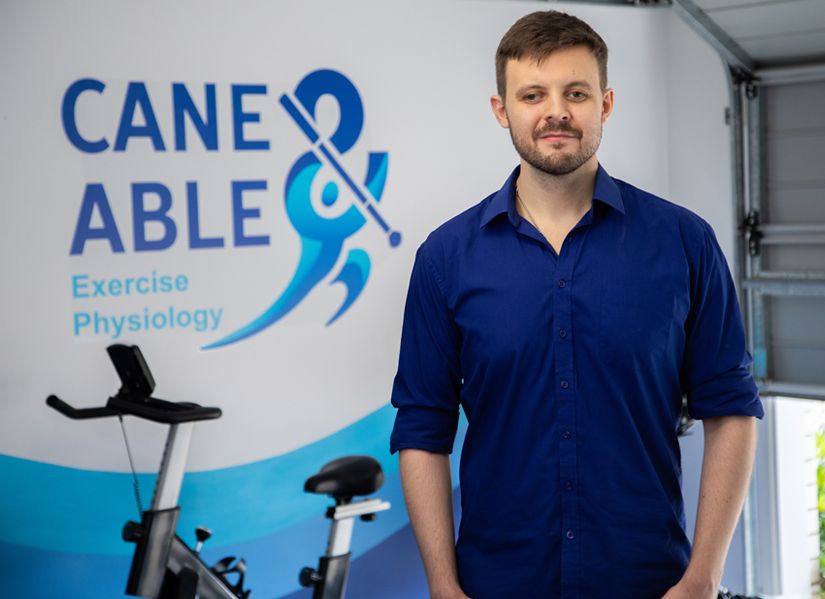
James Steggell navigates the world with 2% vision and graduated from QUT with a Bachelor of Clinical Exercise Physiology (Honours) with one of highest GPAs from a cohort of 150 students. Today James is Australia’s first blind Accredited Exercise Physiologist (AEP) and Accredited Exercise Scientist (AES). He runs his practice Cane and Able Exercise Physiology in Mango Hill, Queensland.
The Alumni team sat down with James to chat about his business, the co-founding of the Health Empowerment and Lifestyle Project (HELP) initiative during his undergraduate degree and what his dreams for the future.
Can you tell us more about Cane and Able Exercise Physiology and what inspired you to start the business?
I run my business from home in a dedicated space I’ve converted into a gym and clinic. Our guiding mission is to provide bulk-billed, low-fee, and free exercise physiology services to those in the community who need them most. I prioritise offering ongoing education and support to clients to help them understand how to improve their health through targeted exercise therapy, why it’s important and how to do so independently. It’s been incredible seeing how positive the reception has been from clients and referrers in the local community.
I decided to start the business out of necessity and a desire to do things differently. When I graduated, I knew it was going to be difficult, as like many people living with blindness or low vision, finding work is often very challenging even with a degree. I applied to dozens of hospitals, private practices and businesses all across Brisbane. As soon as I turned up for an interview with my white cane in hand, I was met with a lot of apprehension or disbelief that I could even do the job. Often the atmosphere would completely change from welcoming to awkward and uncomfortable. This wasn’t a new experience for me but I decided that starting my own business, while difficult, would be the best option forward.
Oh and the name, well it may be a little silly but I chose it for several reasons. I’ve always found humour to be a fantastic icebreaker when it comes to getting past a lot of the awkwardness and uncertainty around disability. I also wanted a way to represent the white cane I use, as well as the many other tools and strategies that give me, like many others, the ability to travel, work and live independently regardless of disability.
What might a standard week look like for you?
Providing one-on-one exercise physiology and supporting clients takes up the majority of my time. Currently, much of my work is through Medicare and NDIS referrals, so I feel pretty lucky that I get to work with a huge variety of clients of all ages to improve their health with exercise therapy. It could be working with someone who has recently had a heart attack or stroke to exercise safely and reduce risks of a recurrent event; someone experiencing chronic back pain to manage symptoms, move more freely and improve strength in key areas to prevent injury; or someone living with diabetes to better manage their blood glucose levels and improve health outcomes long term. Honestly, I love working as a generalist exercise physiologist because it allows me to work with so many different people and I have to learn so much about such a broad range of conditions it keeps me really engaged and always developing myself professionally.
Aside from this I also have many other responsibilities running my own business. It may be a little overwhelming and tough at times, but I’ve grown grateful for it because of all the new skills I may not have developed otherwise.
What technology do you use to assist with the delivery of your services?
I use quite a lot of assistive technology and I’m always on the lookout for more accessible ways for me to do my work. I use a suite of accessibility features and software on my desktop and iOS devices such as screen readers, voice commands, screen magnifiers and colour modification. I also use some great clinical devices I’ve found such as talking blood pressure monitors, pulse oximeters and weight scales, along with some exciting new equipment I’ve recently started using to collect precise force data, range of motion and other metrics which are then sent straight to my tablet and other devices for me to access more easily as compared with traditional equipment.
What’s the difference between an Exercise Scientist and an Exercise Physiologist? What should an individual look for when seeking to engage a professional?
I see this confusion a lot, just like with the role of an Exercise Physiologist versus a Physiotherapist where there can be considerable overlap. Most simply, Exercise Physiologists receive comprehensive training across the full health spectrum and clinical populations, to prescribe and deliver targeted exercise therapy to prevent, manage and treat a broad range of illness and injury. Exercise Scientists do not receive training with clinical populations, and instead focus on exercise and sports performance. A graduate in exercise physiology can be accredited as both an AES and AEP, however an exercise scientist graduate can only be accredited as an AES. This is not at all to diminish the fantastic expertise of exercise scientists though, as they play an invaluable role in performance analysis, strength and conditioning for athletes and teams, community and corporate health, research and many other areas.
Like any professional, I think finding someone who has a deep love of what they do, an eagerness to continue learning, and a strong conviction to always put their clients first are critically important traits to look for.
During your undergraduate degree you created and co-founded the Health Empowerment and Lifestyle Project (HELP). Can you tell us more about the initiative?
The HELP initiative, as far as I am aware, is the first of its kind in Australia and aims to empower students living with a disability at QUT by connecting them with and also providing regular and weekly individualised allied health and other support services on campus at low-to-no cost through a multidisciplinary approach. Students with a disability can sign up to be part of the initiative each semester and then receive individualised regular support through exercise physiology, dietetics, information sessions and other services which aim to improve overall well-being, foster healthy habits, and increase students' access to the support that individually matters most to them.
Thanks to the incredible and tireless work of Gabriel Dillon (who is currently completing his PhD on the project), Dr Justin Holland and others, the initiative has supported over a hundred students since its inception and has had a profoundly positive impact on students’ lives from all of the feedback we’ve received. I can only hope that QUT continues to see the value in this initiative and keeps properly funding its important work as much as needed to show other institutions what is possible.
What’s one thing you learned during your time at QUT that has stayed with you over the course of your journey?
How much I love learning. I know it sounds cheesy and perhaps unremarkable, but to me, it was a significantly meaningful realisation that I’m incredibly grateful for. As someone who left school in year 10, I never expected to be able to study a degree let alone excel and love learning as much as I do now.
During the first year of my degree, I uncovered this insatiable curiosity that I never fully realised I had. I found myself taking any opportunity to ask as many follow-up questions as I could, and even turning up at offices way too often to ask for further reading and information. So much so most staff in the school knew me by name. On that note, if any of my past lecturers or tutors are reading this, I sincerely thank you for your patience and for putting up with me and my seemingly endless barrage of questions.
You’ll now find me learning about anything and everything I can in my free time through research articles, audiobooks, podcasts and more. I think this curiosity will stay with me for the rest of my life, and I truly hope it does.
What is one goal you'd like to achieve - professionally or personally - in 2025?
I’d love to expand my business and even take on another exercise physiologist or other allied health professional to take steps towards the goal of creating a multidisciplinary practice in the future. If possible, I’d also like to offer opportunities to other health professionals with lived experience of disability too. I know it may be ambitious and I have quite a way to go to get there, but with a roadmap set out, I plan to make several steps towards that goal in 2025.
Can you name some of the individuals who inspire you? What qualities in these individuals do you admire and seek to emulate in your own work/life?
There are so many honestly. I get a lot of inspiration from my wife, my older sister, and my late Nonna. I think these three are absolutely incredible and I’m ever thankful I’ve been lucky enough to have them in my life. I’ve always looked up to how truly kind, compassionate, hardworking and resilient they each are, and I think they’ve all had the most significant positive influence for me over my life.
During my degree, I was also very lucky to meet so many amazing people that I think helped to positively shape me into the professional I am today. Dr Tania Best, Gabriel Dillon, Dr Ali Dulfikar, Dr Olumide Awelewa, Amanda McLeod, Sarah Bradley and so many others. I greatly respect each of these individuals for a variety of reasons and I’m immensely grateful to each of them for their amazing support, wisdom and teaching. Conscientiousness, honesty, integrity, self-awareness, resilience, creativity and leadership are just some of the qualities that I most admire and resonate with from these individuals.
What can individuals without a disability do to be a better ally to the community?
I’ve touched on it during some of my other responses, but frankly, negative perceptions of disability, discrimination and lack of inclusion in employment are still very real, major and ongoing issues facing people with disability in Australia. In fact, Australia continues to have one of the lowest rates of employment for people living with disabilities of all OECD countries. A recent survey by Vision Australia of over 1,000 employers across Australia found that more than 50% have never even considered hiring someone who is blind or has low vision, and many employers believe blind people would be unproductive or a financial burden to their business.
We’re just like anyone else. We may do things a little differently at times, but with the right tools and strategies, I believe we’re just as capable as anyone else at excelling in any job within reason.
If anyone reading this is interested in learning more about these issues or disability in general, I’d encourage you to engage with groups like the QUT Guild Disability Collective or with fantastic organisations such as People with Disability Australia and the Queenslanders with Disability Network which have some great information and resources online. I am also always happy to field questions on my own experiences, or to direct interested individuals to helpful resources.
What is one skill you couldn’t live without and why?
Problem solving. As anyone living with a disability knows, it’s a skill that you continuously work on which I suppose is quite fortunate as I think having strong problem-solving skills and being able to quickly adapt is valuable. I’ve personally had to develop creative solutions to countless barriers throughout my life, and without these skills, I don’t think I would be where I am today.
James Steggell
QUT degree – Bachelor of Clinical Exercise Physiology (Honours) (2022).
Do you have a question for James? Connect with him on LinkedIn.
Author
Joanna is an integrated marketing communications specialist with an interest in the Faculties of Health, Business and Law. She holds a Master of Business, Bachelor of Mass Communication and Diploma in Business Information Systems.