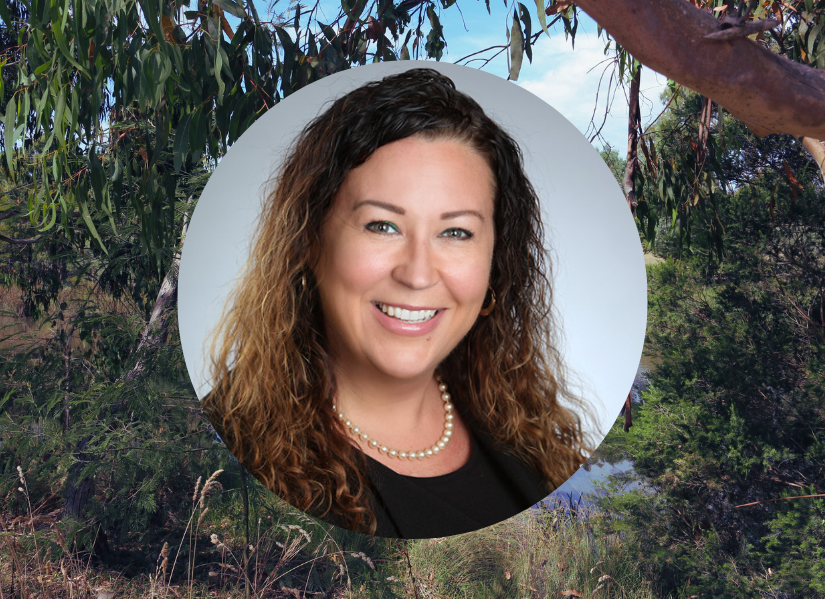
As Chief Regenerative Officer at WWF-Australia, Nicole Forrester is helping shape a future where nature, climate and communities are not viewed as separate challenges, but as deeply interconnected opportunities for transformation. A proud Wiradjuri woman with more than two decades of leadership experience spanning government, diplomacy, corporate innovation and community engagement, Nicole brings a unique perspective to some of the most pressing environmental and social issues of our time. At the heart of her work is a commitment to First Nations knowledge, inclusive decision-making and the belief that regenerative thinking can create lasting change for both people and planet.
In this Alumni Spotlight, Nicole reflects on the values that have guided her remarkable career, from her earliest connections to Country to her vision of becoming a “better ancestor” through decisions that serve future generations. She shares insights into the importance of deep listening, the power of bringing diverse knowledge systems together, and why Indigenous approaches to Caring for Country offer lessons that are increasingly relevant in a climate-changed world. Thoughtful, hopeful and grounded in community, Nicole’s reflections challenge us to rethink leadership, conservation and the role each of us can play in creating a more regenerative future.
As a proud Wiradjuri woman, how has your identity shaped the way you understand leadership, responsibility, and care for Country?
It’s foundational, as my earliest memories with my parents are being in nature. We humans are not separate from Country, something First Peoples have known since the first sunrise. For me, leadership means being a ‘better ancestor’: making decisions today that hold the aspirations of the generations who come after us. The responsibility is really an opportunity for us all to listen deeply to the lived experience of Communities and to refer any Power I have the privilege of holding into the service of others. To ‘Care for Country’ is both a duty and a privilege that guides everything.
You’ve worked across innovation, policy, and community, how do you navigate those different worlds to create meaningful change?
The thread running across my career - from diplomacy and government to corporate innovation, regenerative conservation and now board governance - has been bringing together diverse knowledge systems to solve complex problems. Working at the intersection of innovation, nature, climate and community, I've learnt that lasting change is anchored in deep listening and good governance by weaving diverse perspectives, including First Nations knowledge, through sound judgement. That's how strategy becomes measurable impact, because the best outcomes are always built together.
What do you think is still misunderstood about Indigenous approaches to land and nature?
The biggest misconception is that Caring for Country practice is separate from, or somehow lesser than, western science. In truth, humans are part of nature, not separate from it, and Indigenous Knowledge systems are sophisticated, evidence-rich and tested over tens of thousands of years. Past conservation, even when well-intentioned, hasn’t always served Communities or Country’s best interest. The opportunity isn't to choose between Traditional Knowledges and western science, it's to honour Traditional Knowledges for their own inherent worth, which can open new understanding of the challenges Western science is still working to solve.
WWF Australia’s goal to “Regenerate Nature by 2030” is ambitious. What steps and milestones are required to achieve this goal?
Regenerating nature by 2030 starts with a mindset shift - a mental reset from a linear, extractive economy to one that is circular and works with the abundance nature provides. The deeper work is systems change: reforming national nature laws and transforming industrial sectors to create the conditions for local practice to lead. Across three pillars - Sky, Country and Saltwater - we bring Community, Country and Climate together, moving from local to global and back, so community-led knowledge scales into national and regional impact. Milestones like reforesting landscapes and backing Communities both here and across the Asia-Pacific matter most when they empower people to care for their Country.
We’ve seen the positive impact of half-moon bunds in Arusha to restore the natural landscape. Do you have other examples of Indigenous regeneration practices that are being used today that you are particularly inspired by?
Cultural burning inspires me enormously because it sits within a larger Caring for Country paradigm - one that recognises healthy Community and Country as the same. Since time immemorial, Aboriginal Australians have used 'right-way fire' - cool, mosaic burns - to heal Country, and in the North Kimberley, Traditional Owner groups have revived it through their Healthy Country Plans. The impact? After the return to Indigenous fire management, massive late-season wildfires fell from near-annual to just one in a decade. I'm equally moved by rangers pairing Indigenous Ecological Knowledge with emerging technologies like AI to rediscover the platypus in the Wet Tropics - old wisdom and new technology, working together.
What gives you the greatest sense of optimism when thinking about inclusive conservation and the evolution of regenerative thinking in Australia?
What gives me the most hope is that regenerative thinking is no longer at the fringe, it’s moving into the mainstream. More people understand that our wellbeing, our livelihoods and economic prosperity for all depend on healthy nature. I’m inspired every time Communities and allies choose to talk action and walk with us, not simply hear us. I hold to a belief I’ve carried a long time: power is like a ‘magic pudding’ - when you share it, it only multiplies. When women, First Peoples and allies come together, impossible is nothing.
How do you see younger generations engaging with and reinterpreting cultural knowledge in today’s climate context?
Young people are catalysts for lasting change, and they’re reconnecting with cultural knowledge in powerful ways, whether that’s young rangers learning ‘right-way fire’ from Elders, or youth insisting that truth-telling and voice are central to healing Country. They aren’t just inheriting Traditional Knowledge; they’re reinterpreting it for a climate-changed world, pairing it with new technology and fresh urgency. As a ‘better ancestor’, my role is to bring their concerns and aspirations into today’s decisions, so their voices genuinely shape outcomes for a regenerative tomorrow.
What legacy do you hope your work in inclusive conservation and regeneration will leave for future generations?
To leave the generations who follow more healthy nature, not less. My deepest wish is that First Peoples and local communities are centred in decisions, and Traditional Knowledge is valued alongside western science as “business as usual” not the exception. If the understanding that all humans are part of nature, never separate from it, becomes common, then I’ll have played a part in the chorus to heal nature and ourselves.
What advice would you give to alumni wanting to work in sustainability and inclusive conservation?
Start with a cup of tea and a yarn. In this work, understanding another’s lived experience and aspirations matters more than any single technical skill. Solutions that are led by Communities last longer and go further. Be brave, back the value of your own perspective, and embrace every kind of mentor who comes your way. And remember: bringing people with you isn’t just the right thing to do, it’s the smart thing to do. Inclusion isn’t a nice-to-have, it’s what underpins the sounds judgement which weaves complex understandings to make the impact real and enduring.
What is one skill that you couldn’t live without and why?
Deep listening. I take the mindset that I can always learn more from others, so wherever I am I try to understand people’s lived experience and their aspirations for the future and then carry that into my decision-making. It’s a skill that lets me work across so many different worlds, from a Singapore boardroom to remote Australian Communities. It’s also the foundation of every meaningful partnership I’ve been honoured to build alongside others. Voice is not enough; listening, and then acting on with respect what you hear, is everything.
Have a question for Nicole? Connect with her on LinkedIn.
Author

Jenni is an innovative communications, marketing and engagement specialist with fifteen years of industry experience. She is also a proud QUT alumnus with a Bachelor of Creative Industries (Interdisciplinary).