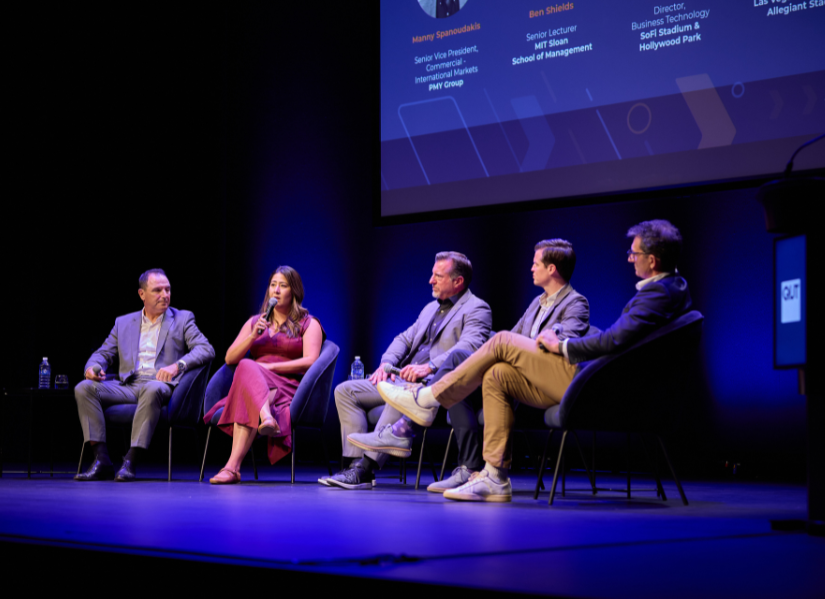
Global Insights from the Future of Sport Conference
QUT’s inaugural Future of Sport Conference in March 2026, brought together a diverse mix of global and national industry, academia and high-performance leaders and practitioners to present a genuinely interdisciplinary view of sport. The discussions reflected not only where sport is heading, but how universities can play a practical role in shaping that future.
Emily Rosemond, Director of QUT’s Brisbane 2032 Engagement, provides five key takeaways from the conference as we look toward Brisbane 2032 and beyond.
1. Getting the foundations right early is critical
A consistent theme throughout the conference, reinforced by the panel on smart stadiums and global venue examples, was the importance of early-stage planning. Decisions made at concept and design phase determine long term cost, capability and user experience. Retrofitting technology, connectivity or operational systems is significantly more expensive and often less effective. The discussion highlighted the need for early alignment across stakeholders, spanning infrastructure, technology, operations and commercial considerations, to ensure venues and systems are designed with future demand in mind, rather than responding reactively after delivery.
2. Data is now central across the entire sport pathway
The discussion on data science reinforced that data capability now spans the full sport ecosystem, not just elite performance environments. From understanding participation behaviours through to athlete monitoring and performance optimisation, data is informing decision making at every level. The shift is no longer about access to data, but about how effectively organisations integrate, interpret and apply it. Those with the ability to connect datasets and translate insights into practical action will be better positioned to improve outcomes across participation, performance and system wide efficiency.
3. Translating research into applied outcomes remains the key challenge
The panel on science and technology highlighted the ongoing challenge of moving from research output to real world application. While there is significant innovation occurring across universities and sport systems, the impact is only realised when it is embedded into practice. This requires structured collaboration between researchers, coaches, practitioners and industry partners. The focus needs to shift toward implementation pathways, ensuring insights are practical, accessible and aligned to the operational realities of sport environments, rather than remaining within academic or experimental settings.
4. High performance is increasingly about systems and culture, not just individuals
The athlete performance discussion reinforced that sustained success is underpinned by well-designed systems rather than individual talent alone. High performance environments are now defined by how effectively they integrate coaching, performance science, wellbeing, and operational support. Culture is a critical factor, influencing consistency, adaptability and long-term outcomes. There is a clear requirement to invest in system capability, including people, processes and environments, to ensure athletes are supported holistically and can perform reliably within increasingly complex global performance contexts.
5. The definition of sport is expanding, and we need to adapt with it
The session on next generation sports demonstrated that the boundaries of sport are continuing to evolve. Emerging formats, digital integration, and changing participation behaviours are reshaping how sport is defined and consumed. This creates both opportunity and complexity for governing bodies, institutions and venues. Flexibility in policy, infrastructure and programming will be required to remain relevant to future audiences, while still supporting traditional sport structures. Adapting to this shift will be critical in maintaining engagement and ensuring long term sustainability across the sector.
Emily Rosemond
Director, Brisbane 2032 Engagement
Author

Jenni is an innovative communications, marketing and engagement specialist with fifteen years of industry experience. She is also a proud QUT alumnus with a Bachelor of Creative Industries (Interdisciplinary).