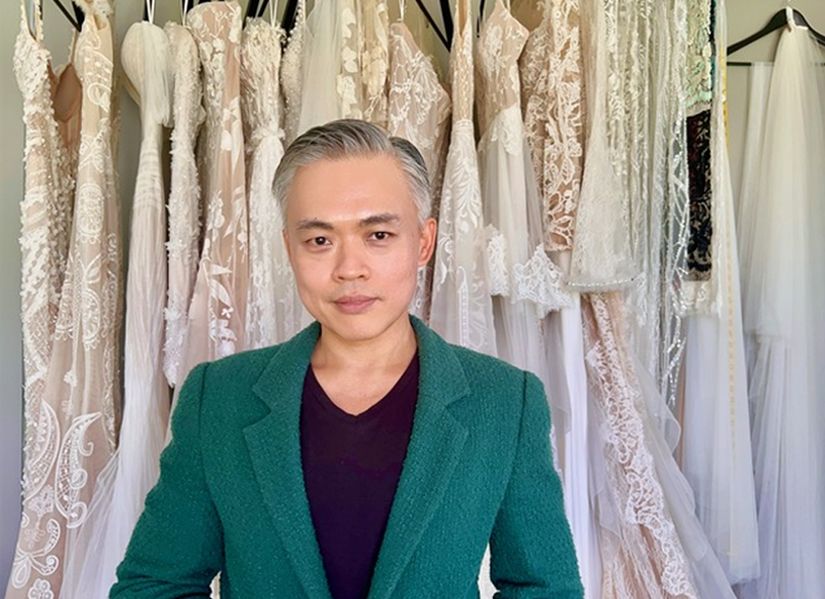
George Wu is a Brisbane-based couture fashion designer renowned for his refined approach to bridal and evening wear, with a career spanning over two decades since launching his eponymous label in 2005. George has built a reputation for exceptional technical precision, combining traditional couture techniques with a modern, ethereal aesthetic. His bespoke designs have been featured in international publications and worn by high-profile clients including Angelina Jolie and Margot Robbie. George sits down with Alumni Team to discuss his legendary attention to detail, commitment to craftsmanship and where fashion is going in the next five years.
What was your first role after graduating, and how did you land it?
During my final year of study, I worked for a few designers in sewing and pattern cutting. After graduating with a collection, I decided to approach boutiques to see if they would stock my work. To my surprise, they placed several orders, and I began working for myself.
What does a typical day look like in your role?
A typical day consists of client liaison, bookkeeping, material sourcing, and content planning, while also acting as the technical advisor for the atelier team. Serving as a mentor for the team is a core part of the daily routine. As a business owner, it is necessary to be a "jack of all trades," which is quite different from the stereotypical perception of what a designer actually does.
How are climate change and sustainability reshaping the fashion industry?
Slow investment fashion has become a central focus after seeing how much waste the industry can generate. The goal is to create pieces that are technically well-made and unique, giving clients a real sense of confidence. Because consumption is such a significant issue, the studio prioritises careful pattern placement to keep fabric waste to an absolute minimum.
Any scraps that are left over are kept for sampling or cleaning to delay them from ending up in a landfill for as long as possible. Even simple habits, like cutting up paper with a clean back to use for studio communication notes, help the environment while keeping costs down for a small business. It really comes down to the "care factor"—when you lead with that mindset, every small act counts.
What major shifts do you expect in the fashion industry over the next five years?
The fashion industry is becoming so fragmented that I expect it to be less about broad trends and more about which specific culture you find relevant. High-end art fashion will follow a different path compared to street fashion, goth culture, or Asian culture.
Social media has become a place where people find their own sense of belonging, so I believe businesses really need to focus on who their specific customer is and ensure that matches the unique strengths of the business. We are going to see less and less "mainstream" fashion that everyone follows; instead, fashion will be about sending a signal of who you are and where you belong.
What types of roles do you think will exist in the future that don’t exist now?
The fashion industry is essentially the opposite of a necessity, so it’s already filled with every role you can think of to encourage people to consume products. I honestly can’t think of any roles that aren't already in place, even looking toward the future. Fashion is constantly focused on what’s next because it’s designed to entice and sell you things you didn’t even know you needed. Because it’s always so far ahead, it’s hard to imagine a role that hasn't been thought of yet!
What advice would you suggest to recent graduates hoping to break into fashion industry?
You absolutely have to have a go at every aspect of the industry to find what you’re really good at. Once you find that, you can grow that strength into your competitive edge. Having technical skills is way more important than just being good at design. Design is a miniscule part of the industry, but it’s so glamorised that people think it’s everything—it’s not.
What is one skill that you couldn’t live without and why?
I never truly appreciated my 3D visualisation skills until recently. I have always found it very easy to learn sewing and pattern cutting because I can see the construction in my head; I see the pieces in 3D, where I can flip them any way I want and adapt them to different uses. While many people struggle with the technical side of cutting and sewing, I find it quite natural. I usually enjoy pushing a specific technique further just for curiosity’s sake, to see how much it can be adapted. So, the skill I absolutely couldn’t live without is my ability to visualise in 3D.
Author

Joanna is an integrated marketing communications specialist with an interest in the Faculties of Health, Business and Law. She holds a Master of Business, Bachelor of Mass Communication and Diploma in Business Information Systems.