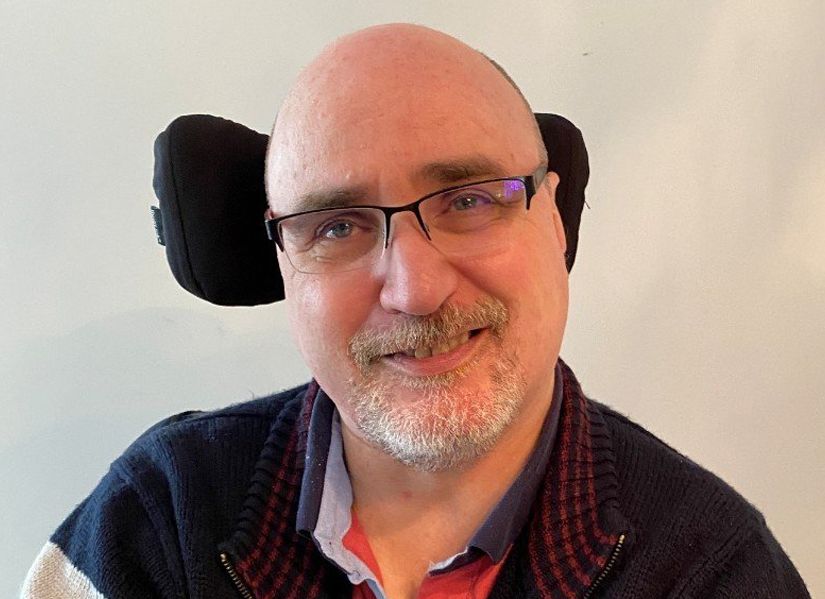
Gary Allen is the Co-Founder of Enabled.vip, a platform that provides the disability community with revenue streams outside of traditional nine-to-five roles. Gary has lived experience of disability as an individual with Progressive Multiple Sclerosis who relies on a powered wheelchair for mobility.
The Alumni team sat down with Gary to discuss his business and how to support a more inclusive workplace, regardless of when people join the community.
Can you tell us more about Enabled.vip and what inspired you to start the business?
Between 2003 and 2024, I was the Managing Director and General Manager of a research ethics and integrity consultancy business. It grew from a passion project (a hobby really) into a successful national and international firm. I realised I'd gained valuable insight and experience that I wanted to pay forward, particularly in addressing the approach to disability workforce engagement in Australia.
Only 48% of Australians with disability are engaged in the workforce, compared to 81% of the non-disabled1. Around 45% of the Australian disability community lives in poverty2. Recently, ABC reported a succession of Australian governments (of both major parties) over the last 30 years spent over a billion dollars on this cause, and only improved matters by 8%3.
The current approach focuses almost exclusively on getting people into a ‘regular job,' ignoring that, for many disabilities, people do not know hour-to-hour if they will be well enough to work. This is incompatible with even casual work. Although this is not the fault of employers or people with disability, it does leave them financially vulnerable and socially isolated.
Disability entrepreneurship is a promising answer to these intractable problems. Enabled.vip is a charitable, national and award-winning disability service. We provide one-to-one mentoring, monthly webinars, a resource library, an internal discussion board and self-paced capacity-building modules currently in development with QUT.
Can you share some ways an organisation can support a more inclusive workplace?
There are a few ways in which a business can establish, nurture, and support a more inclusive workplace:
- QUT is developing a toolkit to help employers design, continually evaluate and improve the workplace. To receive a copy once it is released, please contact Dr Jannine Williams (jannine.williams@qut.edu.au).
- Establish a reference group to inform the design and operation of the workplace. Initially, the membership of the group may be external to the business, but eventually, the membership of the reference group would be internal to the business.
- Advertise for people with lived experience. Have this as a selection criterion for any interview or appointment decision. This may also include looking for people with connections to the Australian disability community.
- Consider establishing flexible work arrangements, in terms of time of the day and location for work. This flexibility may make it easier for people with disability to work for your business.
- Ensure that the workplace is set up to support accessibility, such as ramps and disability toilets for team members in a wheelchair.
- Look for ways to acknowledge the contribution of the reference group and team members with lived experience.
- Decide upon a review timetable for your business.
What does employment mean for an individual with a disability?
Workforce engagement is a fundamental component of modern Australian life—it is essential for dignity, agency and meaning. There is plenty of evidence that a ‘regular job’ is necessary for financial independence, mental health, and well-being.
Depression and mental health difficulties are often common for Australians with a disability, this can be especially true for those who are unemployed, under-employed or not engaged in meaningful work.
Enabled.vip provides resources for Australians for whom a ‘regular job’ is not a viable option. It facilitates Australians with disability in creating their own jobs. We envisage a future where Australian would-be entrepreneurs with disability are celebrated and supported as future business leaders, tax contributors and employers.
Do you have any advice for someone who comes to the disability community as a result of an acquired injury or diagnosis?
Your life isn’t over, but you are just beginning a new chapter. Seek the support of a NDIS Support Coordinator, occupational therapist and psychologist. The NDIS also has a support category for ‘finding and keeping a job’. In this context, employment includes self-employment and entrepreneurship.
Funds like this can help you to build your capacity, support and knowledge.
If you had a magic wand what is the one barrier you would like to see removed to improve the employment of individuals with a disability?
Too often, prejudice and stereotyping can hold people with disability back from pursuing their employment potential and aspirations. If I had a magic wand, I would make it so that employers and supervisors would only see the potential, ability and energy of people with disability.
Around 1.9 million Australians of working age live with a disability. This number is likely to increase as the average age of the Australian population increases. Since the COVID-19 pandemic, many Australian industries are facing chronic skills shortages. We can ill afford to ignore the potential and enthusiasm of Australian workers with disability.
With some relatively modest accommodations and supports, employers can facilitate many Australians with a disability to become productive and valuable members of their teams.
Can you name some of the individuals who inspire you? What qualities in these individuals do you admire and seek to emulate in your own work/life?
One of my inspirations is Stephen Hawking, a brilliant man who made a pivotal contribution to physics and astrophysics, despite living with a terrible medical condition and severe disability symptoms.
In close second is Dinesh Palipana OAM, a lawyer, researcher, author and disability advocate. Dinesh is the patron of Enabled.vip and a fellow QUT Alumnus.
What is one skill you couldn’t live without and why?
I consider my disability to be my superpower, boosted by empathy, respect and a lifelong curiosity about ways in which to assist people to pursue their potential. My work as a consultant opened many doors for me and the fact I did so despite my medical condition has enabled me to become a disability advocate.
References
- Australian Government Institute of Health and Welfare. 2024. “People with disability in Australia.” Accessed November 14, 2024. https://www.aihw.gov.au/reports/disability/people-with-disability-in-australia/contents/summary
- PWC. 2011. “Disability expectations.” Accessed November 14, 2024. https://www.pwc.com.au/industry/government/assets/disability-in-australia.pdf
- Gibbs, E. 2023. “Disability employment rates haven’t shifted in decades — blame discrimination.” Accessed November 19, 2024. https://www.crikey.com.au/2023/01/23/disability-employment-rates-discrimination/
- People with Disability Australia. 2023. “Extent and Nature of Poverty in Australia.” Accessed November 19, 2024. https://pwd.org.au/extent-and-nature-of-poverty-in-australia/
Dr Gary Allen
QUT degree - Doctor of Social Science (2016)
Do you have a question for Gary? Connect with him on LinkedIn
Author

Joanna is an integrated marketing communications specialist with an interest in the Faculties of Health, Business and Law. She holds a Master of Business, Bachelor of Mass Communication and Diploma in Business Information Systems.