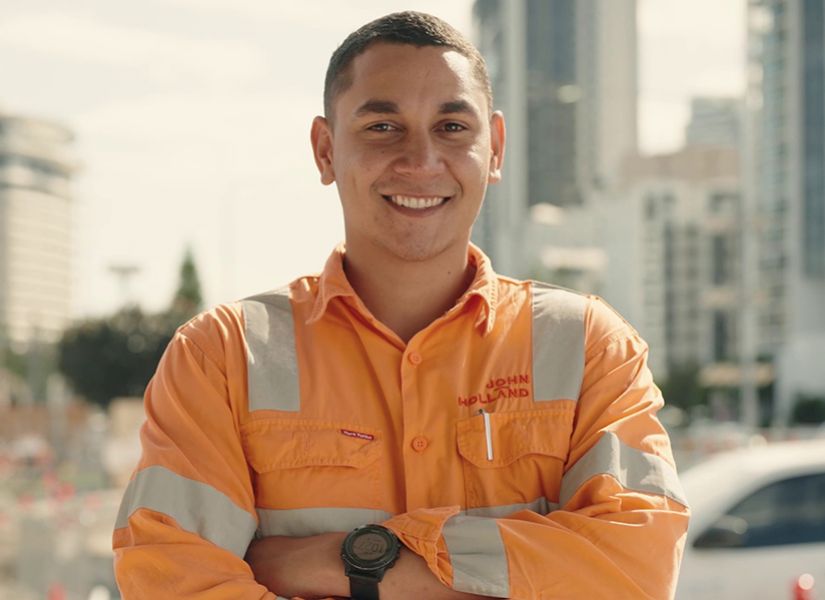
At just 25, Bhosten Savage is already shaping the future of Australia's infrastructure. As a Project Engineer at John Holland, he’s played a key role in delivering major projects like Brisbane Airport’s New Parallel Runway and Cross River Rail. Born on Thursday Island and raised in Brisbane, Bhosten brings a deep understanding of the challenges faced by regional and remote communities—and a clear sense of purpose in addressing them.
In this Q&A, he shares what drives his work, how cultural values shape his leadership, and his advice for the next generation of Indigenous changemakers.
What first inspired your interest in engineering and working on major infrastructure projects?
Growing up, I was interested in how infrastructure connected people, especially in places where distance can mean disadvantage. Constructing major infrastructure gave me a way to translate that interest into impact, solving complex problems, and ultimately delivering projects that improve lives.
What have been some of the standout projects in your career so far, and why?
Some of the most meaningful work I’ve done was in places where infrastructure directly improves people’s ability to access opportunity, whether that’s through constructing runways, highways, bridges, or rail infrastructure. The construction of Brisbane Airport’s New Parallel Runway or tunnelling cross passages on Cross River Rail will ultimately increase their given capacity and make air or public transport a more viable option for future populations. Those are the projects where you can feel the importance straight away.
What drives your commitment to infrastructure delivery in regional and remote communities?
Being born on Thursday Island in the Torres Strait, but growing up in Brisbane, I knew firsthand how significant the education, health, and economic gap is between urban and regional/remote areas. It is my belief that this gap in opportunity is, in part, due to the lower quality and quantity of critical infrastructure, placing limits on one's ability to access opportunities that will ultimately improve their quality of life. The ability to work on projects like Archer River Crossing in Cape York, where a 230m long bridge reduces the frequency of road closures due to flooding from 85-days to 3-days each wet season galvinised my commitment to ensuring that my career path had a chance to improve outcomes for remote and regional communities through constructing critical infrastructure for remote and regional communities.
In what ways did your time at QUT prepare you for the challenges and opportunities of your career?
QUT equipped me with a strong theoretical foundation that can be applied daily in project delivery, whether it’s understanding technical design, managing risk, leading teams, or navigating stakeholder complexity. The theory directly informs how I approach engineering challenges. My Honours and postgraduate research also deepened my understanding of workforce dynamics, which has been invaluable in managing teams on high-pressure projects. The real-world focus of QUT’s programs meant I was ready to contribute from day one.
Are there values or perspectives from your culture and community that influence how you work or lead on projects?
Absolutely. Indigenous ways of knowing emphasise deep listening, collective responsibility, and respect for Country. These values guide how I lead teams, build relationships, and ensure that infrastructure is delivered with integrity and care.
What have you learned about leadership and service through your involvement with Hand Heart Pocket?
The opportunity to be a Board Observer, through the Observership Program and AICD’s First Nations Director Scholarship Program, has deepened my understanding of purpose-driven leadership, particularly how philanthropy and strategic investment can enable lasting change. It’s also reinforced the importance of listening to lived experience when making governance decisions.
Do you see your work as helping to pave the way for others from similar backgrounds to enter the industry?
That’s always the goal. Whether mentoring younger engineers or being a visible example, I hope my journey shows that there’s a place for Indigenous leadership in construction and that we need more diverse faces and voices shaping the built environment.
When working on Country—especially in regional or remote areas—how important is it to approach projects with cultural awareness and respect?
It’s essential. Cultural respect isn’t a box to tick. It’s about relationships, permission, and ensuring that Country is not only heard in decision-making but also heard at the right time. Projects succeed when they’re shaped with community, not just delivered to them.
What advice would you give to Indigenous students at QUT who want to build strong careers and make a difference?
Back yourself. Your voice and perspective are strengths. Build your technical skills, seek mentors, and stay connected to your community because that connection will keep you grounded and motivated.
What kind of leader do you hope to become, both in your industry and for your community?
I want to be a leader who opens doors for others, challenges the status quo, and delivers with purpose. For my community, I hope to embody what’s possible. And in the industry, I aim to lead with both technical merit and social responsibility.
Bhosten Savage
QUT degrees - Bachelor of Urban Development (Honours) 2020 and Master of Project Management 2023
Have a question for Bhosten? Connect with him on LinkedIn.
Author

Zoe is a marketing and communications professional and Alumni Communications Coordinator at QUT. She is also a proud alumnus with a Bachelor of Business (Marketing).