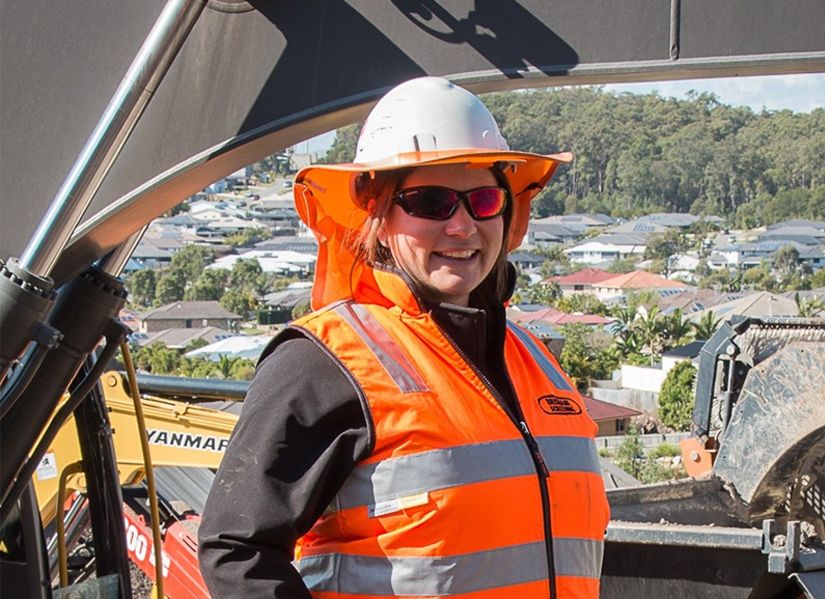
Most Queenslanders rarely think about what happens after the bin goes out and that’s exactly the point for Alison Price. As CEO of the Waste Recycling Industry Queensland (WRIQ), she represents an industry that underpins public health, environmental outcomes and everyday life - working at the intersection of policy, sustainability and community expectations.
Her career has been anything but conventional - from studying part-time while working full-time, to launching her own businesses and helping build a construction and mining venture that evolved into SoilCyclers. In this article Alison reflects on the challenges of shifting community behaviour, the economics of recycling, and the principle that continues to unite the sector: the bin must always be collected.
Can you tell us about your journey since graduating from QUT?
I completed a Bachelor of Business, majoring in Marketing with a minor in Entrepreneurship, graduating in 2003, while studying part-time and working full-time in various administrative roles. I then joined WorkCover Queensland, where I held a variety of roles, including working on projects within the CEO’s office. This was a particularly interesting experience, and I later moved into business improvement and procedural analysis—although this was quite different from my original marketing focus.
I then started my own business, which I closed during the Global Financial Crisis, followed by a venture in the construction and mining sector that evolved into SoilCyclers. After stepping away from that business, I was invited to become CEO of the Waste Recycling Industry Queensland (WRIQ), a role I’ve held for the past few years and have really enjoyed.
Could you introduce Waste Recycling Industry Queensland and describe its key priorities?
WRIQ is a member-based organisation representing around 100 businesses across the state. Collectively, our members own and operate approximately $3.8 billion in waste and recycling infrastructure, directly and indirectly employing more than 16,000 Queenslanders, and collect around 97% of Queensland's waste.
As CEO, my role is highly focused on advocacy. The waste and recycling sector operates within a complex regulatory environment and engages with all three levels of government, so a significant part of my work involves representing industry interests and helping shape policy outcomes. I also serve as a spokesperson for the sector, working with government, the media and stakeholders to raise awareness of key issues and opportunities.
Importantly, I see my role as helping bring the industry together around common goals, ensuring businesses are working collaboratively to advance sustainable outcomes and strengthening Queensland's waste and recycling sector.
What are the biggest challenges in building trust with communities, and how do you overcome them?
Traditionally, the waste and recycling industry has been very good at providing essential hygiene and sanitation services and responding quickly after natural disasters. However, where we haven't always been as effective is in communicating the value of what we do and why it matters.
One of the biggest challenges we face is helping the community understand both the critical services the industry provides and the complexities involved in delivering them. In Queensland, those challenges are amplified by our geography. We have a growing population spread across vast distances, which makes collecting, transporting and processing recyclable materials more difficult and expensive than in many other parts of the world.
At the same time, landfill remains a relatively low-cost option in Australia compared with many other countries, which can make it difficult for recycling to compete on economics alone. Navigating these realities requires close collaboration between industry and government to ensure policy settings support for both environmental outcomes and a sustainable, financially viable recycling sector.
Many sustainability challenges ultimately come down to human behaviour. What role does education play in improving recycling outcomes?
I think we've been educating people about recycling for decades, yet the results suggest education alone isn't enough to drive meaningful behavioural change. While awareness is important, people are often more likely to change their habits when there is a direct financial incentive or consequence.
We saw this reflected in a survey we conducted last year on community attitudes towards waste and recycling. More than 97% of Queenslanders expressed strong support for recycling, which is encouraging. However, many respondents also believed they should be financially rewarded for recycling, much like the 10 cent refund available through container deposit schemes.
What many people don't realise is that recycling can, in some cases, cost more than sending materials to landfill. That disconnect between public perception and the economic realities of recycling is one of the sector's biggest challenges. It's why education remains important, but on its own it is unlikely to deliver the level of change needed to improve recycling outcomes at scale.
What has been the most rewarding (or challenging) aspect of your work in this field?
The waste and recycling sector is incredibly diverse, so one of my biggest challenges when I started was finding common ground and bringing the industry together around shared goals. I'm proud to say we've achieved that.
What makes the sector unique is its collaborative culture. Despite being competitors, businesses work closely together and share a strong commitment to ensuring essential services continue uninterrupted. There is a common belief that the bin must always be collected.
That's what I find most rewarding about the industry. At its core, it's focused on delivering the essential hygiene and sanitation services that communities rely on every day.
What is one skill you couldn’t live without and why?
The ability to put myself into other people’s shoes and understand their motivations.
QUT degree – Bachelor of Business (2003)
Do you have a question for Alison? Connect with her on LinkedIn.
Author

Joanna is an integrated marketing communications specialist with an interest in the Faculties of Health, Business and Law. She holds a Master of Business, Bachelor of Mass Communication and Diploma in Business Information Systems.