
Skip to content
QUT
QUT - the university for the real world
  • Login
  • Contact QUTContact QUT
Study
Undergraduate
  • Architecture and built environment
  • Arts
  • Business
  • Communication
  • Creative arts
  • Design
  • Engineering
  • Diplomas and pathway programs
  • Health
  • Information technology and games
  • Justice
  • Languages
  • Law
  • Mathematics and data science
  • Science
  • Teaching
  • Mid-year entry
  • QUT College
  • New to QUT
  • Why choose QUT
  • Double degrees
  • Vertical degrees
  • Flexible study
  • Applying guide
  • Bridging programs
  • Fees, costs and scholarships
  • Relocating to Brisbane
  • Student life
  • Events
Postgraduate
  • Architecture
  • Business
  • Communication
  • Design
  • Education
  • Engineering
  • Health
  • Information technology and games
  • Justice
  • Languages
  • Law
  • Mathematics and data science
  • Project management
  • Science
  • Doctor of Philosophy
  • Master of Philosophy
  • Professional doctorate
  • Why choose QUT
  • Fast track to postgraduate
  • Scholarships
  • Applying guide
  • Flexible study options
  • Student life
  • Events
  • QUT Leadership Institute
Online study

Our collection of courses are taught entirely online, giving you the flexibility to study anywhere, anytime.

  • Our online undergraduate degrees
  • Our online postgraduate degrees

Browse by study area

  • Business
  • Creative industries
  • Digital capability
  • Education
  • Engineering
  • Health
  • Justice
  • Languages
  • Law
  • Leadership
  • Science
  • Transformation
International
students
  • Architecture and built environment
  • Arts
  • Business
  • Communication
  • Creative arts
  • Design
  • Engineering
  • English language and pathway programs
  • Health
  • Information technology and games
  • Justice
  • Languages
  • Law
  • Mathematics and data science
  • Project management
  • Science
  • Teaching and education
  • Student life
  • Student support
  • QUT in your country
  • Why choose QUT
  • Living in Brisbane
  • Scholarships
  • QUT College
  • Applying guide
  • Study abroad
  • Events
  • Ask us a question
  • Global partnerships
  • Agent resources
Short courses and professional education

Bringing together knowledge from across the whole university to help you or your organisation getfuture fit, fast.

  • More about us
  • Contact us

Improve your performance, advance your career or make a change with real world short courses.

  • Browse all courses

Take your development further with advanced learning and award pathways.

  • Pathways to Politics for Women
  • Public Sector Management
  • Enterprise Leadership

Achieve exceptional business outcomes with co-designed executive education.

  • Tailored executive education
  • Corporate Bundles
Match My Skills

Create a personalised guide to reaching your dream career by taking our Match My Skills quiz.

Research
Why QUT
  • Our research vision
  • Equity and diversity
  • Support for researchers
  • Meet our experts
  • Ethics and integrity
  • Research jobs at QUT
  • Bioinnovation Research Facility
  • Central Analytical Research Facility
  • Design and Fabrication Research Facility
  • Digital Observatory
  • eResearch
  • Medical Engineering Research Facility
  • Research Engineering Facility
  • Samford Ecological Research Facility
  • VISER
  • Advanced Robotics for Manufacturing Hub
  • Herston Imaging Research Facility
  • Translational Cell Imaging Queensland
  • Translational Research Institute
Our research
  • Architecture and built environment
  • Business and law
  • Creative industries, education and social justice
  • Engineering
  • Health
  • Science
  • Browse all our projects
  • Explore open research projects

    Get involved with research projects that tackle real-world challenges.

We're invested in research identified as priorities for the world, the nation and the state.

  • Our strengths
  • Indigenous research
  • Sustainability
  • Research initiatives

See the stories behind QUT research. Read in-depth features and commentary about innovations that are shaping the world.

  • Read Real Focus
Study with us
  • Doctor of Philosophy

    Make a significant contribution to new knowledge in your field.

  • Master of Philosophy

    An ideal stepping-stone to a PhD.

  • Professional doctorate

    Integrate a research degree into your professional goals.

  • Find a supervisor
  • Find a research topic
  • Scholarships (Australian and New Zealand students)
  • Scholarships (international students)
  • Tuition and study costs
  • Supporting your research journey
  • Applying guide
  • e-Grad School
Partner with us
  • Our experts

    Search for a research supervisor, industry expert or collaborator.

  • Research jobs at QUT

    Integrate a research degree into your professional goals.

  • Engage with our graduate researchers

    Work with graduate researchers to help solve your real-world problems.

  • Research initiatives

    Learn about QUT’s involvement in collaborative research initiatives.

  • Plant genomics
  • Australian Centre for Health Law Research
  • Biorefineries for profit
  • CARRS-Q
  • PRIME Futures
Join a research study

Help our researchers develop solutions for real-world challenges by participating in research.

Engage
Industry and partnerships
  • Employment and mentorship

    Find graduate and student talent to employ, or mentor our students.

  • Work placements

    Partner with us to offer work experience opportunities to our students.

  • Sponsor scholarships and events

    Make a difference to students and the university.

  • Olympic and Paralympic Games 2032

    A once-in-a-lifetime opportunity to showcase SEQ's strengths to the world.

  • Research partnerships

    Start a collaborative research partnership with our experts.

  • Expertise for industry

    We can help with more than research. See how we can support your business.

  • Customised executive education

    Customised professional development solutions for your team.

  • Short courses and professional development

    Study a short course for personal or professional development.

  • QUT Leadership Institute
Giving
  • Ways to give

    Discover the different options to donate to QUT.

  • Donor impact

    Whether you've chosen to support students in need through a scholarship fund, want to help advance a vital research project, or give to build a stronger community program, your gift is making a real difference.

  • Support students

    Give the life-changing gift of education by contributing to a scholarship.

  • Support research

    Help shape a better world by giving to a research project.

  • Support community

    Elevate society by supporting community programs that foster meaningful connections.

Alumni
  • New graduates
  • Get involved
  • Grow your knowledge
  • Connect and engage at events
  • Industry-leading alumni
  • Indigenous Australian alumni
  • Alumni tools and FAQs
  • Discounts and offers
  • Alumni newsletter
Meet our outstanding alumni

See the diverse achievements and impact of alumni who are leaders in their professions and communities.

About QUT
Discover QUT
  • Our university

    Learn more about our history, campuses and facilities, leadership team, organisational structure, and governance and policies.

  • Faculties and schools

    Explore our faculties and schools and the real-world learning experiences and research they are engaged in.

  • Strategy

    Connections - the QUT Strategy 2023 to 2027sets out our shared purpose for the future of the university: to provide transformative education, student experiences and research relevant to our community

  • Indigenous Australians

    We're embedding Indigenous Australian cultures, knowledges and perspectives across everything we do.

  • Priorities

    We are working to improve our society and environment through our commitment to equity, diversity, inclusion, creativity, sustainability and improving health and wellbeing.

  • Achievements and recognition

    As one of Australia's leading universities, we are internationally recognised through rankings, and we are committed to celebrating staff and student successes.

  • Working at QUT

    Find job opportunities and learn more about working at QUT.

Campuses and
venues
  • Maps and getting here
  • Around campus
  • Libraries and learning spaces
  • Gym and sports facilities
  • Food and retail
  • Maps and getting here
  • Around campus
  • Libraries and learning spaces
  • Gym and sports facilities
  • Food and retail
  • QUT Art Museum
  • William Robinson Gallery
  • Science and Engineering Centre
  • The Cube
  • Old Government House
  • Gardens Theatre
  • Education Precinct
  • Creative Industries Precinct
  • Virtual tours
  • Science in 360°
  • Virtual reality projects
  • Street art on campus
News and events
  • All QUT news
  • Business
  • Creative industries
  • Education
  • Engineering
  • Health
  • Law
  • Science
  • Justice
  • Real Focus
  • Alumni
  • All QUT events
  • Alumni
  • Business
  • International
  • Staff profiles
  • Email: media@qut.edu.au
  • Phone: + 61 7 3138 2361
Take a tour

Explore the campus with 360⁰ videos and 3D tours of our facilities.

QUT Online
Match My Skills

Find your future with QUT's Match My Skills quiz. Create a personalised guide to reaching your dream career. It takes just 10 minutes.

Australia and NZ

Families rank online connectivity as essential as housing, food, electricity

  1. Home
  2. Study
  3. Families rank online connectivity as essential as housing, food, electricity
First published 1 November 2023

Australian families involved in a three-year investigation into digital disadvantage have rated online connectivity and digital skills as important to them as housing, food, and electricity.

Discussion of the report's findings is available via Webinar: The low-income families digital divide today (Nov 1) 12pm AEST/1pm AEDT.

QUT led the research into digital disadvantage in low-income families from six communities from North Queensland to Tasmania.

The report, titled Digital inclusion is everybody’s business, involved research teams from four universities who partnered with children’s charities to work closely with 30 families for three years.

The research analysed the digital inclusion implications of children’s home and school learning experiences, school leavers’ transitions into work and parenting in digital times.

QUT professor Michael Dezuanni said that low-income families need access to digital technologies because it is now essential for learning, work, and social connection.

“Digital accessibility for everyone needs to be seen as a human rights issue as important as running water and electricity with digital literacy required to access digital-by-default government services.

“Participating families reported great inconsistencies in how schools provide technology to students, and this highlights the need for a coordinated approach to supporting how children in low-income families access educational opportunities through digital technology.”

The Smith Family’s Head of Research Anne Hampshire said a lack of access to essential digital tools widens the knowledge gap between students.

“Not having access to essential digital tools like a device, reliable internet and technical support makes it extremely difficult for a student to fully engage with their education and puts them at risk of falling behind their peers at school,” Ms Hampshire said.

Researchers observed key differences between low-income families from urban areas to remote areas, highlighting a need for place-based approaches that were context specific.

The research also identified families sometimes must choose between digital connections and necessities like groceries.

Report co-author Dr Kim Osman said that low-income families across the country were feeling the effects of the cost-of-living crisis.

“Often tough decisions need to be made and parents and caregivers take on extra work or extra financial commitments that add to the strain,” she said.

“Families prioritise their children’s access to technology as they do not want their children to be left behind. We have observed potentially damaging financial and purchasing practices through use of buy-now-pay-later products which families often struggled to manage,” she said.

To improve digital inclusion of low-income families, the report made 11 recommendations detailing strategies to initiate in the next five years.

  1. Low-income families should have access to affordable prepaid products, including mobile and fixed line broadband.
  2. Digital service delivery platforms must be accessible for the most digitally excluded people.
  3. Educational authorities and policy makers should develop policy and guidelines for the provision of school technology to low-income students.
  4. Expand the range of consumer information available through agencies like Australian Communications Consumer Action Network (ACCAN) and increase consumer awareness of affordable telecommunications products.
  5. Devices provided to low-income families should be appropriate and fit-for-purpose.
  6. Investment needs to be made into designing and delivering digital inclusion programs for families and young people.
  7. Funding for digital inclusion programs and activities needs to be fit for purpose and sustainable.
  8. Rural and regional towns need support to meet the digital inclusion needs of low-income families, recognising the resource constraints often experienced by these communities.
  9. Essential community information needs to be well-planned and communicated across a variety of digital and non-digital platforms.
  10. Communities and organisations must invest in capacity to provide just-in-time support for families to access technology and digital services.
  11. Community-based organisations should collaborate to advocate for increased resourcing to support low-income families’ digital inclusion.

The research team included Professor Michael Dezuanni, Professor Marcus Foth, Professor Peta Mitchell, and Dr Kim Osman from QUT.
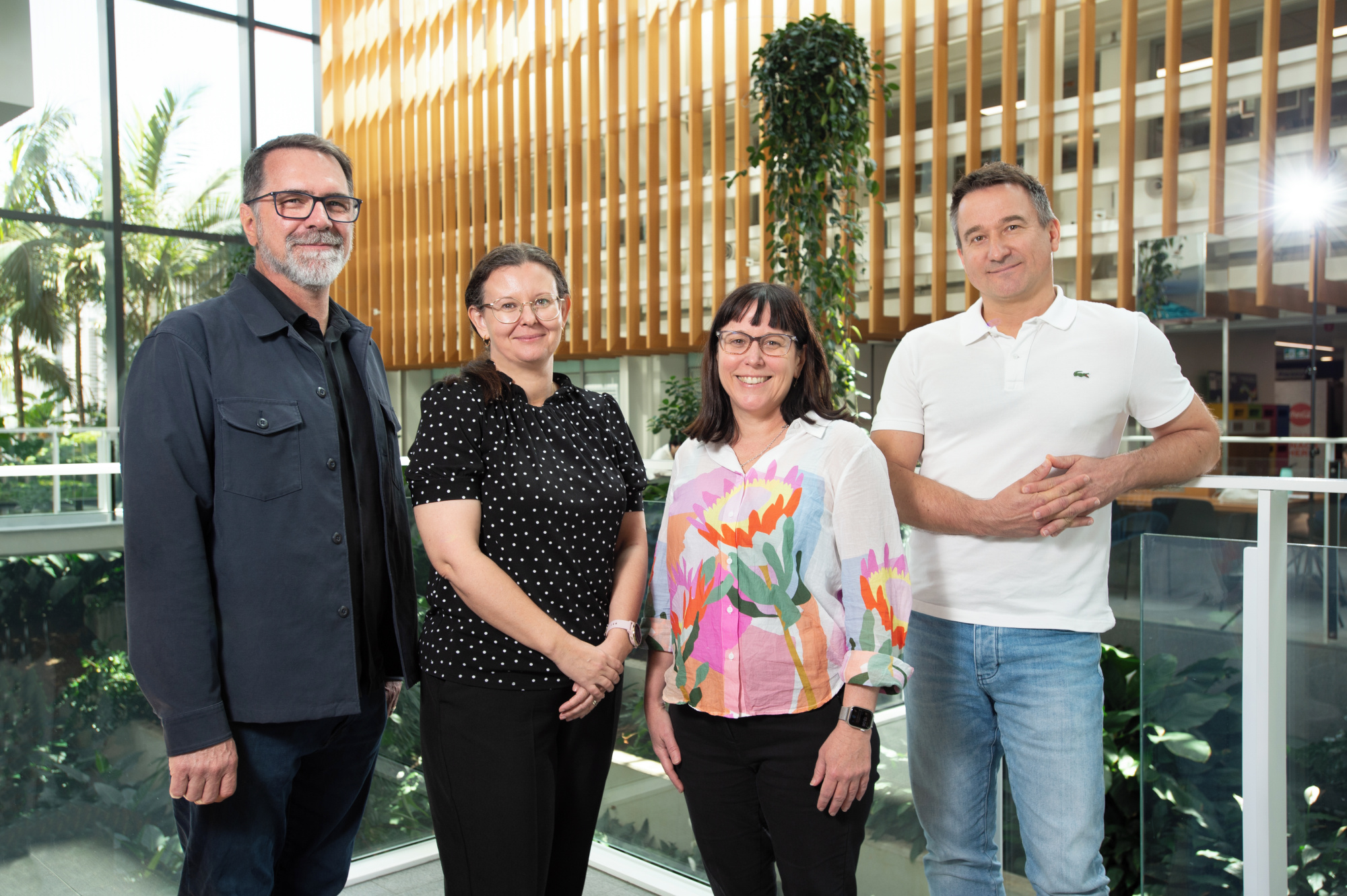
L-R: Professor Michael Dezuanni, Dr Kim Osman, Professor Peta Mitchell and Professor Marcus Foth.


Researchers affiliated from other institutions included Professor Anthony McCosker from Swinburne University, Dr Jenny Kennedy from RMIT, Associate Professor Tanya Notley from Western Sydney University, Dr Amber Marshall from Griffith University, Anne Hampshire from The Smith Family and Dr Marion Byrne from yourtown.

The project was part of the Australian Research Council Linkage Project (2021-2024) Advancing digital inclusion in low-income Australian families.

It is a partnership with Queensland University of Technology, Western Sydney University, RMIT University, Swinburne University of Technology, Good Things Foundation Australia, The Smith Family, yourtown, Infoxchange and the Digital Literacy Foundation.

A pdf of the report is available upon request.

Feature image: Gorodenkoff from Getty Images.

CONTACT: media@qut.edu.au or 0407 585 901 (after hours)
Smith Family: Andrew.dickson@thesmithfamily.com.au and 0421 285 529


Share on Facebook Share on X Email Share on Reddit Share on LinkedIn
Study Research Engage About QUT
  • Undergraduate study
  • Postgraduate study
  • PhDs and research degrees
  • Professional and executive education
  • International students
  • Study abroad and exchange
  • QUT College
  • Graduate success
  • Applying
  • Fees
  • Scholarships
  • Key dates
Whatever you want to study, our range of courses will give you the hands-on learning, industry connections and real-world perspective you’ll need to succeed.
Explore study at QUT
  • Why QUT?
  • Our research
  • Our experts
  • World-class facilities
  • Study with us
  • How to apply
  • Master of philosophy
  • PhD
  • Professional doctorate
  • Partner with us
  • Research jobs
Join us at the forefront of research and development. Access cutting-edge facilities and technology, work with world-renowned experts, and create real-world change.
Explore research at QUT
  • Industry and partnerships
  • Work with our students
  • Expertise for industry
  • Executive education
  • Give to QUT
  • Make a real impact
  • Ways to give
  • Alumni
  • Alumni benefits
  • Update alumni details
  • Alumni tools and resources
Connect with us and see how we can support you. We invite industry partners, alumni and our valued donors to join the vibrant, exciting QUT community.
Explore ways to engage with QUT
  • Our university
  • Our people
  • Achievements and recognition
  • Campuses and venues
  • News
  • Events
  • Jobs
  • Library
Learn what makes Queensland University of Technology (QUT) the university for the real world. Read about our goals for future growth, achievements and success, and the organisational structures that support us.
Explore QUT
QUT acknowledges the Traditional Owners of the lands where QUT now stands.
  • Login
  • Legal
  • Privacy
  • QUT on Facebook
  • QUT on Instagram
  • The QUTube
  • QUT on LinkedIn
  • QUT on TikTok
Our social media
Contact QUT
  • TEQSA Provider ID: PRV12079 (Australian University)
  • CRICOS No. 00213J
  • ABN: 83 791 724 622
  • Page updated: 11 April 2024

Book an appointment