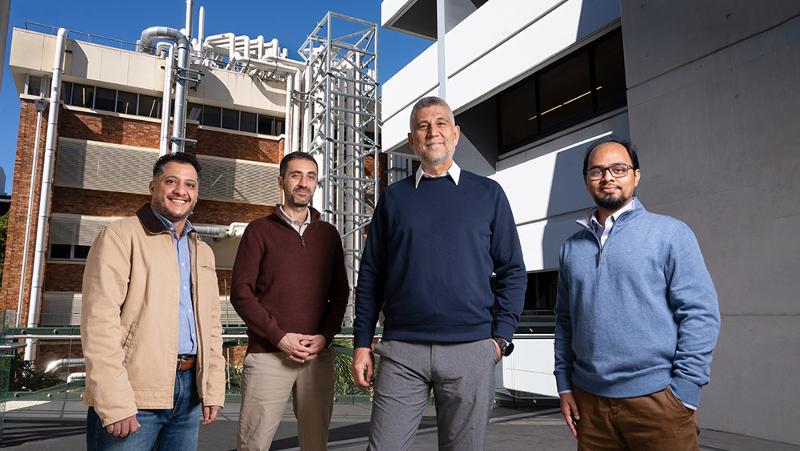
Published in the journal Urban Climate, the researchers argue that their Cooling with Consent framework addresses the fact that not all communities are the same as to which cooling initiatives they will accept and therefore AI-driven heat adaptation solutions cannot be imposed upon residents without their buy-in.
“A growing disconnection is emerging between technical capacity and implementation on the ground,” Professor Yigitcanlar said.
“The Climate AI framework we propose takes account of the fact that people’s response to heat risks is shaped by their lived experiences, cultural norms, and immediate priorities.
“Many communities do not see mitigation of increasing urban heat as urgent, especially when extreme heat has become normalised or overshadowed by more pressing concerns.
“If they have a strong connection to their neighbourhood they may resist visible interventions such as shade structures or tree planting if these are seen as altering their local identity or routines.”
Professor Yigitcanlar said that even when cooling initiatives gained community licence, they could be stymied by budget constraints, lack of coordination among various agencies, political priorities such as elections and regulatory approvals.
"Thus, we advocate shifting from conventional risk-based approaches to a readiness-based framework that prioritises where interventions are most socially and institutionally feasible.
"Our framework repositions AI systems as decision-support tools that are socially aware and procedurally grounded by using behavioural and institutional proxies to enhance planning, guide resource allocation and strengthen the legitimacy of the process.
“It is designed to build on data streams commonly used in urban planning, such as census data, administrative records, mobility patterns, and structured or unstructured public feedback.
“Our framework focuses on equitable deployment of community approved cooling systems by incorporating inclusion of vulnerable groups using census data and socio-economic datasets.
“Community readiness and legitimacy can be estimated using natural language processing (NLP) of citizen feedback and public discourse.
“Attachment to place may be inferred from geospatial behaviour, such as long-term residency or frequent public space use.
“Institutional inertia can be estimated using network analysis or lag metrics in policy implementation. Resource allocation should use indicators of institutional feasibility such as governance structure, inter-agency co-ordination and procedural readiness.
“Incorporating such indicators enables models to rank not only areas of high thermal stress, but also locations where adaptation is most feasible, equitable and inclusive and so more likely to succeed.”
The QUT research team comprised Professor Yigitcanlar, Tahsin Hussain, Abdulrazzaq Shaamala, Dr Kenan Degirmenci with researchers Professor Yan Liu from The Chinese University of Hong Kong, Professor Zhong Ren Peng from the University of Florida.