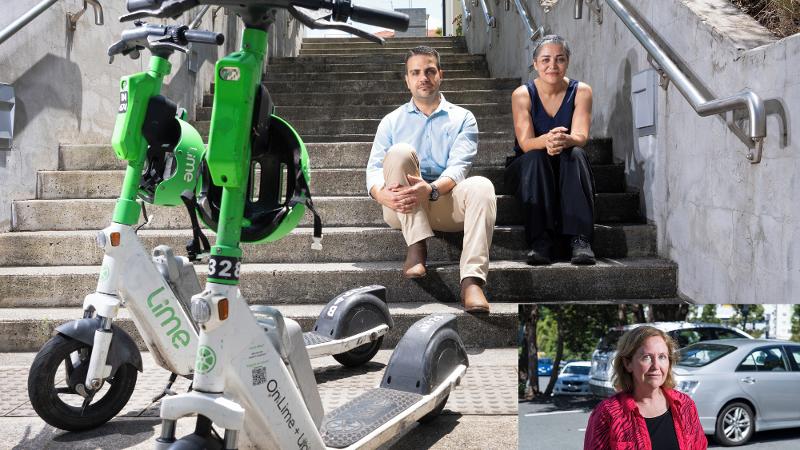
Riders of shared e-scooters are much more likely to attribute their near misses to inexperience than riders of privately owned e-scooters, a longitudinal study led by QUT road safety researchers has found.
Study suggests early training and practice for new riders
Safety improvements may level off within the first year
Survey of 285 Australian shared and private e-scooter riders
The study followed 285 Australian shared and private e-scooter riders over 12 months and found no statistically significant change in their near-miss rates over that period.
The study, led by PhD researcher Fariborz Mansourifar from QUT's MAIC-QUT Road Safety Research Collaboration, published in Safety Science, compared near misses and crashes on shared and private e-scooters to see if the same riders’ near-miss rates changed over a year.
''The rise in e-scooter injuries and deaths has prompted extensive research into e-scooter safety and regulation," Mr Mansourifar said.
''However, much of the existing research relies on hospital and police records, which do not capture near misses and often do not distinguish between shared and private e-scooter users.
''We surveyed riders from Queensland, Victoria, Western Australia, the ACT and Tasmania from July 2024 to June 2025 and again from July 2025 to June 2026.
''In each survey, riders reported crashes and near misses experienced in the previous 12 months, including details of their most recent event and the extent to which rider inexperience, road conditions and the behaviour of other road users contributed."
Mr Mansourifar said Australian states and territories all had different laws and regulations for e-mobility vehicles, with Queensland most recently requiring a driver's licence for riders who must be 16 or supervised by an adult from 12 and over.
"To our knowledge, this is the first study to follow the same e-scooter riders over time to examine changes in their safety outcomes," he said.
"The results showed most near misses involved another road user, most often a car (78 per cent at the follow-up survey and 70 per cent at the final survey).
"Most reported crashes occurred without another road user involved, although crash numbers were small, with 18 reported at follow-up and 22 at the final survey.
“Lack of riding experience was rated significantly higher for near misses on shared e-scooters than for near misses on private e-scooters at both surveys (2.3 versus 1.3 at follow-up, 2.2 versus 1.3 at final).
''Private e-scooters put their near misses down to other road users' behaviour most often, and then road infrastructure and road maintenance.
“This suggests that onboarding, beginner riding modes and brief, hands-on practice are worth evaluating as potential ways to support new riders."
Mr Mansourifar said that after accounting for how frequently participants rode, researchers found no statistically significant change in near-miss rates between the two surveys.
''This does not mean that safety outcomes necessarily stayed the same. Our results cannot rule out a real change in either direction,” he said.
“'Possible explanations are that safety improvements may level off within the first year, growing confidence may offset some of the benefits of experience, or riders’ perceptions of what counts as a near miss may change over time.
"Further research is needed to understand these possibilities.”
The research team comprised Mr Mansourifar, Professor Narelle Haworth and Dr Zohre Ahmadabadi, all from the Motor Accident Insurance Commission-QUT Road Safety Research Collaboration, and Professor Christopher R. Cherry from the University of Tennessee, Knoxville. The research was funded by an Australian Research Council Linkage grant.
The paper, A longitudinal comparison of shared and private e-scooter crashes, near-miss rates, attributions and characteristics, was published in Safety Science.
(Image: from left: Fariborz Mansourifar, Dr Zohre Ahmadabadi, inset: Professor Narelle Haworth.)
QUT Media
Niki Widdowson


