Bushfire smoke is affecting Queensland urban air quality more often and more severely than previously understood, with new QUT-led research revealing bushfire-impacted hours have almost tripled in recent years, increasing health risks for communities.
Published in Geophysical Research Letters, the study analysed air quality data from 22 urban monitoring sites across Queensland between 2008 and 2023, finding transported bushfire emissions can increase fine particle pollution (PM2.5) by up to 160.5 per cent and ozone levels by up to 33.2 per cent during fire-active seasons (July-December).
The research, led by the QUT School of Earth and Atmospheric Sciences and Centre for Environment and Society, used a machine-learning model to quantify how bushfire smoke influences air quality in Queensland cities.
It was conducted in collaboration with the Queensland Department of the Environment, Tourism, Science and Innovation (DETSI), University of Western Australia, and a research group within the AustraliaChina Centre for Air Quality Science and Management (ACC-AQSM). The international team combined expertise in atmospheric science, air quality monitoring, and machine learning to examine how transported bushfire emissions affect urban air quality across Queensland.
Lead researcher Dr Zijun Li said the findings highlighted a growing environmental and public health challenge for Queensland.
"Bushfire smoke is not only a problem for communities located near fires. Our research shows emissions can travel hundreds or even thousands of kilometres and significantly affect air quality in urban areas far from the source," Dr Li said.
The study found bushfire-impacted hours during Queensland's fire-active season (July to December) were approximately three times more frequent during 2018-2023 compared with 2008-2017.
Researchers also identified the devastating 2019-20 Black Summer bushfires as a period of particularly intense smoke impacts across Queensland.
"While Queensland generally enjoys relatively good air quality, bushfire events can quickly change that. We observed substantial increases in both fine particulate matter and ozone during bushfire-affected periods," Dr Li said.
Fine particulate matter, known as PM2.5, is small enough to penetrate deep into the lungs and bloodstream, and has been linked to a range of respiratory and cardiovascular health impacts.
The study found bushfire emissions accounted for as much as 61.6 per cent of ambient PM2.5 concentrations and up to 24.9 per cent of ozone levels during bushfire-impacted periods.
Dr Li said the research also uncovered important insights into how bushfire smoke behaves and affects communities.
"The impact of bushfire smoke on particulate pollution depends on both the intensity of the fire and how long the smoke has been travelling through the atmosphere. Stronger fires produce more pollution, but smoke concentrations decrease as plumes become diluted during transport," he said.
The team found the highest pollution levels occurred when intense bushfire plumes reached urban areas within 12 hours of being emitted.
The research also showed ozone pollution was influenced by interactions between bushfire emissions and existing urban pollution sources.
"Ozone formation is complex. We found bushfire emissions can interact with local urban emissions, particularly nitrogen oxides from vehicles and industry, to increase ozone concentrations. This means bushfire smoke can worsen air quality even when the fires are a long way from the city," Dr Li said.
The researchers say the findings demonstrate the need to account for increasingly frequent bushfire smoke events in air quality management, public health planning and emergency response strategies.
"As climate change increases the frequency and intensity of bushfires in many regions, understanding how smoke affects urban air quality is becoming increasingly important. These findings provide evidence that can help governments and communities better prepare for future bushfire seasons," Dr Li said.
The research by Dr Li and his co-authors, including QUT researchers Adjunct Professor Zoran Ristovski, Yang Xiao (now at Tsinghua University), Hongzhi Zhang and Huon Morton, follows on from two other projects on Queensland air quality which have been published in the past year - Evaluating Ground-Level Ozone Formation Sensitivity on the Eastern Coast of Australia via Analysis of Long-Term In Situ Observation Data and Quantifying Contributions of Wildfire to Urban Ozone in Eastern Australia via in Situ Observation and Machine Learning.
The full study - Impact of Transported Wildfire Emissions on Urban PM2.5 and O3 in Queensland, Australia – can be viewed online in Geophysical Research Letters.
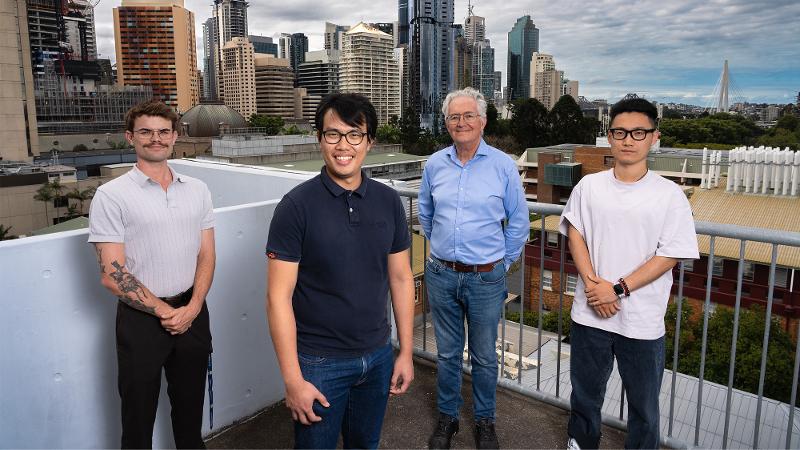
Top image, from left: Mr Huon Morton, Dr Zijun Li, Adjunct Professor Zoran Ristovski and Mr Hongzhi Zhang.
Media contact:
Amanda Weaver
QUT Media


