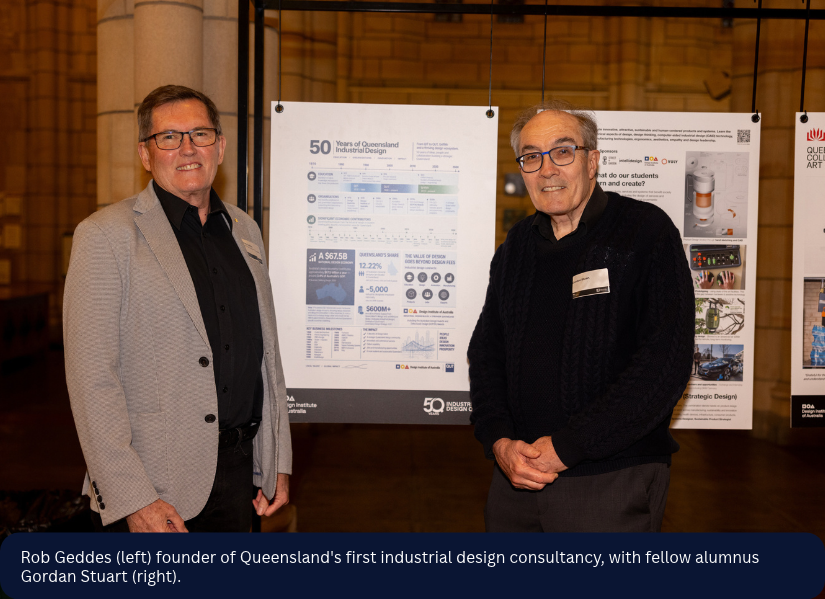
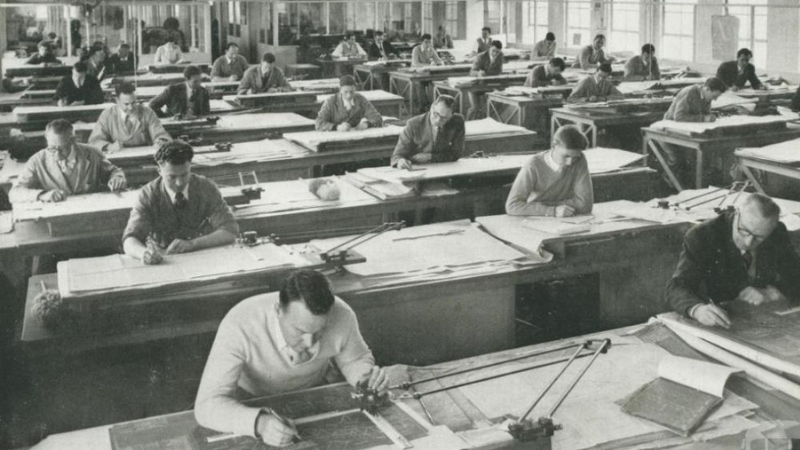
When the first Queensland Industrial Design (QIT) course began at QUT in 1976 the prevailing technology was just the same as when the Industrial Revolution embraced electricity. We had hand tools as well as electrical power tools and workshop equipment, light tables for tracing over previous drawings, manual drawing boards but no computers. Electronics was restricted to calculators and transistor radios…. and not yet in televisions. The emerging profession in Australia was focused on manufacturing technology - how to make things, and how to make things work. Function was all mechanical or electro-mechanical.
The design process in industry at that time was centred on a very basic ‘form-follows-function’ mantra, almost oblivious to the user or the environment, but it did retain some old-school values - simple honesty in form and practicality through inbuilt durability and ability to service, maintain, repair and even upgrade.
Edwin Codd as founder of the course ensured that while creative Problem Solving was a core focus of the course, Technology, Man and Environment, and Communication capabilities also had equal weighting. These core subject areas set a much-needed new direction for Industrial Design from the beginning. Quite a shake-up for industry - with many manufacturers resisting all this as unnecessary, and only some industry embracing it slowly. Changing the ways of decades-old industry was slow.
It took another 15 or more years for basic electronics, computing, communications and core technologies to become useful tools for designers. 2D CAD sped up drafting, but then 3D CAD, Stereolithography and CAD-CAM transformed our industry by light years in the mid to late 90s. Change hasn’t stopped. New technologies need people with new skills. Opportunities started to open up.
Queensland at the forefront
Queensland had Australia’s first major product CAD capability and 3D printing, vacuum cast prototyping, and more, at Queensland Manufacturing Institute. Industrial Designers embraced it and ran with it. CAD also took off with software to design circuit boards and create electronics to enable smarter products. Possibilities multiplied.
Queensland manufacturers made membrane control panels and used CAD-CAM to machine tooling as well as components. The design world was on fire. The first CURVE magazine in 2002 dedicated to Industrial Design in Australia reported that Queensland was a hot spot for Industrial Design in this country - for good reason. The foundation in designing manufacturable products to meet a user need, be responsible to the community and the planet through the smart use of available technologies and materials saw Queensland educated Industrial Designers in many and varied responsible and influential roles, locally, interstate and moving internationally. That continues today.
The changing role of designers
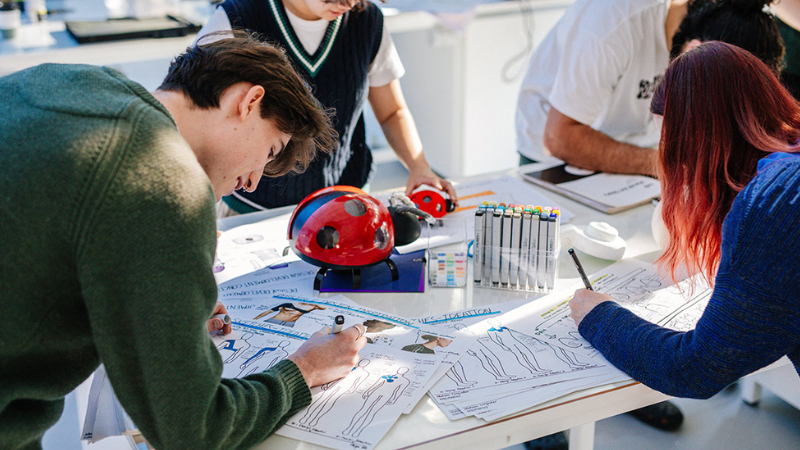
Today the roles Industrial Designers fill are much more diverse than 50 or even 25 years ago. And the relationship that Industrial Designers have with technology is immense and integral to our careers. The innovation and benefits that designers bring to the world continue to be more and more astounding.
As Industrial Designers’ skills span all aspects of a physical product’s life - from the exploration of its need, the vision for the outcome and its impact, conception of alternative solutions, embracing alternative technologies, materials, processes, functional configurations, means of manufacture, assembly, packaging, distribution, commissioning, operation, maintenance, repair, re-use and end of life - a broad knowledge of technology is vital. We need to be able to converse with specialists in many fields.
An impossible ask to be across every technology, a designer needs to work well within a development team, bringing enough knowledge and capability of their own across so many areas, understanding enough to ask the pertinent questions and have a good feel for what to involve where. So many design projects and roles cross over traditional boundaries, and Industrial Designers crucially have the breadth of skills and insights to creatively straddle multiple realms while keeping the end user in focus. This is one of our major strengths, and not something that’s easily replicated through machine learning.
The design process has embraced technology at every step. From the Deep Dive. Immersion into research on relevant knowledge and prior art. Anything that helps understand the current state of play and the full gambit of thinking and experience and technology available to harness is a gift. From desktop research to online forums, we can now explore fields better than ever before. With user forums we can tap into real user experiences and areas of dissatisfaction.
Much useful information is now at our fingertips, from searching and analysis of problems to solve and design for, to opportunities to seek, explore and visualise market gaps or IP gaps, and possible new approaches emerge and can be explored.
There are new ways to engage, collaborate and generate ideas. Ways to understand current blockages and constraints. The creative mind thrives on wrangling diverse inputs as inspiration.
Technology enabling a future world
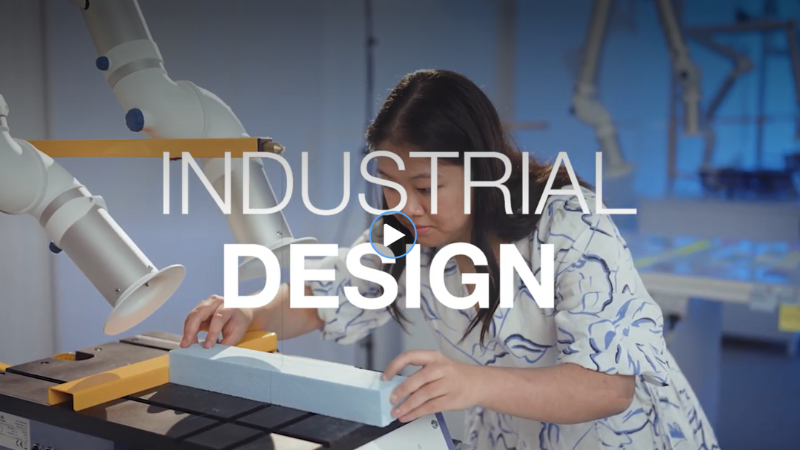
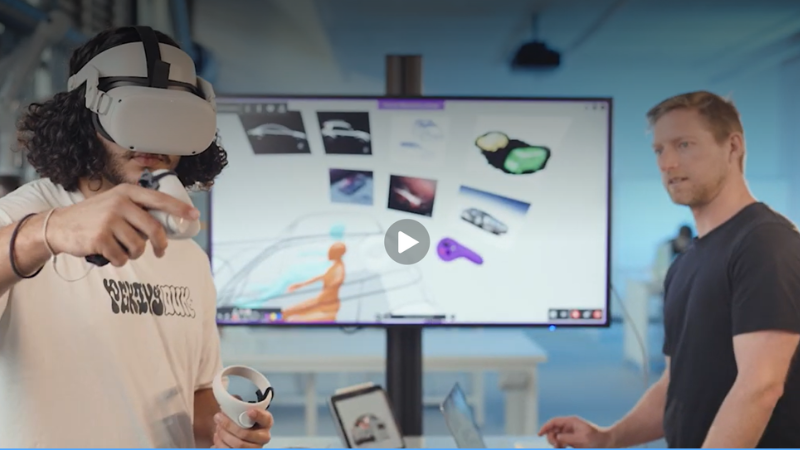
Technology also provides ways to visualise things that do not yet exist, explore the “what-if” scenarios we raise. Creative visualisation can provide new visuals and present them in VR and AR. Designers can sketch and create 3D forms using AR headsets and wands or modify scans from reality. There are now almost countless ways to mock-up, prototype and test designs for user feedback and also generate empirical outputs. We used to just use foam and cardboard or wood/plastic.
Now the power of prototyping is a secret weapon of the Industrial Designer, and we now have a whole armoury of options to work with. With these tools we can be sure that our perceived market empathy has been well cultivated, and our ergonomics sound.
Technology provides enabling tools for a designer and takes away some of the hack work of days past. Designs can be more rapid, less risk and produce better outcomes. CAD that is smarter than ever can provide rapid ideation early in the process, generate variations quickly for evaluation, check for clashes, test strength and mould flow and assist decision making and refinement in so many ways.
And with early generative AI we are seeing the need for the process to be driven by a prescient guide, the designer.
New technology may also be used to help the final design perform better, with sensors and feedback loops providing data on performance through the internet of things. Providing responsive maintenance, online upgrades, user input to improve future models or create popular variations / new products / services / ways to use, or forensic examination of product failure to drive design upgrades.
In the past 50 years there has been a massive change in the technology we use in design practice and the technology we use in our designs. The changes are getting faster and more significant. Each designer will still need to keep across the changes in their own sector, as well as changes in other fields to be at the forefront of change. You are designing for tomorrow, designing for the years to come. That requires an awareness of what’s available, what’s coming, developing ideas of integrating various technologies and awareness of possible future implications.
One designer cannot hope to be across it all. It is crucial to develop support networks and ways to work with others to achieve the design intent. Working towards being the Ringmaster who makes the outcome special - who knows how every act fits into building the final performance - again and again, each time uniquely special.
Moving forward, what critical skills will designers have which can never be replaced by technology?
- Harnessing empathy - the ability to observe, research, enquire and listen to users and people connected throughout the development and value chain and know their unmet wants and needs is fundamental. This is also not machine logic. This is fundamentally human and fraught with contradictions and nuance that differs in every application.
- Seeking insights - an enquiring mind, seeking to understand the real need, by keeping a satellite view of the field in which you are working, and seeing gaps and clashes, opportunities and mistakes down to precise detail. That developed ability can help you define your successful path. It will be your unique superpower.
- Visual thinking - Using your ability to sketch an idea for others to understand, especially in client and team meetings - talking to clients - talking to users - talking to enablers and suppliers. Use it during Divergence by generating many possibles. Use it during Convergence to integrate ideas. Use it to reveal a preferred concept as an exploded view - showing how all elements fit together and can be assembled. Drive the design resolution with your visuals. Hand drawn during ideation, through to realistic renderings as the design takes a resolved form.
- Iteration and Prototyping - the designer’s insistence on physical models during the early stages and later prototyping and testing to learn what was missed to enable refinement before design freeze.
- Managing ambiguity - wrangling multiple conflicting complexities simultaneously whilst guiding the final cohesive solution is the key to the magic of Industrial Design. This is not logical - it requires a skilled, intuitive balance, targeted at a desired outcome. It’s design.
- An enquiring mind
- Creativity
- Innovation
- Adaptation and integration of technologies
- Embracing ambiguity
- Balancing apparent conflicts
- Spanning multiple disciplines
- Drawing together the team’s skills
- Visualising ideas on the fly
- Adaptation on the fly
- Iterate the design
Blended with passion and drive…sticking to your well-founded and tested Design Vision and bringing the team along with you to the successful launch.
Design and technology combined has a powerful future.
About the author:
Rob Geddes is a QUT Alumnus and the Executive Director at the Australian Institute of Commercialisation. Connect with Rob via LinkedIn.