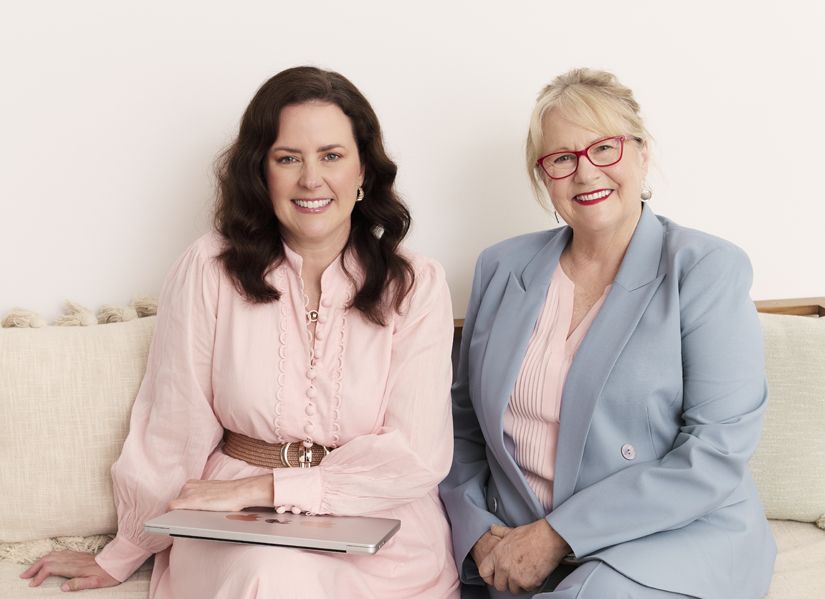
When Laura Furiosi was going through her divorce, she had a lot of questions. Fortunately, she knew exactly who to call: her mum, Lynette (Lyn) Galvin, a family lawyer who patiently walked her through the rules and processes that seemed so difficult to navigate. When friends began going through divorce too, Laura started putting them on the phone to Lyn, until the pair realised that understanding divorce shouldn’t depend on having a family lawyer in the family. What began as a laptop, a holiday cabin and ten episodes recorded using GarageBand has since grown into The Divorce Course Podcast, which is approaching 1.5 million downloads. Both QUT alumni, Laura and Lyn have drawn on their teaching and legal backgrounds to create a resource designed to provide clear, practical information to people navigating divorce, with the warmth and reassurance of a trusted friend.
For those who haven't discovered The Divorce Course Podcast yet, what's the story behind the podcast and who did you hope it would reach?
I'm an independent learner. When I go through something, I want to understand it properly, from the inside out. So, when I went through my own divorce, I found the whole pathway confusing. The rules and processes were genuinely hard to find, and even with a lawyer, I couldn't find anything that explained it well enough to help me. So, I rang Mum. Constantly. She's a family lawyer, and I'd have her walk me through the same things over and over until they made sense.
Then friends started going through it too, and I'd put them on the phone to Mum as well. Watching her answer the same questions again and again, I realised something: this information shouldn't depend on whether you happen to have a family lawyer in the family. So I said, "Let's record your answers and put them on a podcast." That was it. We wanted it to reach the person sitting up at 2am with no one to ask.
Looking back over the journey so far, how has the podcast changed, or perhaps even surprised you?
We started on a laptop in a holiday cabin, recording ten episodes in a week with no microphone and the GarageBand App. That's the whole origin story. We've come a very long way since then.
The first real surprise was seeing we'd hit number one in the How To category on Apple Podcasts, and the top 25 in Education on Spotify. We're still charting at number 1 on How To, and still in the charts across a number of other countries, which we never once imagined when we set out. We're now on our way to 1.5 million downloads.
But the thing that genuinely surprised us wasn't the numbers. It was that people listened, and that it helped so many of them. We hear from listeners constantly, and that's the part that changed us. It stopped being a project and became a responsibility.
Are there any skills, experiences or connections from your university years that you still draw on today?
Obviously, Mum's law degree does a lot of heavy lifting! (and she took me to her lectures as a baby so technically I did some classes too). But I give enormous credit to our teaching degrees.
Teaching taught us how people learn. We're not just talking about family law, we're structuring it. Every episode and every lesson in our online course is built to scaffold the learner and support them through a process at the exact point they're at, rather than dumping information on someone who's already overwhelmed.
My teaching degree also gave me something less tangible but just as useful: the confidence to work things out and have a go. Recording, editing, marketing, building an online course from scratch. None of that was in the curriculum, but the habit of figuring it out was.
You cover some incredibly complex and emotional topics. Which conversations are you most passionate about having, and why do they matter so much to you?
The conversations we care most about are post-separation abuse, coercive control, and domestic and family violence, and how those things play out inside the divorce process and the family court system. People navigating separation in those circumstances face a completely different set of risks, and understanding that early can genuinely change their outcome.
Over the years, Mum and I have received thousands of emails from listeners sharing their stories. What we've learned is how many people fall through the cracks of the support system. Someone reaches crisis point on a Friday night and the next available appointment is Tuesday. We want the podcast to be the stop-gap in between. Something steady they can reach for at 3am when there's nothing else open.
How do you decide when a topic is best explained by the two of you, and when it's important to bring in another expert?
Our members essentially set the content calendar. Mum and I meet with them every week to talk through whatever they're facing right now, and the struggles that come up repeatedly in those sessions become episode topics. It keeps us anchored to what people actually need rather than what we assume they need.
When it comes to experts, we bring someone in when there's a genuine gap in our own understanding. Mum can speak to the law, and I can speak to the lived experience of going through it, but neither of us is a psychologist or a financial specialist. We're careful about who we invite. They have to fill a real gap, align with our values, and more often than not they've been recommended to us by our own members.
What's one thing you wish you'd known before launching your first episode?
I wish I'd known to ignore the people who told us it was stupid and that we shouldn't do it.
We got a lot of pushback when we started, particularly from parts of the professional community. There were moments where we seriously considered stopping. And now? Many of those same people, and plenty like them, are hosting podcasts of their own.
What I learned is that disrupting an industry is nerve-racking, and the discomfort you feel doing it isn't evidence that you're wrong. We were doing it for the right reasons and with the right heart. If I could go back, I'd tell myself to hold that a bit more firmly and second-guess it a lot less.
Can you name some of the individuals who inspire you? What qualities in these individuals do you admire and seek to emulate in your own work and life?
Mum, without question.
She worked incredibly hard to get her law degree after I was born. I watched her study through her own divorce, raising us on her own with very little money, and somehow do both.
What I admire most is that after everything she went through, she came out of it caring more. She sees the people who are struggling and she actually gives a damn. That quality is the reason the podcast exists at all. I want to keep emulating it for as long as I can, both in the work we do together and as a mother myself. If I can be half as strong for my own kids as she was for us, that'll do.
QUT degrees
Laura - Bachelor of Education (Primary) (2003)
Lynette Galvin - Bachelor of Laws (1989), Bachelor of Education (Primary) – Graduate Course (2003)
Do you have a question for Laura and Lyn? You can contact them via the Divorce Course website.
Author

Joanna is an integrated marketing communications specialist with an interest in the Faculties of Health, Business and Law. She holds a Master of Business, Bachelor of Mass Communication and Diploma in Business Information Systems.