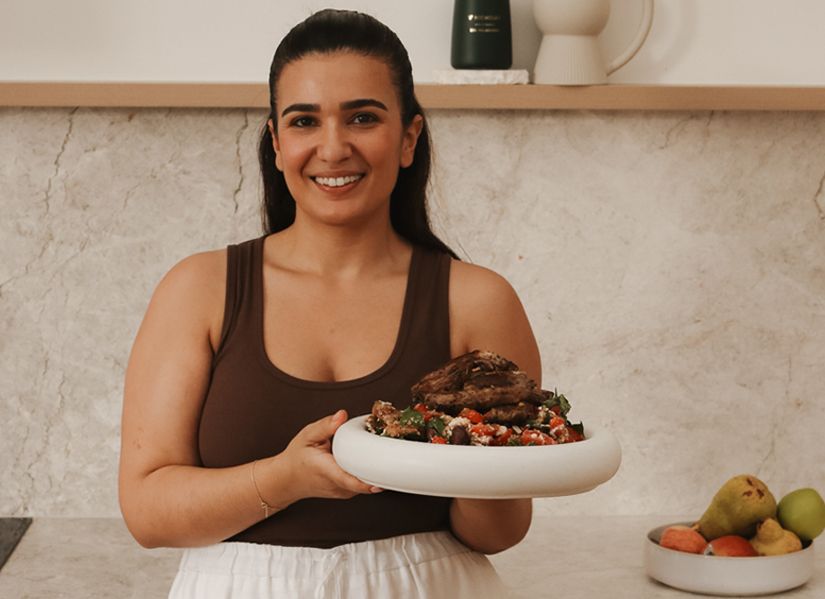
A career doesn't always follow the path we imagine when we graduate. For Jacqui Toumbas, a Bachelor of Health Science led first to a career in nutrition, then to founding an iconic Brisbane café and, eventually, to two businesses combining her love of food, travel and bringing people together. Today, she is building a career – and a life – on her own terms, while helping other women do the same.
Can you tell us about your journey since graduating from QUT?
I graduated in 2014 with a Bachelor of Health Science, expecting to work as a nutritionist. And I did, for a while. But what I kept coming back to was food itself. Not food as a set of numbers on a page, but food as the thing that gets people to a table.
So I opened a cafe. Miss Bliss started as a small wholefoods space in Brisbane. I ran it for five years and sold it in 2020. Those five years taught me more than any single course could. How to read a profit and loss statement, how to hire and how to let someone go, how to keep trading when the numbers are tight, and how to build something people feel loyal to.
These days I run two businesses. Savour the Slow, where I host small-group culinary retreats in Southern Italy and Greece for women who want to travel solo but not alone. And Business Banquet, where I consult and mentor women in service businesses on the parts of business nobody warns you about.
None of it was a straight line. But every part of it has used the part before it.
You grew up in an entrepreneurial family and started working in the family business from a young age. How did that early exposure shape the way you think about business, creativity and opportunity?
Taverns, cafes, supermarkets, news agencies. Very typical Greek family. There was always something being run, which really means I grew up inside a business, full stop. There was no line between home and work. Dinner conversations were about staff, suppliers, what sold and what sat there.
Two things came from that. The first is that I never saw business as something other people did. It was ordinary. Risk was ordinary. Working weekends was ordinary. When I opened my first cafe, I wasn't crossing some huge psychological line; I was doing what I had watched happen my whole life.
The second is that I learned hospitality long before I learned marketing. Watching my family look after people taught me that the product is rarely the point. People come back because of how you made them feel, whether they can articulate that or not. I still build everything that way. The retreats, the dinners, the membership. The detail is the strategy.
The downside is that I also inherited the belief that you have to do everything yourself. That one has taken a lot longer to unlearn.
There is often pressure for entrepreneurs to do more, grow faster and constantly chase the next opportunity. What do you think aspiring founders need to hear about building sustainably?
That the fastest growing business in your feed is often the one closest to falling over.
I have watched a lot of people scale their way into a business they no longer want to run. More revenue, more staff, more moving parts, and somewhere in there they have built themselves a job with worse hours than the one they left.
The question I would ask before chasing anything is: what does this add to my week? Not to my revenue, to my week. Because you are the one who has to live inside it. A business that makes good money and quietly costs you your health, your relationships or your interest in the work is not a success, it is a delayed problem.
I also think we badly underrate boring, repeatable income. One offer that works, sold consistently to people who trust you, will outperform five launches and a lot of noise.
Grow when it is genuinely time. Not when someone on the internet has made you feel behind.
What separates an idea that stays as a dream from one that becomes a viable business?
Someone paying for it. That sounds blunt, but most ideas never survive contact with a real customer because they are never taken to one.
The dream version of a business is very comfortable. You can plan it, name it, design the logo, talk about it for two years. None of that carries any risk. The moment you ask someone to pay, you find out whether you have a business or a nice concept.
The other difference is that a viable business solves a problem specific enough to be worth money. Not "women want connection", but "women want to travel through Southern Italy and they don't want to do it alone, and they don't want to do it on a bus with sixty strangers either". Specific is what makes people say yes.
And then there is the unglamorous part. Pricing, systems, cash flow, following up. Plenty of brilliant ideas die because the founder loved the creating and hated the admin. The ones that make it are usually run by someone willing to do both.
Social media has transformed the way entrepreneurs build businesses and communities. How do you see its role evolving, and what opportunities do you think it offers the next generation of founders?
Social media removed the gatekeepers, and I still think that is the most underrated thing about it. I have built two businesses from a phone and an audience that trusts me. Twenty years ago I would have needed a publisher, a broadcaster or a franchise to do the same thing.
What is shifting is where the trust sits. Follower counts matter less every year. What matters is whether people believe you, and whether they would pass your name on to a friend. I would rather have three thousand women who read everything I write than fifty thousand who scroll past.
For the next generation of founders, the opportunity is in owning the relationship rather than renting it. Platforms change, algorithms turn, accounts get restricted overnight. Email lists, communities, real world events, a body of work people can actually find. That is the asset.
And the thing that still works is the thing that always worked. Be useful, be specific, be recognisably yourself. Most people are trying to sound like everybody else. Sounding like you is the strategy.
What skills from your QUT experience have stayed with you throughout your entrepreneurial journey?
The most useful thing my degree gave me was not nutrition knowledge. It was research literacy. Health science trains you to look for the evidence behind a claim, to ask who funded the study, to sit with nuance instead of rushing to a conclusion.
That has been quietly enormous in business. The online world runs on confident people making unfounded claims. Being able to slow down and ask, "is that actually true, or does it just sound true?" has saved me money, time and more than one bad decision.
The second thing is translation. A large part of that degree is taking complicated information and making it usable for a real person sitting in front of you. That is the same skill as writing a good caption, teaching a workshop, or explaining to a business owner why her pricing is too low.
The third is less romantic. I worked in hospitality the whole way through my degree. Learning to carry a full load without dropping things is a skill you use forever.
Can you name some of the individuals who inspire you? What qualities in these individuals do you admire?
My Yiayia, first. She fed people constantly, with very little, and never once made it look like effort. Watching her taught me that generosity is a discipline, not a mood.
My parents, for the work ethic, and for showing me that you can build something from not very much if you are willing to be uncomfortable for a long time.
And then a broader group: women running businesses on their own terms, usually without a template to follow. I am 38, single and childfree, and I have built a life that looks nothing like the one I was raised to expect. The women I admire most are doing something similar. They have stopped waiting for permission, or for the timing to be right, and they have made decisions other people found confusing.
What they have in common is self-trust and a long view. They are not chasing the fastest result. They are building something they actually want to be inside of in ten years. That is the quality I keep coming back to.
QUT Degree – Bachelor of Health Science (2014)
Do you have a question for Jacqui? Connect with her on LinkedIn.
Author
Joanna is an integrated marketing communications specialist with an interest in the Faculties of Health, Business and Law. She holds a Master of Business, Bachelor of Mass Communication and Diploma in Business Information Systems.