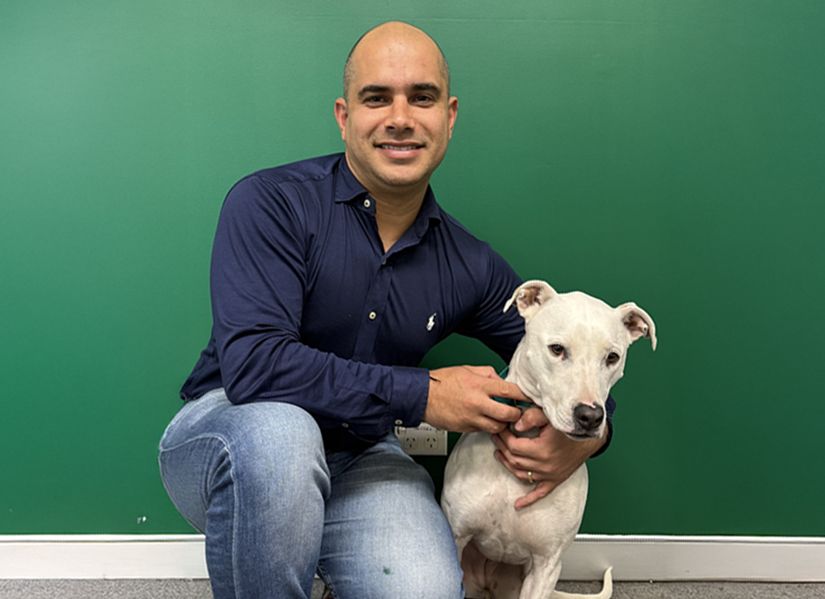
Reinvention has been a constant throughout Gui’s career. After more than six years in the oil and gas industry across Latin America, a downturn prompted him to rethink his direction and pursue a Master of Engineering Management at QUT. Today, as Operations Director at Australian pet wellness company Lyka, Gui draws on his engineering foundations to lead manufacturing, embrace emerging technology and help scale one of Australia's fastest-growing pet brands.
Can you tell us about your journey since graduating from QUT?
Before QUT, I spent more than six years with Schlumberger in the oil and gas industry across Brazil, Ecuador and Colombia. When the sector experienced a significant downturn around 2016, I had to reconsider my career direction.
My Master of Engineering Management at QUT became an important enabler for that transition, broadening my perspective from technical engineering into operations, strategy, finance and people management.
After graduating, I joined Kraft Heinz, where I progressed through engineering, maintenance, continuous improvement and plant management across New Zealand and Australia.
Today, as Operations Director, I lead manufacturing operations for New South Wales. QUT gave me the tools to translate my engineering background into broader leadership roles, taking me from drilling operations in Latin America to leading manufacturing teams in Australia.
Can you tell us about Lyka and your role there?
Lyka is an Australian pet wellness company improving pet health and longevity through nutrition. I lead manufacturing operations, working across research and development, strategy, supply chain, finance, data, food safety and engineering to turn growth strategy into scalable operational capability.
My role connects strategy and execution by building the capacity, systems, technology and teams needed to scale safely and efficiently. This includes improving manufacturing performance and asset reliability, introducing new processes, scaling products, consolidating operations, and supporting Lyka’s expansion into Brazil. Ultimately, I focus on building sustainable operations that maintain safety, quality, customer experience and performance as the business grows.
Innovation is a big part of Lyka’s approach to manufacturing, including the use of technology and predictive maintenance. How do you see technology changing the future of manufacturing and supply chains?
I see manufacturing moving from reactive and time-based decisions towards condition-based and data-driven decision-making.
Condition-Based monitoring, combined with artificial intelligence (AI), can help us understand the actual health of equipment, identify abnormal patterns earlier and support better maintenance decisions. The same principle can be applied across production, quality, inventory, demand, labour and supply chains.
However, technology should augment people rather than replace engineering judgement. AI cannot compensate for weak processes, unclear standards or poor accountability. The strongest organisations will combine technology with solid engineering principles, disciplined processes and capable people.
Lyka has experienced significant growth and was ranked sixth on LinkedIn’s 2023 Top Startups in Australia. What does it take operationally to scale a fast-growing business while maintaining quality?
One of the biggest lessons I've learned at Lyka is that scaling is very different from simply increasing production. If operational systems don’t mature alongside the business, complexity can grow faster than the organisation. For me, sustainable scaling is built around standardisation, visibility, accountability and recognition.
As volumes increase, processes, training, food safety, traceability and risk management need to become stronger, not weaker.
Accountability and recognition go hand in hand. People should understand what they own while knowing that good performance and the right behaviours will be recognised.
Ultimately, successful scaling means building systems that prevent complexity from growing at the same rate as the business.
You were recognised on the Dean’s Honours List during your time at QUT. What did that period of your life teach you about setting goals and challenging yourself?
It reinforced something I had learned through sport: ambitious goals become achievable when you translate them into consistent daily actions.
I have always competed primarily with myself, but QUT taught me something equally important: ambition doesn’t have to be an individual journey. When you surround yourself with talented people who share similar standards and aspirations, you challenge each other and multiply what you're capable of achieving.
That has influenced how I lead today. Individual ambition can drive personal performance, but shared ambition builds extraordinary teams.
Can you name some of the individuals who inspire you? What qualities in these individuals do you admire?
The people who have influenced me most are those closest to me.
My two mothers, Lígia and Marcia, taught me ambition, humility and the meaning of family. They are sisters, but together they have always shown me what family truly means. They understood the importance of surrounding me with good people and examples that could positively influence my future.
My karate sensei, Rogério, shaped my resilience, discipline and determination, teaching me that resilience is built by repeatedly pushing beyond what you think your limits are.
My uncles Venilton and Gegeio shaped my entrepreneurial mindset. They taught me that being employed doesn’t mean thinking only like an employee. I try to think like an entrepreneur alongside my employer — understanding the economics, looking for opportunities and taking ownership of outcomes.
What advice would you give current QUT students who are still figuring out what they want their career to look like?
Don’t put too much pressure on yourself to design your entire career at the beginning. Instead, build capabilities that will remain valuable wherever your career takes you: problem-solving, communication, understanding data, working with people and taking responsibility for outcomes.
For engineers, spend time where value is actually created. Some of my most important lessons have come from operators and technicians rather than meeting rooms.
Finally, become comfortable being uncomfortable. You don't need to know exactly where your career will end up; keep choosing opportunities that help you learn, stretch and become more capable.
QUT Degree – Master of Engineering Management (2017)
Do you have a question for Gui? Connect with him on LinkedIn.
Author
Joanna is an integrated marketing communications specialist with an interest in the Faculties of Health, Business and Law. She holds a Master of Business, Bachelor of Mass Communication and Diploma in Business Information Systems.