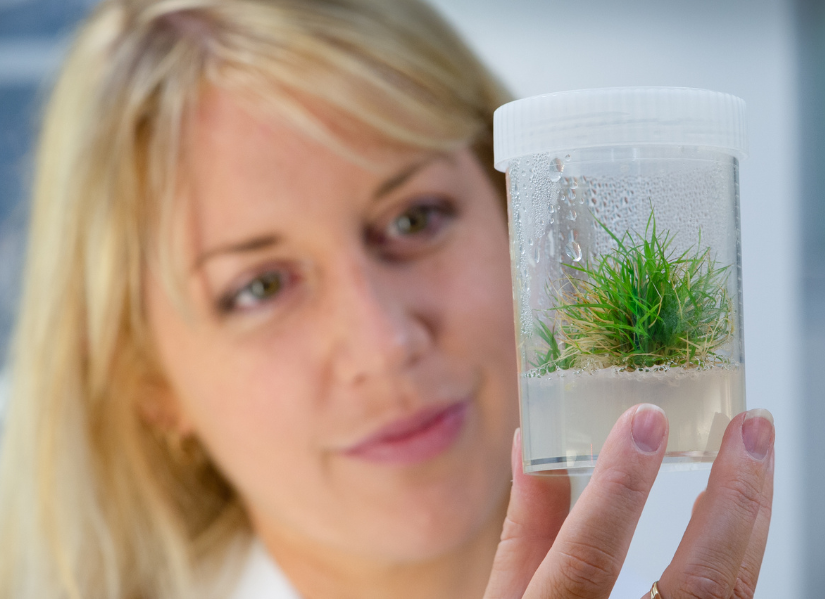
Not many careers move from psychology to quantum cognition and then into the space sector. But for Dr Lauren Fell, the common thread has never been the discipline—it has been a fascination with how people make sense of the world around them. Whether researching trust and human decision-making, helping bring ambitious space initiatives to life or inspiring the next generation of innovators, Lauren's work centres on making the complex more accessible. In doing so, she has built a career connecting people, ideas and opportunities in ways that create lasting impact.
How do you turn complex scientific ideas into initiatives that attract support and create impact?
A lot of people think having a PhD means becoming an absolute expert in a very narrow field, and, to some extent, this is the case. What I've found is that it's actually the skills peripheral to that, which are what you value most as you progress into your career. For me, one of those was being able to speak very different domain languages. My PhD at QUT was using quantum formalisms to explain human cognition, and the meta-skills I developed that enabled that research are essentially what are sometimes called "soft" skills: creative thinking, communication, etc. These ended up being vital not only in running projects that combine disciplines like science and engineering, which speak different languages themselves, but also in translating these complexities to a wider audience.
Completing a PhD on trust and human decision-making must change how you see the world. Has it influenced how you approach leadership, collaboration or relationships?
Certainly. Spending as long as I did focusing on trust across all aspects of experience meant that I now inevitably see it everywhere! My PhD focused on trust at a fundamental level in terms of how we experience it in our interactions with the world. Thinking about it through this framework has taken me away from viewing leadership and collaboration in terms of transactional interactions, where trust is offered or broken, but instead in terms of curating environments where trust can arise more naturally, and ensuring that this is fostered across the ways in which I work with people.
What do you find most rewarding about helping people connect with ideas, opportunities and disciplines that might otherwise feel out of reach?
I think it comes from having sat on the outside of a few different fields myself. Coming from psychology to quantum physics and space engineering, neither of them were mine to begin with, so I know what it feels like when something seems closed off just because you don't have the right vocabulary yet. What's rewarding is watching that gap close for someone else, whether that's a leader who recognises the Schrödinger's cat analogy and can suddenly see a way through the complexities of quantum physics to understand how it might apply to a trust decision, or a student at an outreach event realising space isn't reserved for just astronauts and engineers. Most of the time the barrier is the translation rather than the subject itself, and that's easy to overcome.
Looking back, what's one experience, job or opportunity from earlier in your career that has proved surprisingly valuable in what you do today?
When I was just out of school, before I started my undergrad, I used to work with my dad who's an electrician. It was mostly just helping to change lights, grabbing tools out of the car, etc. but through simply tagging along and helping, I learnt work ethic. An electrician has a clear goal, to provide power. And the pathway to that goal is not always straightforward, especially when it involves fixing something that is hidden behind a wall or a mess of cables. But dad would always find a solution. He didn't made excuses or give up and say it can't be done, he just got on with working the problem until it was fixed. I think learning this persistence and dedication early in my career - before I even started my career - helped me to get through difficult days in a range of jobs I've had, particularly when the way forward was not straightforward.
What does entrepreneurship look like when it’s grounded in scientific expertise — particularly in a field like space with long timeframes and high uncertainty?
Entrepreneurship requires patience, and so does science. In both, you need to be comfortable with failure. In science, if your hypotheses are always reinforced, you're probably asking the wrong questions. Building a venture works the same way, as a run of constant success, in most cases, will put you in a bubble that will eventually burst. Put space into the mix and it's even more stark, as space is one of the highest-risk industries there is. You can spend years on something knowing that there's a real chance it never makes it to its destination in one piece, often for reasons completely outside your control. Accepting that, and treating it as data rather than defeat, is, I think, the scientific mindset's most valuable export to entrepreneurship.
How do partnerships across industry, education and government help turn scientific ambition into something scalable and real world?
Industry-government partnerships are quite common, but integrating education as a priority is something that I think a lot of space programs do really well. Without a focus on building the next generation's talent pipeline, any initiative's momentum will eventually fade. Space is a growing industry with growing government support, and public outreach is core to how it stays that way. Fortunately, space tends to sell itself, especially for school-aged kids. Our project pairs the wonder of space with something completely accessible: plants. Plants are everywhere and watering a seed to watch it grow under different conditions is one of the easiest science experiments to do at home or in the classroom. The combination of the mysteries of space and the Moon with the ubiquitous and accessible practicalities of life on Earth lets us close the loop between government, industry and education through genuine participation.
What has been the most rewarding part of bringing Lunaria One's ALEPH project from idea to a lunar mission?
What's been most rewarding is watching perspectives shift. From talking about sustainable ways to grow food locally, which will be a necessity on the Moon but is increasingly important here on Earth too, to showing young students that there are real opportunities to work in space right here in Australia, and that there's no one pathway to get to that career. I feel privileged to be part of a wave of innovation happening in the Australian space sector, and I hope that in some way I've been able to help influence where it takes us in the future.
The past year has been a big one. What helps you stay focused when everything feels big and complex?
Just one step at a time. It’s never helped me to look up at the top of a mountain when I’m at the base ready to climb it. Focusing on the next step is sometimes the best thing you can do to make progress. That, and, of course, a (probably, at times, delusional) belief that I can achieve anything, and that there is always a solution to any barrier, it just needs to be found. Humans are, by nature, optimistic creatures, and we should embrace that, as it drives us forward and enables us to do things that should be impossible.
QUT degree:
Doctor of Philosophy (2025)
Do you have a question for Lauren? Connect with her on LinkedIn.
Author
Victoria believes that every alumnus has a story worth telling. Naturally curious, she asks the thoughtful questions others often don't — creating stories that connect, inspire and reflect the depth of the QUT Alumni community.