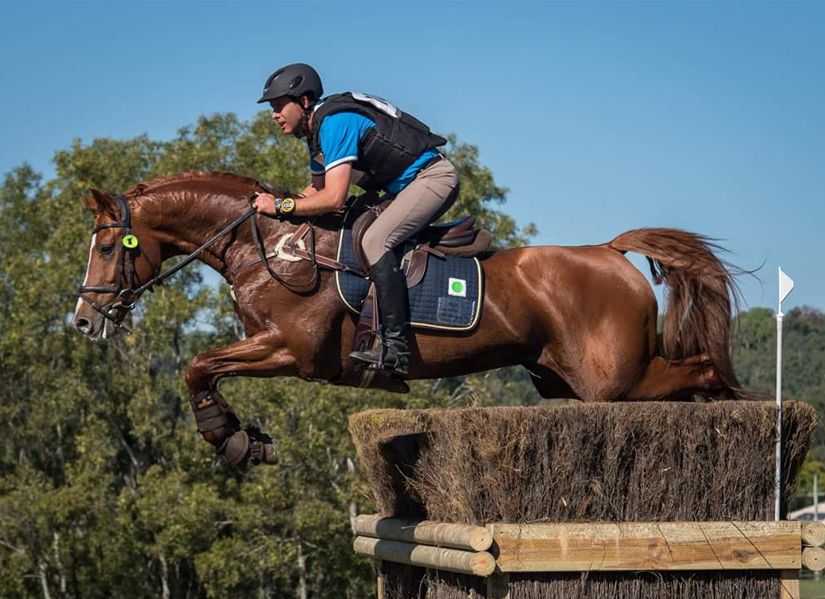
For Brett Cantle, patience is more than a virtue – it is a skill honed over three decades in the classroom, competition arena and stable. A QUT Bachelor of Education alumnus, Brett has built a career bringing together his passions for teaching and equestrian sport, progressing from Queensland classrooms to competing at the highest levels of eventing and, today, coaching riders and helping shape the future of the sport as an Equestrian Australia Board member. A Level 2 Eventing Specialist and Coach Educator, Brett was named Equestrian Queensland's Coach of the Year in 2024 and Equestrian Australia's Coach of the Month in 2025. At 51, he continues to ride, coach and teach, guided by a belief that whether you are working with a student, a rider or a horse, progress takes time – and small improvements can eventually add up to something significant.
Can you tell us about your journey since graduating from QUT?
After graduating from QUT with a degree in primary education, specialising in physical education, I began my teaching career in Queensland classrooms, spending time in Redcliffe, Logan, Quilpie and eventually Gympie. I taught students from Years 3 to 7 and also delivered PE classes. Looking back, I was fortunate to be surrounded by experienced educators who supported and mentored me in those early years. I had a healthy appreciation of how much I still had to learn, so I leaned heavily on the people around me, worked hard and took every opportunity to improve. Those first years in education were demanding, but they gave me a strong foundation that has shaped the rest of my career.
Alongside teaching, I was deeply involved in sport, particularly equestrian eventing, which combines dressage, showjumping and cross-country. Teaching proved to be an ideal profession to balance with that passion, giving me the flexibility to train, compete and continue developing as an athlete. As my experience grew, I began coaching as well. I spent countless hours observing some of Australia's best coaches, learning from them, taking lessons myself and refining my own approach. Since then, my journey has evolved from being solely a competitor to becoming both a competitor and coach. Even at 51, I'm still striving to improve in both roles, and that's one of the things I love most about the sport.
What does a typical week look like for you?
My weeks are busy, but they're built around the things I enjoy. Most days start with the horses. Depending on the season, I'm usually riding by 4.30am or 5.30am and finished by 7.30am before heading to school. I still genuinely enjoy teaching, and from Tuesday to Thursday I'll usually coach riders after school as well. Teaching and coaching have always fitted together naturally for me, and I've spent years learning from some of the best coaches in Australia while continuing to develop as both a coach and competitor myself.
Weekends are generally spent doing one of three things: competing, running clinics somewhere around Queensland, or working on the farm at home. I enjoy all three for different reasons. It's a full schedule, but I'm lucky because I genuinely like everything I do. Teaching is still a great job. You can see the progress students make each year and know you're making a difference, while equestrian sport continues to challenge me and give me something to strive for.
You grew up around horses, but was there a particular moment when you realised eventing was something you wanted to pursue seriously?
I grew up on a farm near Bundaberg, surrounded by horses and influenced by my three older sisters, so equestrian sport was always part of my life. In those pre-internet days, I'd spend hours reading magazines and following Australia's top riders, looking up to them and wondering what it would be like to compete at that level. When I came to Brisbane to study at QUT, I worked at an equestrian centre and started attending more major competitions. It was during those university years that I realised I could hold my own alongside some of the riders I'd admired for so long, and that sparked a belief that I could take the sport seriously.
There wasn't a single defining moment. It was more a combination of hard work, opportunities and the people I met along the way. I spent countless hours training, often behind the scenes, and gradually doors started to open. The old saying that the harder you work, the luckier you get is certainly true in my experience. A major turning point was being partnered with an outstanding horse that gave me both confidence and results. From there, my self-belief, desire and work ethic continued to grow. During my university years I couldn't compete full-time because of the realities of study, work and finances, but I always felt that if I kept putting in the effort, I'd eventually get there.
Every rider has horses that leave a lasting mark. Which horses have been particularly important in your journey, and who are the horses keeping you busy in the stable now?
I've been fortunate to have a few horses that genuinely changed the course of my life. Early in my career, I had a horse that took me to the highest levels of the sport, gave me enormous confidence and, when I eventually sold him, provided a financial springboard that helped set me up for the future. More importantly, he taught me to back myself and approach competition believing I belonged there. Later came Premonition, an imported stallion with the talent to reach Olympic level before injury interrupted that journey. He taught me some of the most important lessons I've learnt as a rider and coach. With a horse like him, you had to listen, adapt and work with the horse you had. If you did that, he gave everything in return.
These days, Finch Farm Memphis is keeping me busy. He's a stunning horse with an outstanding pedigree and a growing fan club of his own. What excites me most is watching his potential unfold and seeing what he might become. Every horse is different, and that's one of the things I continue to love about the sport. The horses that leave the biggest mark aren't just the successful ones, they're the ones that teach you something new, and I've been lucky enough to have a few of those throughout my journey.
How do you help your students deal with pressure and make good decisions when things don't go according to plan?
The first thing I tell my students is, "Welcome to my world." Pressure, disappointment and setbacks are part of sport, so I can relate to what they're feeling. When you're at your lowest, it often feels like you're the only person who's ever been there, but that's rarely the case. I encourage my students to stay gracious, celebrate the success of others and remember that everyone appreciates a good winner. I think that's a healthy mindset, both in sport and in life.
You’ve spoken about surrounding yourself with good people and recognising that learning never really stops. Who have been some of the people who have influenced you most, and what have you learned from them?
Early in my career, coaches such as Jim O'Farrell and Edgar Lichtwark gave me the technical foundations I still rely on today. Later, I worked with Christian Thiess, who brought a deep understanding of theory, preparation and performance. Each of them helped shape the way I think about horses, coaching and competition, and I'm grateful for the lessons they shared with me.
As I've got older, I've realised I work best with a small number of trusted people who know me well. These days, I work closely with Emma Flavelle and David Finch. They understand not only my skill set, but also how I think, how I ride and how I work with horses. What I value most is their honesty. If something is good, they'll tell me. If it's not, they'll tell me that too. It's a very healthy relationship built on trust and mutual respect. I also work with Sally Collins at competitions, where she provides another perspective without over-coaching. I've learnt that having the right people around you is far more important than having lots of people around you.
What is one skill that you couldn’t live without and why?
Patience. It's the first thing that comes to mind because it's just as important in the classroom as it is with horses. As a teacher, you quickly learn that every student develops at their own pace. You don't always know what's happening in a young person's life, so you need to be patient, support them and give them the time they need to grow.
The same applies to horses. I've never found hard work difficult, but patience is something I have to keep reminding myself about. Every horse develops in its own time, and if you try to rush a process that really needs two years, you can end up creating bigger problems than you solve. At the same time, you don't want to waste time either. It's about finding the right balance. Whether I'm working with students or horses, I've learnt that steady progress adds up over time. A lot of small improvements eventually become something significant.
Photograph by: Jane AndersonQUT Degree – Bachelor of Education (Primary) (1995)
Do you have a question for Brett? Follow him on Instagram.
Author

Joanna is an integrated marketing communications specialist with an interest in the Faculties of Health, Business and Law. She holds a Master of Business, Bachelor of Mass Communication and Diploma in Business Information Systems.