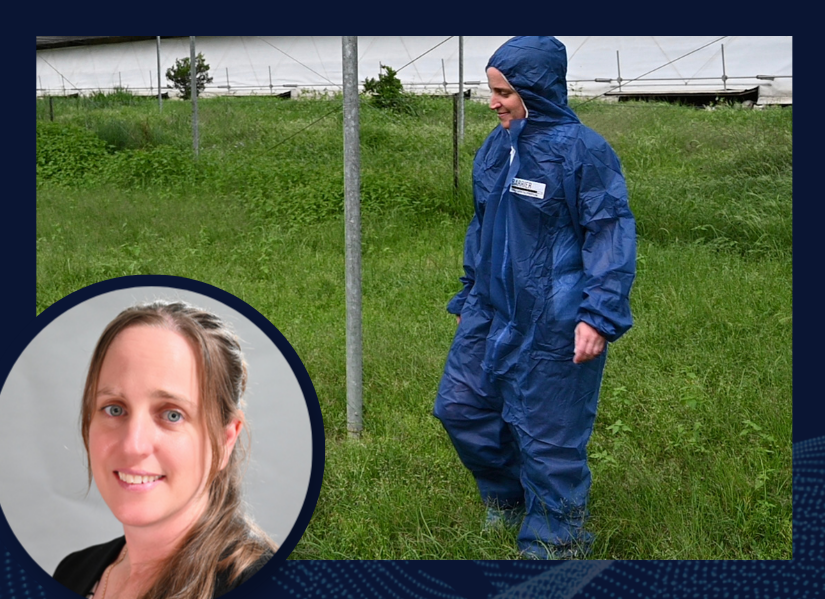
Creating meaningful change rarely happens through a single breakthrough. Scientist and QUT alumna Dr Kylie Hewson has built her career around helping science make a practical difference—whether that's translating research into action, bringing people together around complex challenges, or creating opportunities for others to succeed. Today, as Deputy Director of CSIRO's Minimising Antimicrobial Resistance Mission (Animal Health and Environment), she works at the intersection of science, policy and practice, helping turn knowledge into meaningful change.
How did you transition from conducting science to leading programs that influence policy, industry and behaviour change, and what can future scientists learn from your journey?
I've always got a thrill from seeing science have impact. Giving someone new knowledge or tools that help them do something better. I loved bench science, but became frustrated when I could see opportunities to make the science more useful but wasn’t in a position to support this. I went from doing the science on one project to overseeing a whole portfolio of research investments, where my job was to make sure those investments were collectively leading towards change or improvement. That experience ultimately made me a better scientist. Now I'm running science projects again, I design them at larger scale, build impact pathways in from the beginning, and bring stakeholders along. I think every scientist should have that opportunity.
In your role at CSIRO, how do you translate scientific research into coordinated programs that deliver measurable, real-world impact?
Impact means change, and change means someone somewhere has to do something differently. Facilitating change is hard enough, but the added complexity is that while the science to inform the change might be the same, how it gets applied is completely different depending on contextual factors, and the science needs to be translated into language that makes sense in that context. My role is taking often very complex science, translating it into something people can use, working with them to implement the change, and then identifying where science can solve the next problem and building new programs of science around that cycle.
How do you bring together research, policy, and diverse stakeholders to drive system-wide change in complex challenges like antimicrobial resistance?
Antimicrobial Resistance is too complex for any single solution. Real progress comes from lots of small changes made by lots of different people in different contexts over time. This is the really hard part of science but to me, it’s the most important, and work worth doing. My role is to understand those contexts, build trusted relationships across sectors, and connect people with the evidence most relevant to them. System-wide change needs a trusted coordinator (sometimes a person, sometimes an organisation) so people don't need to know everything, just who to call, or trust who will contact them when new information matters.
Entrepreneurship isn’t always about startups — within large, mission-driven environments like CSIRO, what does entrepreneurship look like in practice?
For me, it's about spotting opportunities to do things better and finding new ways the organisation can create value from the work it's already doing. That might mean building the case for a new capability or connecting people with complementary skills and interests to solve a problem together. I'm always interested in the science and skills my colleagues have, and I'm always looking for opportunities to bring different people together to tackle problems in new ways. Often that means building teams around emerging challenges that can grow into new projects, generate new science, and ultimately deliver real-world impact.
What skills have proven most valuable throughout your career that weren't necessarily taught in a science degree?
A science degree teaches you technical skills, but being curious requires courage, and that's not necessarily taught. It's having the courage to question things, including long-standing scientific dogma or ideas, and not being satisfied with "it's always been done this way". If something doesn't fit or could be better, you need to back yourself and explore it. It's not enough to know the science. You need to bring people along with you. That requires skills in negotiation, influence, persuasive writing and communication. I've seen great ideas not get funded because they weren't communicated well, and poor ideas funded because they were. Being able to communicate your ideas and your science in a way that people listen to, understand and engage with is a critical skill.
What opportunities and career pathways do you think future scientists should be paying more attention to?
I actually don't see research and industry as separate pathways. Industry does science. Companies large and small need scientists to improve their products, processes and services. Only a small proportion of scientists follow an academic career, but that doesn't mean everyone else stops doing research. I'd strongly encourage scientists to diversify. E.g. working in biotech as an undergraduate taught me about quality assurance and why it's critical for the veracity of research findings, and I still apply that today now that I’m a researcher again. Scientific skills are incredibly transferable across industry, government, teaching, government policy, regulation and compliance, advocacy and start-ups. Don't think about where scientists work; think about where scientific thinking adds value, which is just about anywhere.
What misconceptions do people have about careers in organisations like CSIRO, and what opportunities do they often overlook?
Because CSIRO is so large, I understand why people might see it as a complex behemoth. But the reality is it's filled with passionate scientists solving incredibly diverse problems. The opportunity to connect those people and cross-pollinate ideas across disciplines is amazing, without many of the institutional barriers that normally make collaboration difficult. People can also underestimate the opportunities that come from having to find diverse ways to fund research. Research doesn't have to start with a grant. You can embed projects in companies, work with government, philanthropy or the private sector. CSIRO provides enormous opportunities if you have an adaptable mindset.
Was there a particular opportunity, mentor or experience that had a lasting influence on the direction of your career?
There are many people I cherish from my career journey, but what these people all had in common was that they saw potential in me that I didn't yet see in myself, and gave me the support and opportunity to step up. For example, my QUT honours supervisor Dr. Jon who gave me a chance despite my grades; an industry leader who recognised my ability to connect with people and recommended me for an industry leadership position; the academic leader who worked with me to create an opportunity and then held it for me while I was pregnant. They took the time to know me and then pushed me beyond my comfort zone. I'm forever grateful for these people, and I actively try to give that same gift to the people I work with.
What continues to motivate you to work on long-term challenges like antimicrobial resistance, where progress often takes years to achieve?
It's the hard work that's worth doing. I find fulfilment in making progress on tough challenges because the reality is we live in an increasingly complex world, and there are no silver bullets or easy answers. A mentor once told me that you're only a custodian of the solution to a problem for a small part of its pathway, and that has always stuck with me. It's not about me being able to solve big challenges myself; it's about doing what I can to move us towards a solution, knowing my contribution creates opportunities for others to build on. I’ve seen that happen in practice over my career to date, and it’s incredibly rewarding and therefore, motivating to continue.
QUT degree:
Bachelor of Applied Science (2008)
Bachelor of Applied Science (Honours) (2007)
Do you have a question for Kylie? Connect with her on LinkedIn.
Author

Victoria believes that every alumnus has a story worth telling. Naturally curious, she asks the thoughtful questions others often don't — creating stories that connect, inspire and reflect the depth of the QUT Alumni community.