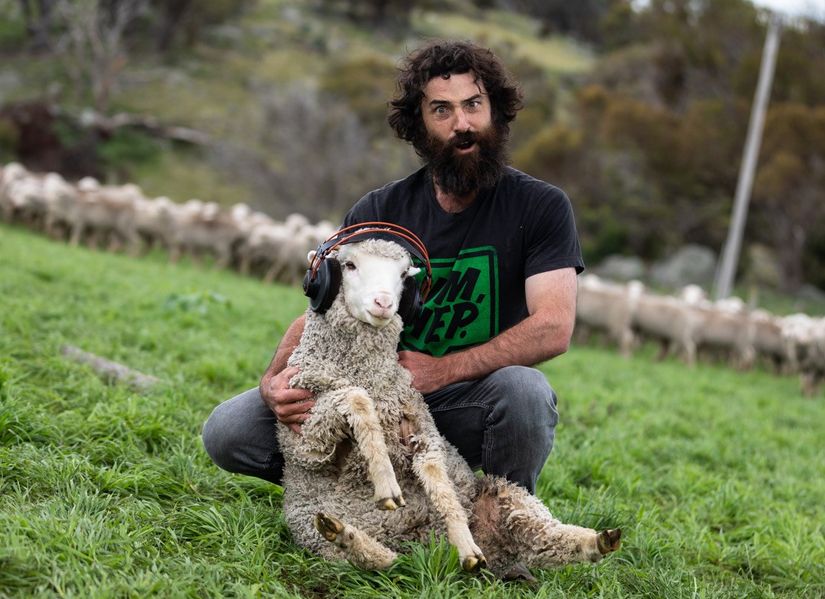
For fifth-generation farmer Benjamin Jackson, creativity has never been confined to one place. From studying drama at QUT to working on the family farm in Guyra, DJing as Electric Postman and creating intricate sheep art, Benjamin has followed his curiosity wherever it has led. His creative pursuits have not only brought a sense of purpose and joy to the demands of farming, but have also shaped the way he approaches work, learning and life. For Benjamin, staying open-minded has meant embracing the unexpected – and discovering that sometimes the most rewarding career paths are the ones you never planned.
You’re a fifth-generation farmer from Guyra, but your career and interests have also taken you into music, DJing and visual art. Are there any skills you developed at QUT that helped support your portfolio career?
Absolutely. Studying drama through QUT’s creative industries degree gave me fundamental skills in collaboration, teamwork and, most importantly, open-mindedness. It helped me understand not only who I was as a person, but also who I was as a creative, and how that creativity could manifest itself throughout my life rather than being pigeonholed into one particular path.
QUT also gave me real-world experiences and the opportunity to explore the breadth of the creative industries, whether that was events and festivals, music, stage productions, production behind the scenes, costume or other creative roles. It showed me that you don’t necessarily have to be a stage actor or follow one prescribed path. There is so much breadth and scope within the creative world, and that understanding of what’s possible has stayed with me. Being open-minded means recognising that anything can become your creative space.
Sheep art has become one of the things you’re best known for. How did the idea of creating art with your sheep first come about?
It’s sort of one of those things that was born from hardship. When I came back to the farm and really got stuck into agriculture, you wouldn’t necessarily think farming and art would mix – they’re sort of like oil and water. But during the substantial drought in 2019 and 2020, we were feeding the sheep every day, driving up and down the paddocks just trying to keep them going. After about six months of doing that, the monotony of going out into this dusty, barren, dry landscape really started to take its toll. Myself and my neighbours were all in a pretty bad headspace.
So, around State of Origin time, I bought a bloody drone and decided to create some sheep art saying “Go Blues”. It was really just about bringing a bit of cheer and joy into what was otherwise a pretty difficult time. It lifted my spirits, gave my neighbours a bit of a laugh and, from there, the sheep art started to give me a sense of purpose again. It sparked a creative part of my brain and made going out to feed the sheep exciting again. It kept me motivated, while also giving other people something to enjoy.
Do you have a favourite sheep-art creation, or is there something you’d love to try that you haven’t managed yet?
I’ve done a fair few bits and pieces, but the Woolmark logo would have to be one of the creations that really challenged me. That was extraordinarily difficult to make happen, and I’ve never felt more challenged by a piece of sheep art.
Moving forward, I’m trying to expand my horizons and get a little more adventurous. I don’t particularly want to go around reproducing corporate logos; I’d rather take on things that present a genuine challenge. I’ve done pieces inspired by some of my favourite artists, including AC/DC and Billie Eilish, but I tend to do everything in big block letters.
So, I think cursive writing is probably on the agenda. It’s about progressing from Grade 3 writing to Grade 5 writing – maybe one day I’ll even get my pen licence in sheep art.
You’re also known as Electric Postman and have a long-standing connection with music. What role does creativity play in your life, particularly when farming can be such a demanding and unpredictable profession?
Creativity is really about understanding who I am as a person. My brain is configured in a way that it gets scratched by art, music and all those sorts of things. Farming is demanding, labour-intensive and physically intensive, so I need that creative outlet to give me a different kind of stimulation. Music has really been the through line for me.
Studying drama and creative industries, helped solidify that understanding of creativity as a core part of who I am. I can’t exactly go and recite Othello to my sheep and expect a productivity gain, but I can listen to music, incorporate a bit of dance into my day, or spend an afternoon or evening producing music or DJing. It gives me that mental switch-off. Once I’ve finished the water, feeding, fencing and mechanical jobs, I can leave the farm at the door, so to speak, put on some music and just immerse myself in something completely different.
Do you have any recommendations for how consumers can strengthen their relationships with farmers and tread more lightly on the land?
I think it starts with listening. There’s an ever-increasing divide between city and country, and neither side necessarily understands the challenges the other is facing. The two-way street is still there, but it’s got a lot of potholes in it.
One thing I learned at QUT, and something that was fundamental to pretty much every unit I studied, was to stop and listen. If you have a different opinion, hear it out and then make a considered argument for or against what’s being put forward. Nine times out of 10, you’re not going to be the expert in someone else’s field, so you might not have all the information you need to say, “That’s the way it has to be.” Instead, listen and think, “Actually, I’d never considered that perspective or how that might have an impact.”
I think that’s particularly important when it comes to the relationship between consumers and farmers. People in the city can seek out those country voices, whether that’s through social media or other channels, and get a better understanding of what life and work on the land actually looks like. It’s about recognising that there are people in the country doing creative and innovative things, building careers and communities, and trying to care for the land at the same time. It’s a complex issue, but I think listening is a pretty good place to start.
Can you name some of the people who have inspired you? What qualities in those individuals do you admire, and have they influenced the way you approach your own work?
When I think about inspiration, I’m immediately reminded of my tutors and lecturers at QUT, people like Sean Mee, Lucas Stibbard and Bridget Boyle. These people instilled ideas in me and fostered a creative nature – not just in what they taught, but in the way they approached life as creatives themselves. They gave me a blueprint for how to go forth in the world, both through what they were teaching at QUT and through the careers they were forging outside of it.
These days, though, I find inspiration much more in the real world around me. I take an enormous amount of pride in my father. He’s not a creative at all, but I can appreciate the work he puts in and everything he’s prepared to put on the line to help me and educate me in the agricultural space. My friends and family are also constantly throwing ideas at me – “Would this be a cool idea for some sheep?” or “Could this work?” – and those real-world relationships are where I think you can draw genuine inspiration.
Ultimately, it doesn’t really matter what field someone is in. If they’ve worked incredibly hard, gone on a journey and arrived at an outcome they’re proud of, I find that inspirational. It’s not about taking the path of least resistance; it’s about doing the time, doing the work, making a discovery and seeing where that takes you.
What advice would you give current QUT students who are still figuring out what they want their career to look like?
First and foremost, don’t panic. Don’t try to get to the finish line too quickly, because you can forget to stop and smell the roses along the way. Enjoy the process. Enjoy the learning and sink your teeth into as many different things as you possibly can, because you might end up liking the broccoli.
Keep an open mind and don’t become too rigid in your thinking. Being flexible, being able to enjoy the surprises and being willing to be taken in different directions – particularly in creative fields – is normal, healthy and part of the process. I think you get much more out of life when you enjoy the process rather than focusing solely on the product.
If you’d asked me while I was studying drama at QUT whether I would end up back on the farm doing sheep art, working on music and DJing, I don’t think any of that would have been high on my list. I imagined I’d be behind the scenes, on stage, or behind or in front of the camera, making things happen. But because I stayed open-minded and kept walking through different open doors, I ended up somewhere I’d never imagined – and it’s brilliant. I wouldn’t change it for anything.
That’s the thing about a career: you don’t necessarily know what it’s going to look like in five or 10 years, and that’s okay. Sometimes you have to take the path in front of you, but if you keep putting in the work and exploring along the way, you might discover something you never expected. For me, the journey has always been more exciting than the outcome. No one sees all the rehearsals, the arguments, the discoveries and the hard work behind the finished product. They just see the 30-second Instagram reel where everything has paid off. The real value is in everything that happens before that.
Photograph by - Jim Baker
QUT Degree – Bachelor of Creative Industries (2011)
Do you have a question for Benjamin? Follow him on Instagram.
Author

Joanna is an integrated marketing communications specialist with an interest in the Faculties of Health, Business and Law. She holds a Master of Business, Bachelor of Mass Communication and Diploma in Business Information Systems.