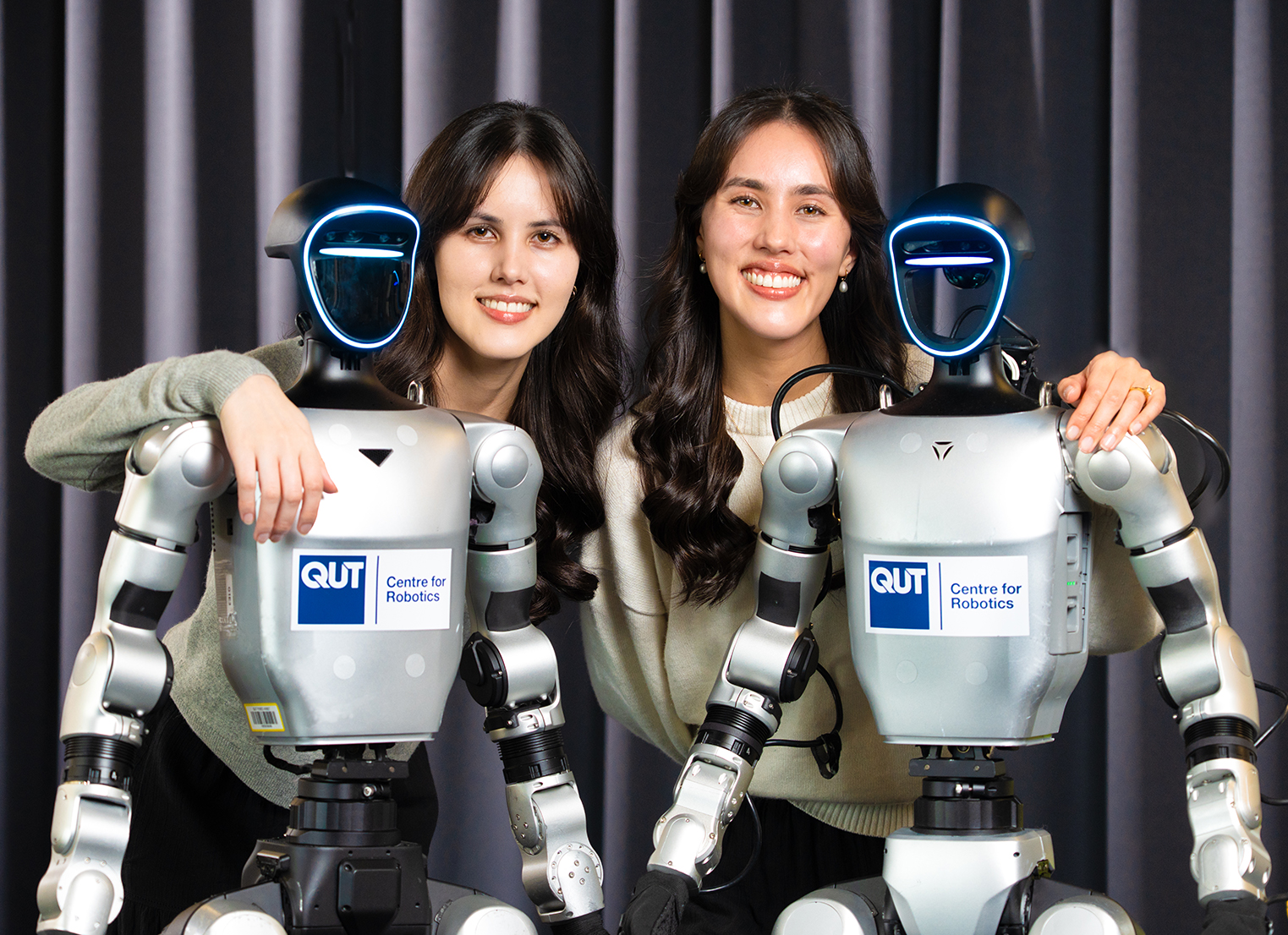
Resilience, perseverance and a passion for problem solving has led twin sisters from a tiny town on the edge of the Queensland outback to one of Australia’s top robotics research centres.
Beverley Gorry and Brittany Gorry had never met an engineer or scientist growing up in Miles – a town of less than 2000 people that’s a 337km drive north-west of Brisbane – and their high school was too small to offer a physics class or robotics club.
But they are both now high-achieving QUT graduates and PhD research students at the QUT Centre for Robotics in Brisbane, which will showcase its research and robots at the QUT Open Day on July 26.
Beverley studied a QUT double degree program and has a Bachelor of Engineering (Honours) (Mechatronics) and Bachelor of Information Technology (Computer Science). She is now doing her PhD on computer vision techniques to help robots better monitor underwater environments like the Great Barrier Reef.
Brittany has a Bachelor of Science (Physics) – and a QUT Medal for her perfect GPA of 7.0 – and is researching how AI and machine learning can improve environmental monitoring in Antarctica using drone and satellite imagery.
The 25-year-olds say university opened up their world and shed light on new study and career pathways they didn’t know about when they finished high school.
Now they hope their own experiences will inspire others … and remind current Year 12s that it’s okay if they don’t already have their futures mapped out.
“I started university without a clear picture of where I would ultimately end up and my interests evolved significantly over time,” Brittany said.
“I think that’s important for school students to hear, because there can be a lot of pressure to have everything figured out early, or a fear of their decisions feeling permanent.
“In reality, university is a place to explore interests, discover new opportunities, and develop skills that can lead you in unexpected directions.”
The twins also know the value of taking time to assess your interests and futures, having both elected to recharge with extended gap years after graduating as the top two students at Miles State High in 2017.
Brittany’s three-year gap included local jobs in healthcare and training and doing a TAFE business diploma, while Beverley used her year to complete a Christian discipleship program and do outreach work in the USA.
Eventually they returned to their love of STEM, with QUT’s reputation for combining theoretical knowledge with strong practical experiences drawing them to university in Brisbane.
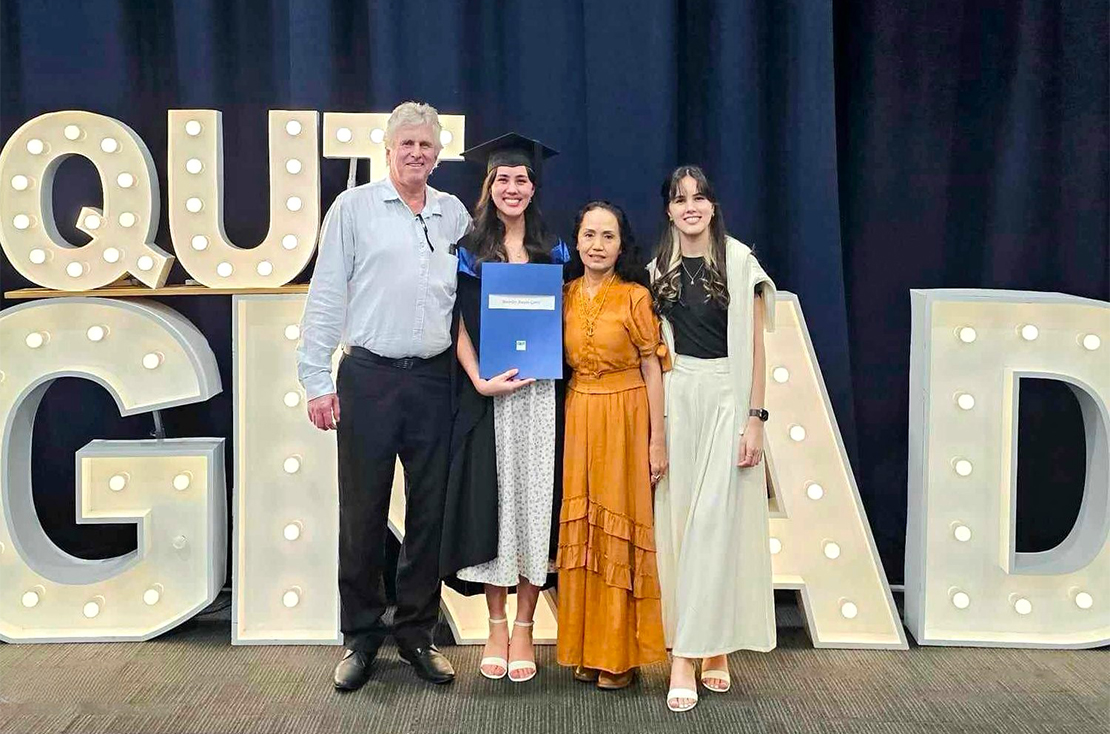
The sisters are the first members of their family to pursue STEM careers but share valuable traits with their parents, who also moved to Brisbane after their daughters settled into uni.
“Our parents worked in a hospital and neither came from a STEM background,” Brittany said.
“But they taught us the value of hard work, perseverance, and problem solving from a young age … and those are qualities that were essential for fostering my interests and achievements in STEM.”
Beverley said growing up in a small regional town had the advantage of strong, personalised support from teachers who had smaller class sizes.
“The main disadvantage was simply that some opportunities weren’t available … so I started university with a steeper learning curve than many of my classmates,” she said.
“At the time, that was challenging. But, looking back, I think it taught me how to learn independently and persevere when I didn’t understand something right away.
“Research is largely about tackling problems where there isn’t a textbook answer, so those experiences have ended up being valuable preparation for the work I do today.”
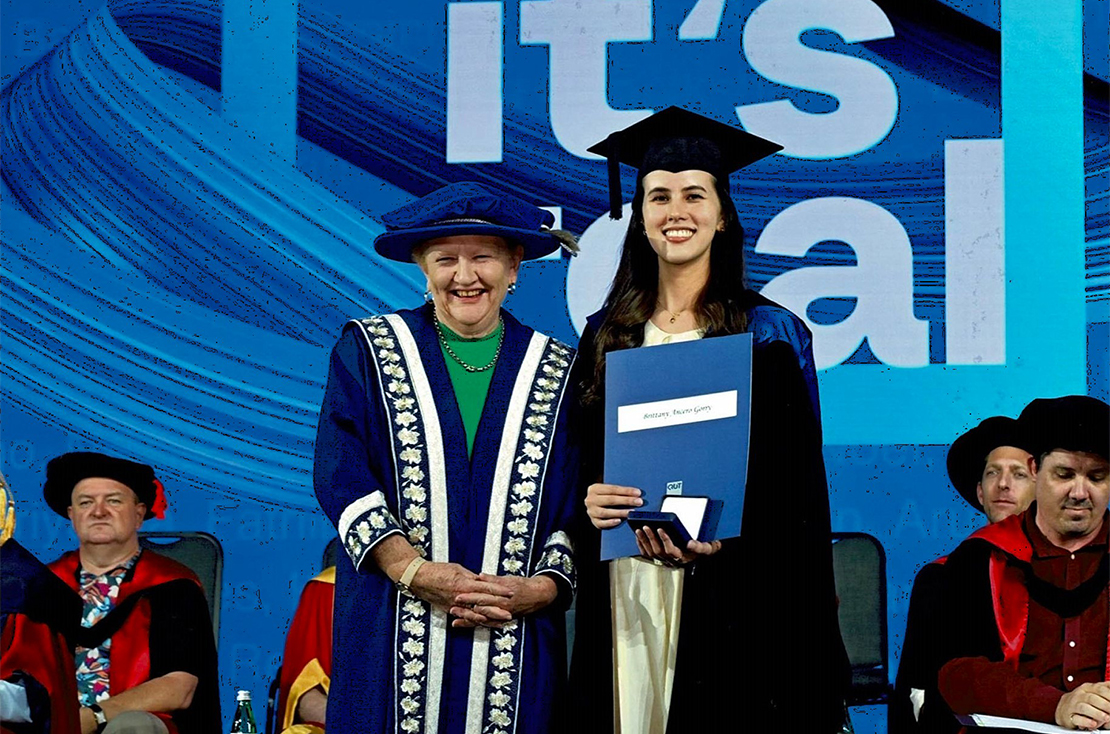
Brittany also had to work hard to catch up to her city peers when she started uni … particularly after she realised she was destined for a field she hadn’t even studied in Year 11 and 12.
“I initially chose the Bachelor of Science without a clear idea of what I wanted to specialise in,” she said.
“At the time, I thought I might pursue chemistry because it had been one of my stronger subjects in school – and physics wasn’t even offered at my high school.
“During my first semester, however, I realised that physics aligned much more closely with my curiosity about the fundamental principles that underpin the world around us.
“Combined with my engineering minor, it gave me an opportunity to develop problem-solving and critical-thinking skills while continuing to investigate the ‘why’ behind things.”
Today, that curiosity is driving Brittany’s PhD research into how AI models can be adapted to better recognise satellite and drone imagery of Antarctica and make it easier for scientists to accurately identify environmental changes over time.
“As part of the project, I’m being supported by CSIRO (through the Alberto Elfes Memorial Scholarship Fund) and am working alongside researchers involved with Securing Antarctica's Environmental Future (SAEF),” she said.
“One of the things I enjoy most about the project is seeing how researchers from many different disciplines work together to better understand and protect Antarctic environments.”
Beverley also wasn’t sure where her career path would go after high school – but she thought engineering would be part of it.
“Engineering appealed to me because it combined problem solving, critical thinking, and the flexibility to pursue many different career paths,” she said.
“I also wanted to challenge myself and develop skills that would be highly transferable in the future.”
Combining computer science with mechatronics gave Beverley an even wider skill set.
During her dual degrees she landed undergraduate software engineer roles with Shell and the Bureau of Meteorology, and also did her final-year engineering research project with the QUT Motorsport student racing team’s autonomous car.
Since starting her PhD, Beverley has presented her work at the IEEE/RSJ International Conference on Intelligent Robots and Systems (IROS) in China, attended a prestigious computer vision summer school in Sicily and visited leading international research institutions including the Technical University of Munich (TUM).
Brittany has also travelled internationally during her undergraduate studies; she completed a summer internship at the prestigious Korea Advanced Institute of Science and Technology (KAIST).
Beverley and Brittany both firmly believe that where you start doesn’t determine how far you can go.
Their message for school students in regional areas is to embrace opportunities, even if they feel intimidating.
“Moving from a small regional town to a city for university can feel incredibly daunting, but it can also be one of the most rewarding experiences,” Beverley said.
“There were times throughout my journey when I felt very unsure about where I was and where I was going, but I resolved to embrace opportunities as they came and see where they led.
“I’ve learned that it is more important to stay connected to your interests and passions than to always follow the most obvious next step. Looking back, some of the most valuable and rewarding experiences in my career have come from being willing to try something new, even when I didn’t have the entire path mapped out.”
Brittany said it was also important to not be put off a particular career path because of limited experience to that field during school.
“Everyone arrives at university with different experiences and backgrounds, so it's important to focus on your own strengths rather than viewing your background as a limitation,” she said.
The sisters also want more young women to recognise that STEM needs their perspectives and ideas, and to have faith in the growing support network extending across science and engineering.
“I’ve seen a genuine growth in the representation, support, mentorship, and community available to women in engineering and science,” Beverley said.
“While there is still progress to be made, I see that as an opportunity for the next generation of women to help shape the future of these fields.”
The Gorry sisters are part of QUT Centre for Robotics’ Visual Learning and Understanding Research Program and its team of researchers who investigate the fundamental problem of how a robot can learn to reliably interpret its environment and move through it. Beverley is also part of the centre’s Perception and Localisation Research Program.
Beverley’s PhD supervisory team includes Dr Tobias Fischer (principal supervisor), Professor Michael Milford and Dr Alejandro Fontan Villacampa. She is also a recipient of the Women in Electrical Engineering Postgraduate Research Top-Up Scholarship from the QUT School of Electrical Engineering and Robotics.
Brittany’s PhD supervisory team includes Professor Jonathan Roberts (principal supervisor), Professor Felipe Gonzalez, Dr Juan Sandino and Dr Peyman Moghadam (CSIRO/QUT).
The QUT Centre for Robotics will be open to the public during the 2026 QUT Open Day on Sunday, July 26, from 9am to 3pm. The centre is located in S Block at Gardens Point campus.
Some of the university’s most recognisable robots – including the ‘QUTie’ humanoid robots and Spot the robot dog, pictured above with Brittany and Beverley – will also show off their moves on stage at engineering course information seminars in Gardens Theatre (X Block) at 9am, 10am, 11am, 1pm and 2pm on the day.
The 2026 QUT Open Day will be held across Gardens Point and Kelvin Grove campuses and include tours, information tents, seminars, and food and entertainment, and plenty of opportunities to talk one-on-one with university staff and students about courses and careers.
Plan ahead by taking the Match My Skills quiz for course inspiration, then checking out the QUT Open Day program and creating a personalised program via the Open Day Planner.
Visitors can also register before the day to get updates and go into the draw to win a Macbook Pro.

We believe in the free flow of information
Republish our articles for free, online or in print, under Creative Commons licence.

Republish
You are free to republish the text of this article both online and in print.
We ask you follow some simple guidelines.
Images are not included in this blanket licence as in some cases we are not the copyright owner.
Do not edit the piece, ensure you attribute the author and mention the article was originally published on Real Focus.
By copying the HTML below, you will be adhering to all our guidelines.
Copy this HTML into your CMS.Press ⌘C or CTRL+C to copy.
Latest stories

16 October 2026
Some Australian research funding is now a lottery. And that’s actually good news
Professor Adrian Barnett from QUT and Professor Philip Clarke from The University of Melbourne explain why leaving some funding decisions up to luck can save everybody time and effort – and help understand what the funding actually does.
Read more of Some Australian research funding is now a lottery. And that’s actually good news

7 October 2026
It’s true, Australia won’t ban ‘sock puppet’ accounts on social media. Here’s why
Professor Daniel Angus and Associate Professor Timothy Graham from the QUT Digital Media Research Centre explain how Australia's proposed Digital Duty of Care bill will protect university researchers using fictitious accounts for online safety research.
Read more of It’s true, Australia won’t ban ‘sock puppet’ accounts on social media. Here’s why

25 September 2026
An AI model has found a new ‘CRISPR‑like’ biological system. Here’s what it means for science
AI agents may become another tool for researchers and even transform biological research, but there are also questions around how the technology can be kept safe, writes Associate Professor Dimitri Perrin, Co-Director of the QUT Centre for Data Science.