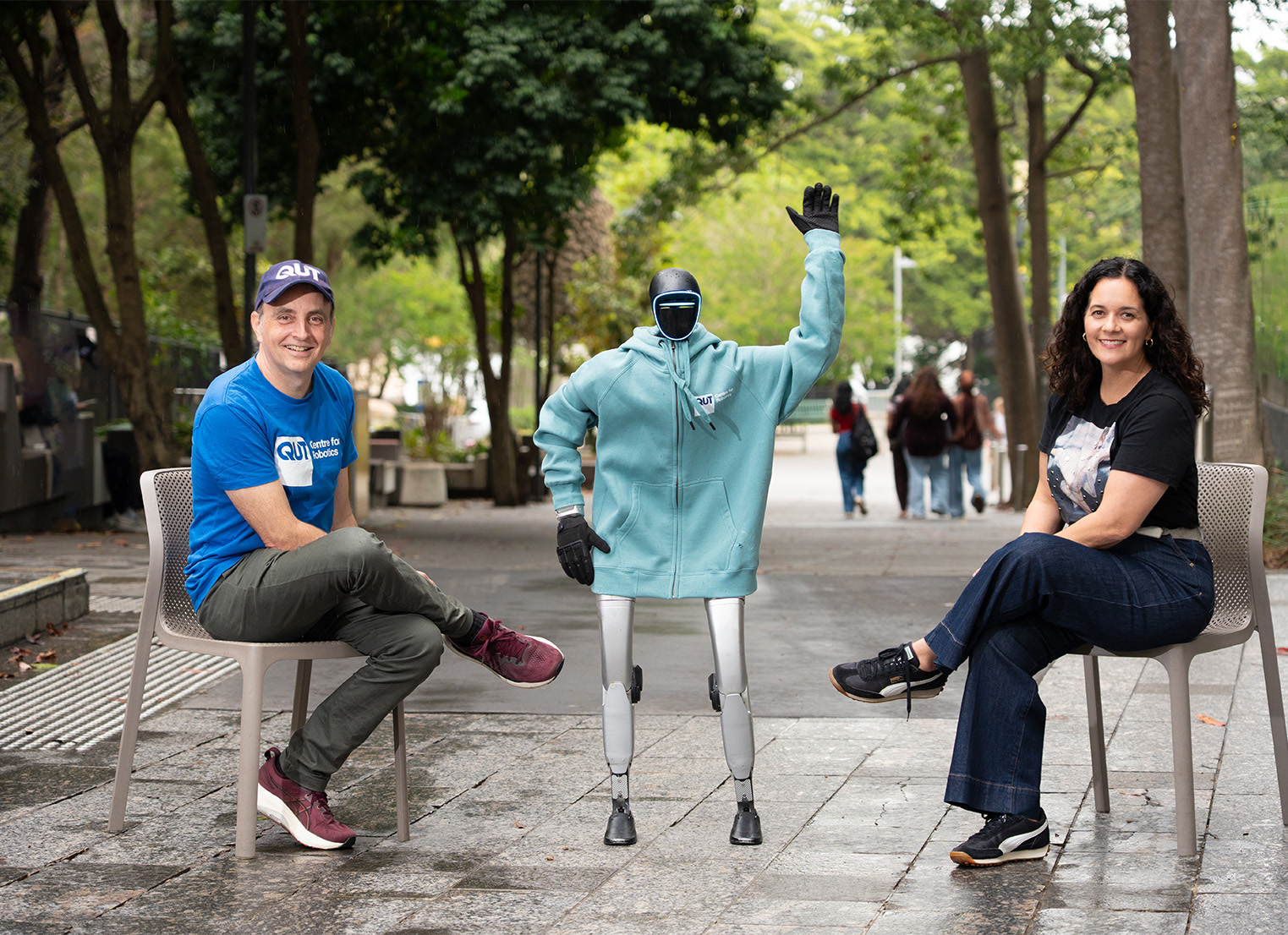
Professor Jonathan Roberts, QUT Centre for Robotics and QUT School of Electrical Engineering & Robotics, and Professor Glenda Caldwell, QUT School of Architecture & Built Environment
Humanoid robots can now walk, climb stairs, carry objects and even perform coordinated dance routines. Videos of robots doing backflips and martial arts have attracted millions of views online.
The progress is remarkable. But watching a robot perform a backflip is one thing. Having one work alongside you in a hospital, on a construction site or in a factory is quite another.
The important question is no longer simply what humanoid robots can do. It is what we should allow them to do, and under what conditions.
Why humanoids, and why now?
Australia faces some difficult challenges. Our population is ageing, industries struggle to find workers, and productivity growth has been disappointing.
Humanoid robots could help address some of these problems.
Unlike traditional industrial robots, which generally operate in structured environments, humanoids are designed to move through spaces built for people.
They could assist care workers with physically demanding tasks, move materials around construction sites or support manufacturing operations where conventional automation is difficult to implement.
Rather than redesigning workplaces around machines, we might eventually introduce machines that can operate within existing environments.
But there is an enormous difference between demonstrating a capability and performing it reliably, safely and economically in a real workplace.
When robots look human
Humanoid robots present an unusual challenge. Their human-like appearance encourages us to interpret their movements and behaviour in human terms.
At QUT, we have been exploring this through QUTie, our humanoid robot, including taking it into the community and participating in dance performances at the Brisbane Festival.
Seeing a humanoid dance alongside people is entertaining, but it also raises interesting questions.
A robot should earn our trust through its behaviour, not its appearance
What do people expect a robot to understand? How do they interpret its movements? And how should a robot communicate what it can and cannot do?
A robot that looks human does not necessarily possess human judgement, awareness or social understanding.
This matters because people may assume a humanoid is more capable than it really is.
Designing safe humanoids therefore involves more than making them move reliably. We must also consider how people understand, trust and interact with them.
A robot should earn our trust through its behaviour, not simply its appearance.
Safety is about more than preventing accidents
When people think about robot safety, they often imagine a machine colliding with someone or dropping something heavy.
These are genuine concerns. Humanoids are mobile machines that must maintain their balance while moving through environments occupied by people.
But safety also extends to the people working alongside them.
Will humanoids reduce physically demanding work or create new pressures? Could workers lose important skills? Will they improve job quality or threaten employment?
And who is responsible when something goes wrong?
These questions cannot be answered by engineers alone. They require expertise in psychology, workplace relations, design, law and ethics.
Most importantly, they require the involvement of workers and communities who will encounter these machines.
Technology moves faster than regulation
History shows that new technologies can enter society before appropriate rules and safeguards are established. This is sometimes called the pacing problem.
Industrial robots, ridesharing platforms and, more recently, artificial intelligence have all challenged existing regulatory frameworks.
Humanoid robots could present an even greater challenge because they bring artificial intelligence into the physical world.
They will not just generate information. They will move, manipulate objects and potentially act directly on people and their surroundings.
We therefore need to consider questions about safety, responsibility, privacy and workplace rights before humanoids become commonplace.
Waiting until problems emerge risks repeating mistakes made with earlier technologies.
Australia's opportunity
China, the United States and other countries are investing heavily in humanoid development.
Australia is unlikely to compete in mass-producing humanoid hardware. But we have an opportunity to lead in something equally important: understanding how humanoids can be introduced safely, ethically and effectively into workplaces.
This is the focus of the new Australian Humanoid Hub, bringing together researchers from QUT, Swinburne University of Technology and Flinders University, alongside industry and government partners.
Building on Australia's established expertise in robotics, the Hub will investigate humanoid adoption in care, construction, manufacturing and logistics.
Its work will range from testing robot capabilities in realistic environments to examining workplace safety, regulation, job design and human–robot interaction.
The aim is not to demonstrate that humanoids can do everything people can do.
It is to establish where they genuinely provide benefits, where the risks outweigh those benefits, and how decisions about their use should be made.
People must remain at the centre
Humanoid robots offer exciting possibilities, particularly in industries facing labour shortages and growing demand.
But technological capability alone is not a sufficient reason to introduce a robot into a workplace.
We need evidence that humanoids improve safety, productivity and people's lives.
That means experimenting, asking difficult questions, involving workers and communities, and being prepared to conclude that some applications are simply not appropriate.
The future of humanoid robotics should not be determined solely by what engineers can build or manufacturers can sell.
It should be shaped by the people who will live and work alongside these machines.
About the researchers
Professor Jonathan Roberts, from the QUT Centre of Robotics, is the director of the ARC Research Hub for Safe and Ethical Humanoid Robot Implementation and Adoption. His main area of research is in the area of how to enable people to work with robots. Professor Glenda Caldwell, deputy director of the hub, her research area is on how we design spaces and processes for people to interact and collaborate with robots.

We believe in the free flow of information
Republish our articles for free, online or in print, under Creative Commons licence.

Republish
You are free to republish the text of this article both online and in print.
We ask you follow some simple guidelines.
Images are not included in this blanket licence as in some cases we are not the copyright owner.
Do not edit the piece, ensure you attribute the author and mention the article was originally published on Real Focus.
By copying the HTML below, you will be adhering to all our guidelines.
Copy this HTML into your CMS.Press ⌘C or CTRL+C to copy.
Latest stories

16 October 2026
Some Australian research funding is now a lottery. And that’s actually good news
Professor Adrian Barnett from QUT and Professor Philip Clarke from The University of Melbourne explain why leaving some funding decisions up to luck can save everybody time and effort – and help understand what the funding actually does.
Read more of Some Australian research funding is now a lottery. And that’s actually good news

7 October 2026
It’s true, Australia won’t ban ‘sock puppet’ accounts on social media. Here’s why
Professor Daniel Angus and Associate Professor Timothy Graham from the QUT Digital Media Research Centre explain how Australia's proposed Digital Duty of Care bill will protect university researchers using fictitious accounts for online safety research.
Read more of It’s true, Australia won’t ban ‘sock puppet’ accounts on social media. Here’s why

25 September 2026
An AI model has found a new ‘CRISPR‑like’ biological system. Here’s what it means for science
AI agents may become another tool for researchers and even transform biological research, but there are also questions around how the technology can be kept safe, writes Associate Professor Dimitri Perrin, Co-Director of the QUT Centre for Data Science.